
Instruments · Aerophones
Barrel organ
A barrel organ plays music by using turning a barrel, with notes decided by an arrangement of pins. It is very similar to a simple music box where the pins pluck a metal harp. With a barrel organ, the pins in the barrel lift "keys" that open valves that let air from the bellows to play the pipes.
Summary: Simple English Wikipedia, “Barrel organ” — CC BY-SA 4.0. Revision of 2023-08-05.
Museum photographs
These 4 photographs span 1790–1840, 4 places of origin and 1 museum. Every photograph is public domain or openly licensed, and links to the museum’s own record.
-
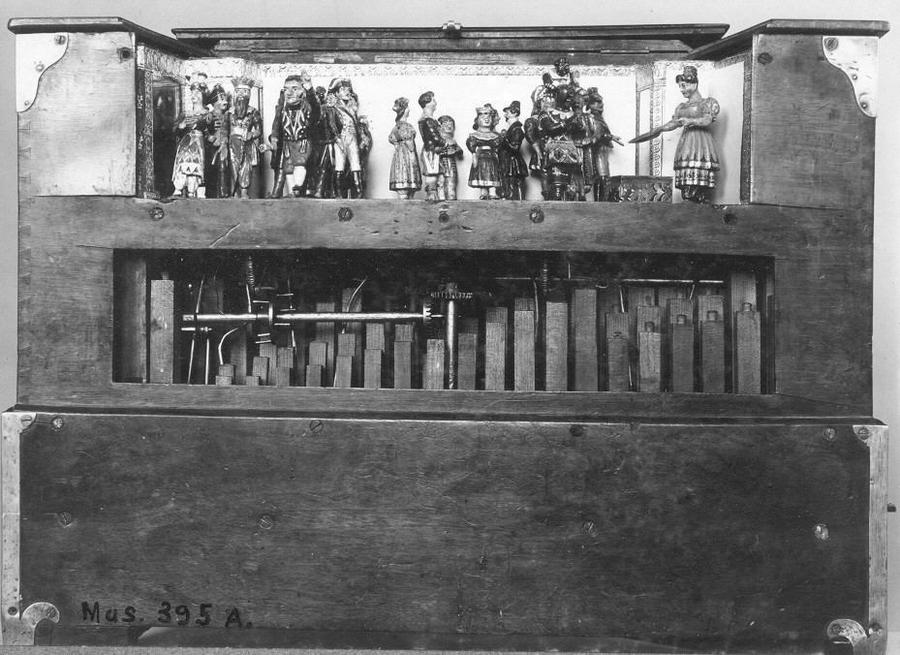
Barrel Organ1839 · Germany -
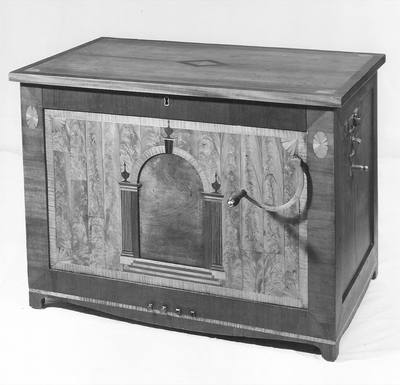
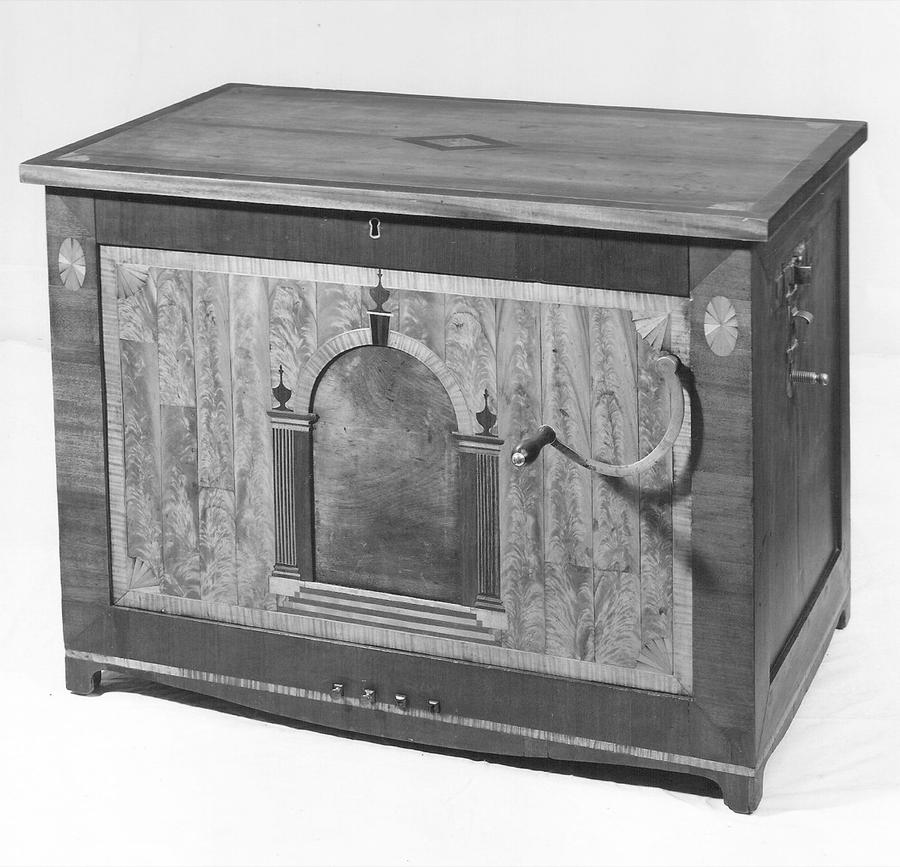
Barrel Organca. 1800 · American (United States) -
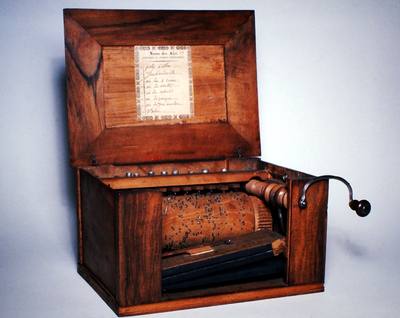
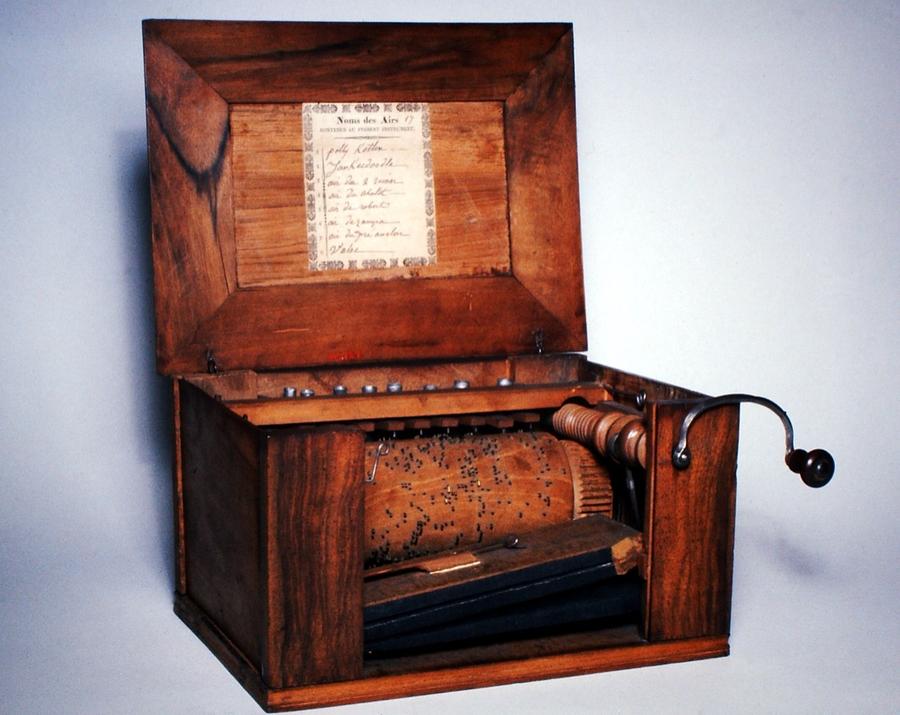
Serinetteearly 19th century · French (France) -
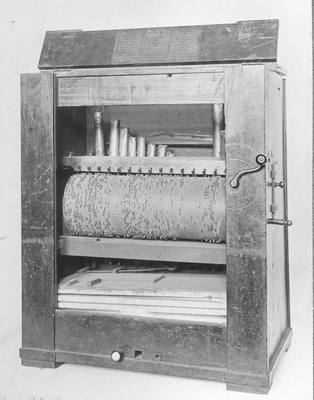
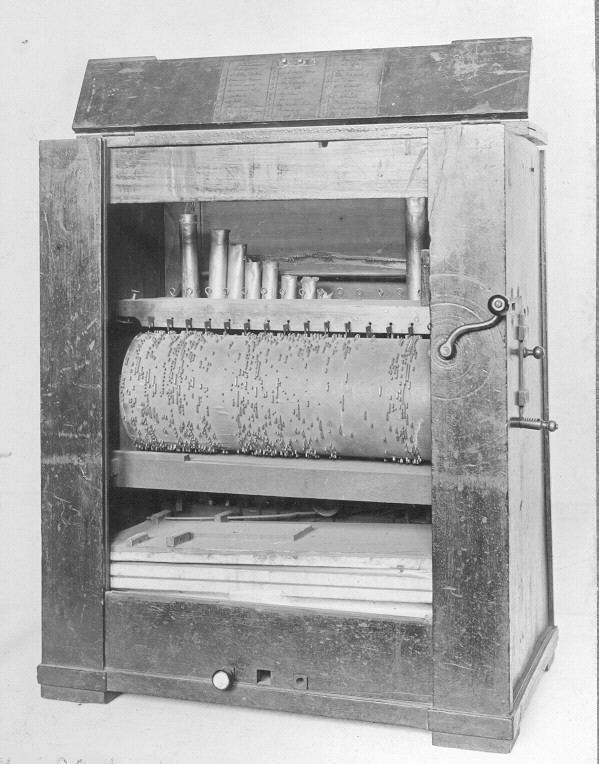
Barrel Organca. 1830 · British (United Kingdom)
Facts at a glance
| Hornbostel–Sachs number | 421.222.11-9 |
|---|---|
| Hornbostel–Sachs group | Aerophones › Non-free aerophones (wind instruments proper) › Edge-blown aerophones or flutes |
| Also known as | roller organ, crank organ |
| Wikidata labels | 45 languages |
| Wikipedia article | Barrel organ |
| Wikidata item | Q752638 |
| Wikimedia Commons category | Barrel organs |
| MusicBrainz instrument | e6fa08fe-bcc3-4715-9486-9d642ec38726 |
| Encyclopaedia Britannica | art/barrel-organ |
| Audio sample (Wikimedia Commons) | AF Street organ.ogg |
Sources: Wikidata (CC0 1.0) — classification number, aliases, identifiers (dump of 2026-07-22); Wikipedia (CC BY-SA 4.0) — infobox fields (description of the classification number, development, inventors) and the names of the Hornbostel–Sachs groups (article “Hornbostel–Sachs”, revision of 2026-01-04).
The name in other languages
| Language | Name | Also written |
|---|---|---|
| English | barrel organ | roller organ, crank organ |
| French | orgue de Barbarie | |
| German | Drehorgel | Harmonipan, Leierkasten, Leierorgel |
| Spanish | organillo | |
| Italian | organo a rullo | organetto di Barberia, organino, organo a rulli |
| Portuguese | realejo | Órgão Mecânico |
| Dutch | draaiorgel | handdraaiorgel, druif, straatorgel |
| Russian | шарманка | Шарманщик, Уличный орган |
| Japanese | 手回しオルガン | バレルオルガン |
| Chinese | 手搖管風琴 | 手搖風琴, 手摇风琴 |
| Arabic | أرغن يدوي | الأرغن اليدوي, ارغن يدوي |
Sources: Wikidata (CC0 1.0) — labels and aliases; MusicBrainz (CC0 1.0) — instrument aliases (names only).
About the barrel organ: history, construction and playing
A barrel organ (also called roller organ or crank organ) is a French mechanical musical instrument consisting of bellows and one or more ranks of pipes housed in a case, usually of wood, and often highly decorated. The basic principle is the same as a traditional pipe organ, but rather than being played by an organist, the barrel organ is powered by either a person turning a crank, or by clockwork driven by weights or springs. The music is encoded onto wooden barrels (cylinders) using pins. The pins strike levers which are analogous to the keyboard of the traditional pipe organ. A person (or in some cases, a trained animal) who plays a barrel organ is known as an organ grinder.
Barrel
The pieces of music (or tunes) are encoded onto the barrel using metal pins and staples. Pins are used for short notes, and staples of varying lengths for longer notes. Each barrel usually carried several different tunes. Pinning such barrels was something of an art form, and the quality of the music produced by a barrel organ is largely a function of the quality of its pinning.
The organ barrels must be sturdy to maintain precise alignment over time, since they play the same programming role as music rolls and have to endure significant mechanical strain. Damage to the barrel, such as warpage, would have a direct (and usually detrimental) effect on the music produced.
The size of the barrel will depend on the number of notes in the organ and the length of the tune to be played. The more notes, the longer the barrel. The longer the tune, the greater the diameter.
Since the music is hard-coded onto the barrel, the only way for a barrel organ to play a different set of tunes is to replace the barrel with another one. While not a difficult operation, barrels are unwieldy and expensive, so many organ grinders have only one barrel for their instrument.
Operation
A set of levers called keys is positioned just above the surface of the barrel. Each key corresponds to one pitch. A rod is connected to the rear of each key. The other end of the rod is a metal pin which operates a valve within the wind chest. When the instrument is played (by turning the crank), offsets on the crank shaft cause bellows to open and close to produce pressurized air. A reservoir/regulator maintains a constant pressure. A worm gear on the crank shaft causes the barrel to rotate slowly and its pins and staples lift the fronts of the keys. This causes the other end of the key to press down on the end of the rod which, in turn, activates the valve and allows air from the bellows to pass into the corresponding pipe.
To allow different tunes to be played from one barrel, the barrel can be moved laterally to bring a different set of pins and staples under the keys. Street barrel organs usually play 7 to 9 tunes, although small organs (usually the older ones) can play up to 15 tunes. Less commonly (and usually for large orchestrions) the pinning will form one continuous spiral and the barrel will be gradually moved as it rotates so that the pins remain lined up with the keys. In this case, each barrel plays only one long tune.
Usage
The barrel organ was the traditional instrument of organ grinders. With a few exceptions, organ grinders used one of the smaller, more portable versions of the barrel organ, containing perhaps one (or just a few) rank(s) of pipes and only 7 to 9 tunes. Use of these organs was limited by their weight. Most weighed 25 to 50 pounds but some were as heavy as 100 pounds.
There were many larger versions located in churches, fairgrounds, music halls, and other large establishments such as sports arenas and theaters. The large barrel organs were often powered by very heavy weights and springs, like a more powerful version of a longcase clock. They could also be hydraulically powered, with a turbine or waterwheel arrangement giving the mechanical force to turn the barrel and pump the bellows. The last barrel organs were electrically powered, or converted to electrical power. Eventually, many large barrel organs had their barrel actions removed and were converted to play a different format of music, such as cardboard books or paper rolls.
Combined barrel and manually played instruments
Especially in churches, some large barrel organs were built as "barrel and finger" organs. Such instruments are furnished with a normal organ keyboard, in addition to the automatic mechanism, making it possible to play them by hand when a human organist is available. The barrels were often out of sight.
At the beginning of the 20th century, large barrel organs intended for use as fairground organs or street organs were often converted, or newly built, to play music rolls or book music rather than barrels. This allows a much greater variety of melodies to be played.
Barrel organs in the Basque Country
It's very common to see barrel organs in the Basque Country, as there are lots in the Guggenheim Museum in Bilbao, the Concha Beach in San Sebastián or the Virgen Blanca square in Vitoria-Gasteiz. For the tourists, it's a major attraction and at the solar eclipse coming soon on August 12th, its barrel organs are multiplied by 10.
Source: Wikipedia, “Barrel organ” — CC BY-SA 4.0 — text excerpted as published (references, images and tables removed); see the article for the full text and the list of authors. Revision of 2026-07-03.
From Grove’s Dictionary (1900)
BARREL ORGAN. A musical instrument, of all others the most easy of manipulation, as it requires nothing beyond the regular rotary motion of a handle to keep it playing. In some examples even this power is applied mechanically, either by means of clock-work, or by weights. These instruments are of the most various capacities, from the simple street organ—the 'barrel organ' of ordinary parlance—to large and complicated machines representing the full orchestra. But the principle of action is the same in all. A wooden cylinder, or barrel, placed horizontally, and armed on its outside circumference with brass staples or pins, slowly revolves, in the direction from back to front; and in doing so the pins raise certain trigger-shaped keys, which correspond with simple mechanism communicating with valves that on being opened allow wind to enter the required pipes. In this way either melody or harmony is produced. The wind is produced by bellows which are worked by the same motion which turns the barrel. The most simple kind of instrument of this nature is the small 'bird organ,' used, as its name implies, for teaching bulfinches to pipe—which plays the simplest music in melody only.
Source: Wikisource, A Dictionary of Music and Musicians (Grove, 1900) — “Barrel Organ” (entry by Edward John Hopkins) — Public domain (published 1879–1910; authors died before 1929) — the first paragraphs of the entry, as transcribed; see the page for the full entry.
Sources and licences
- Barrel Organ, Ignaz Bruder, 1839, Germany. Wood, various materials. The Crosby Brown Collection of Musical Instruments, 1889 (89.4.1217). Museum record · CC0 1.0 (public domain dedication)
- Barrel Organ, ca. 1800, American (United States). Wood, various materials. Gift of Eric M. Wunsch, 1972 (1972.166). Museum record · CC0 1.0 (public domain dedication)
- Serinette, early 19th century, French (France). Wood, metal. Gift of Walter S. Poor, 1944 (44.127). Museum record · CC0 1.0 (public domain dedication)
- Barrel Organ, ca. 1830, British (United Kingdom). Wood, various materials. The Crosby Brown Collection of Musical Instruments, 1889 (89.4.1411a, b). Museum record · CC0 1.0 (public domain dedication)
Photographs: open-access collections of the museums named above; each is shown here reduced in size, otherwise unchanged. Text: Wikipedia (CC BY-SA 4.0), Grove’s Dictionary (public domain), Wikidata and MusicBrainz (CC0). The full list of sources and licences is on the credits page.