
Instruments · Aerophones
Ocarina
An ocarina is a kind of flute that is not made out of a tube. Because the ocarina is in a round or box-like shape, its sound is a little different from other flutes.
Summary: Simple English Wikipedia, “Ocarina” — CC BY-SA 4.0. Revision of 2023-07-22.
Museum photographs
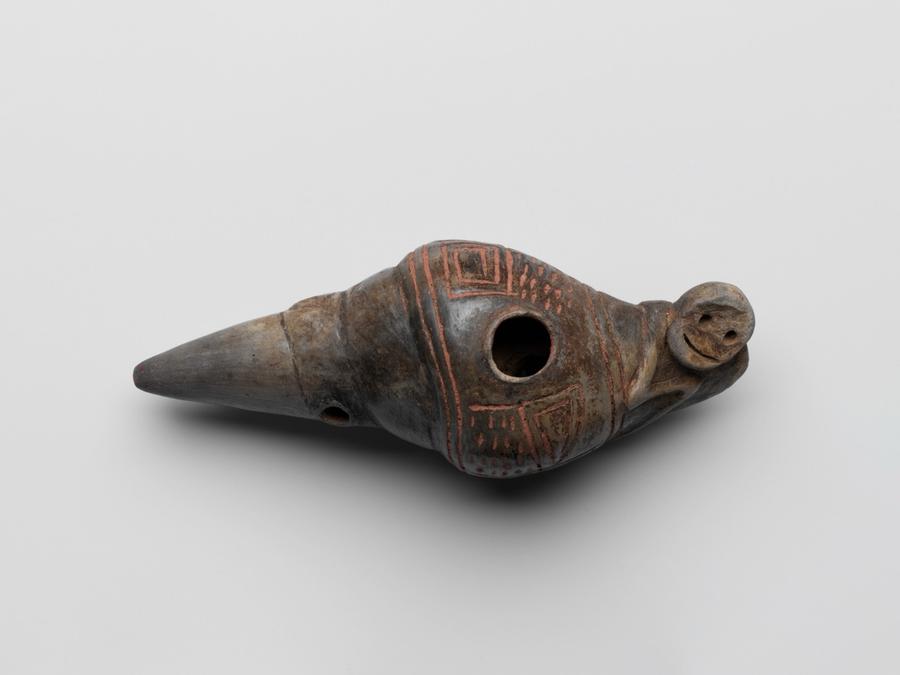
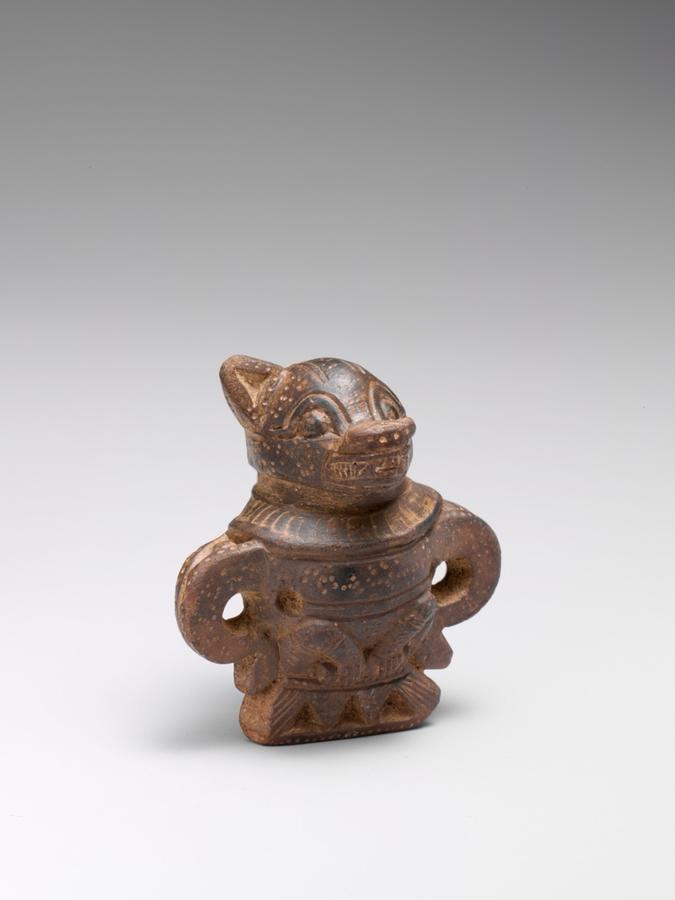
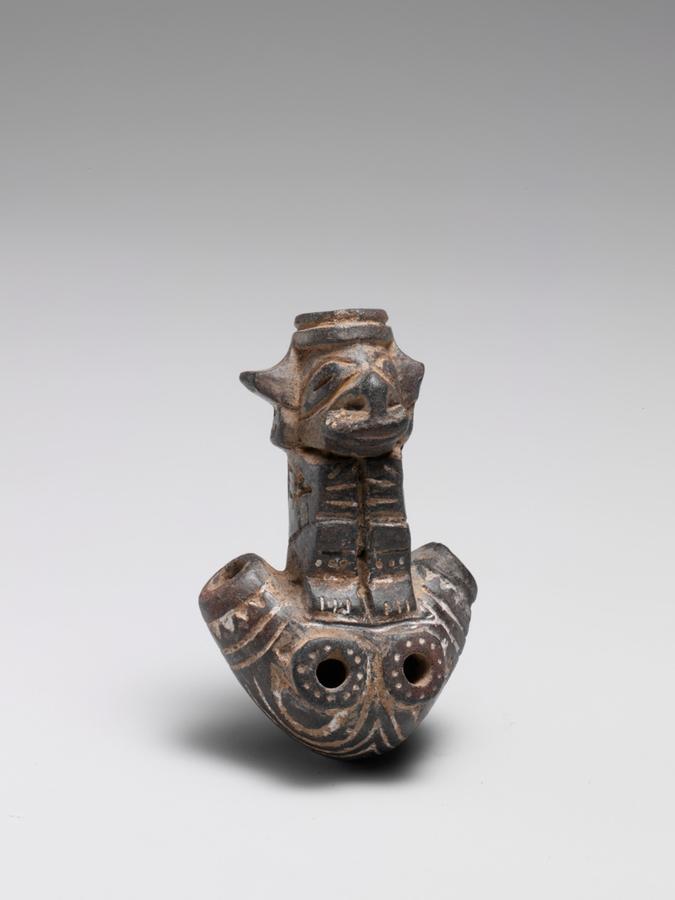
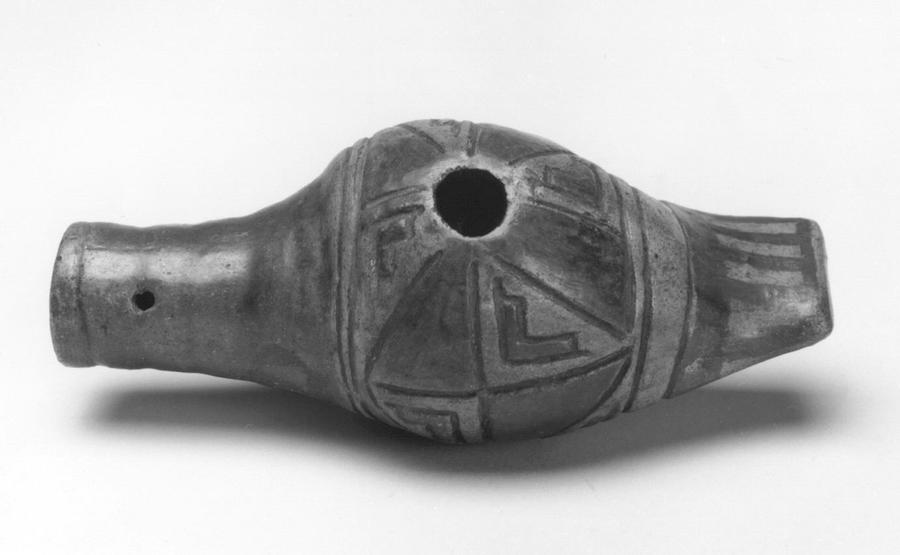
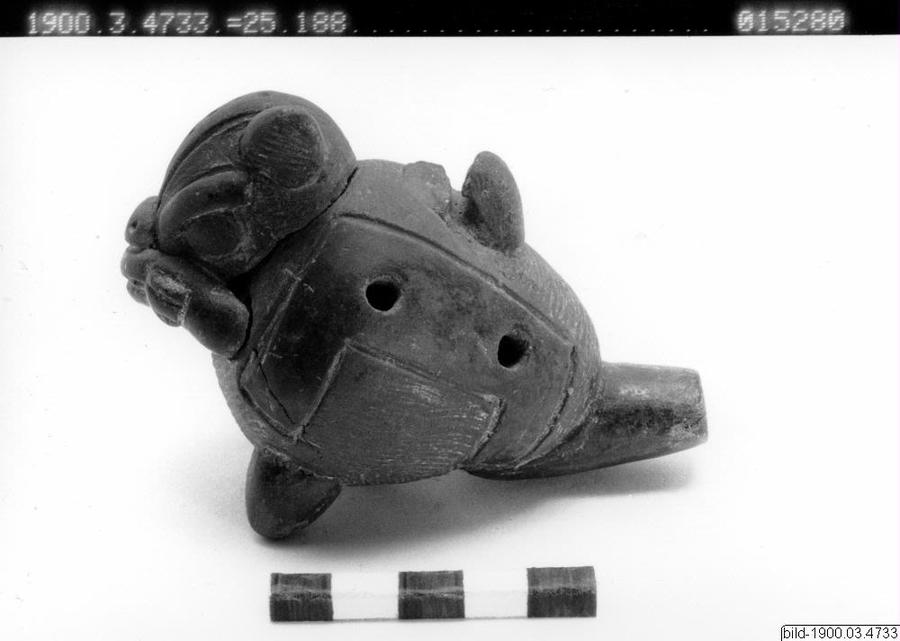
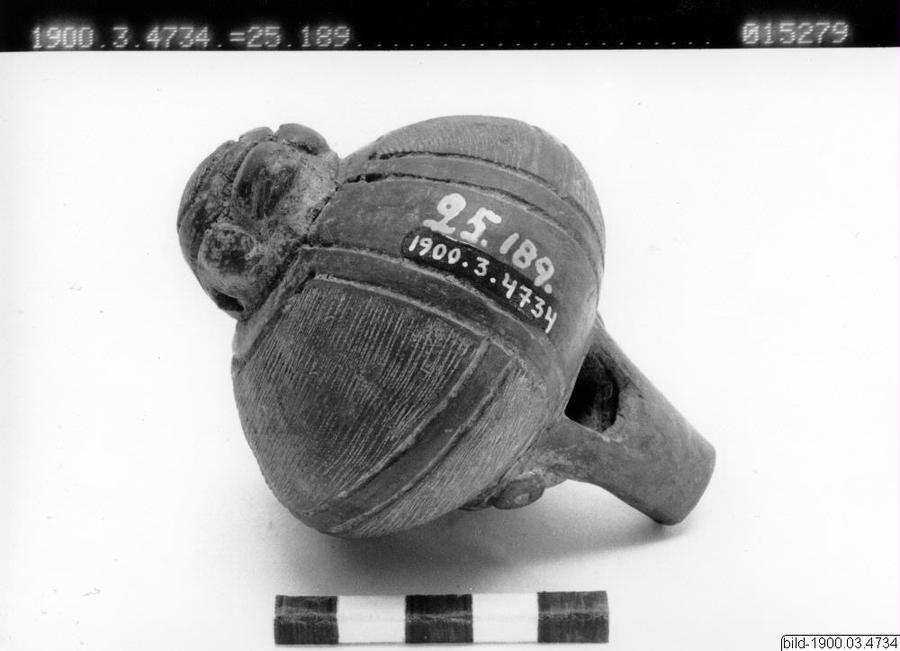
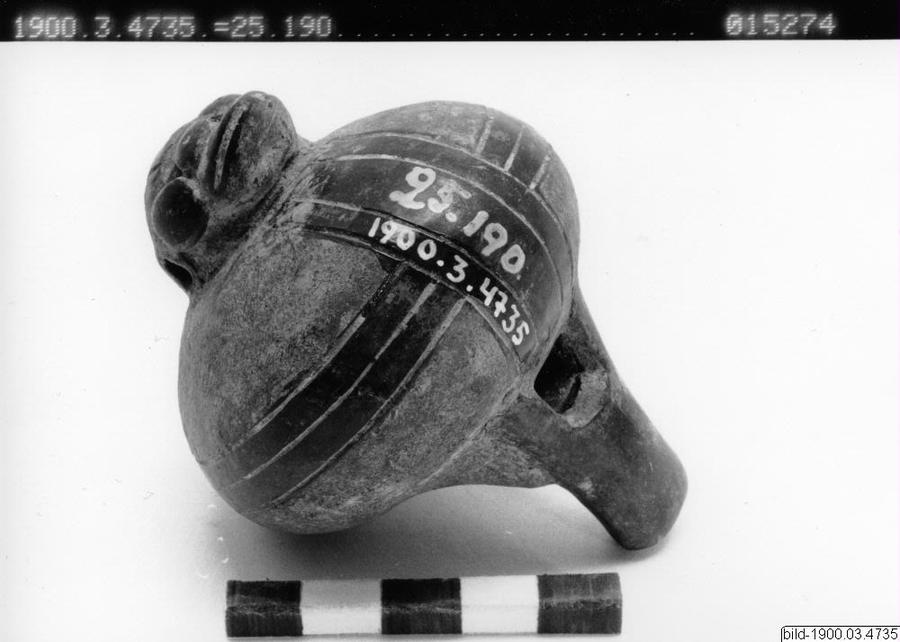
These 8 photographs span 600–1910, 3 places of origin and 2 museums. 3 of them carry no date in the museum record. Every photograph is public domain or openly licensed, and links to the museum’s own record.
-
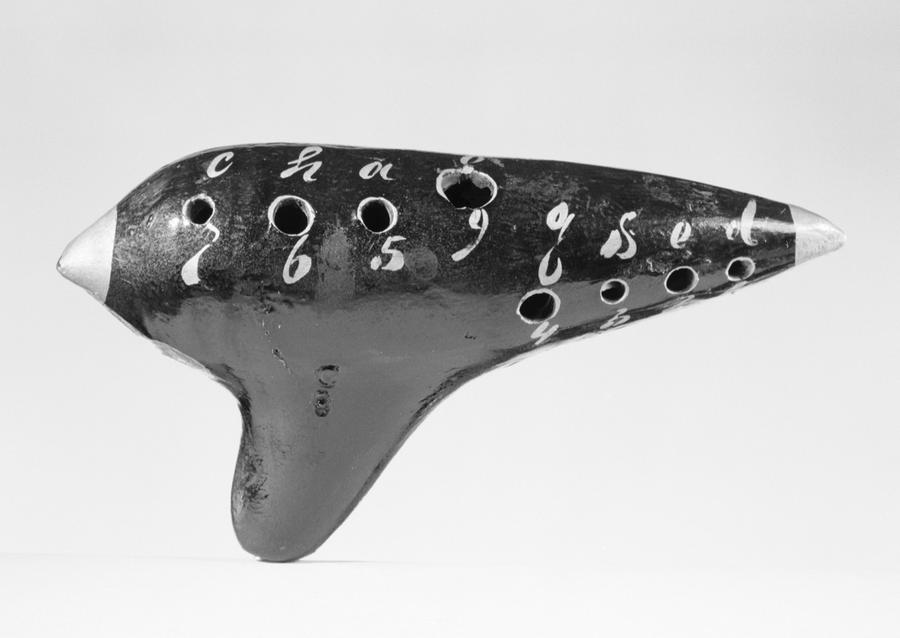
Ocarinaca. 1900 · Austrian (Austria) -
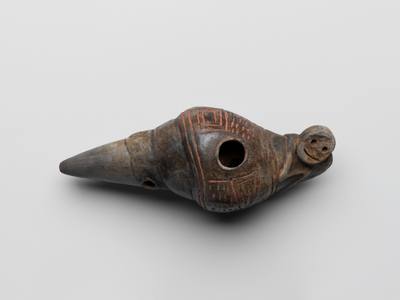
Ocarina600–1200 · Nariño (Colombia) -
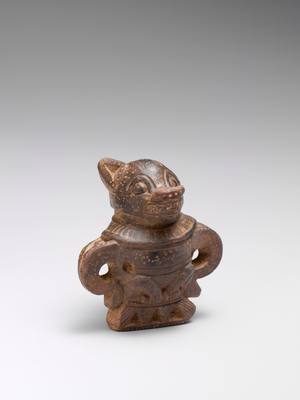
Ocarina1300–1500 · Tairona People; Gayraca style (Colombia) -
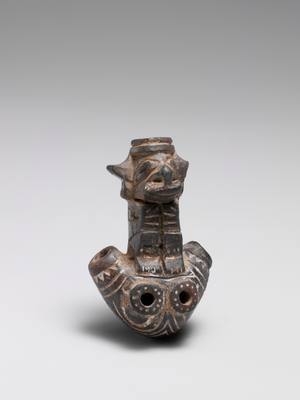
Ocarina1300–1500 · Tairona People; La Aguja Style (Colombia) -
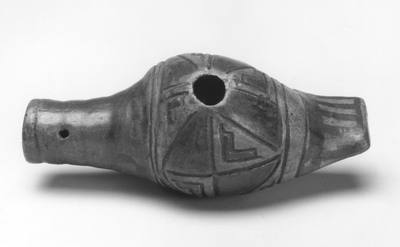
Ocarina1300–1550 · probably Colombian (Colombia?) -
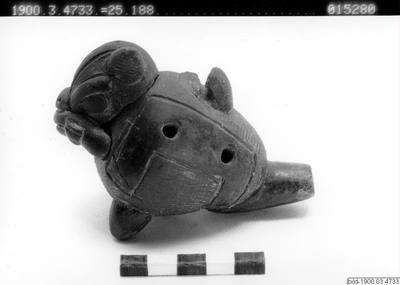
Clay cuckoo, flute, okarinaUndated · Sweden -
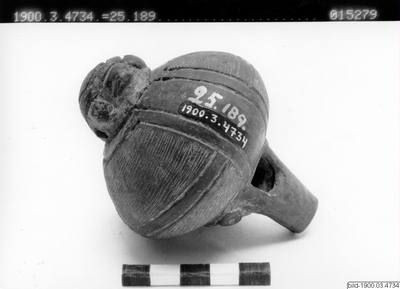
Clay cuckoo, okarina, fluteUndated · Sweden -
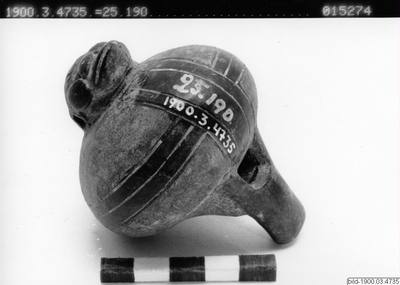
Plunger, flute, okarinaUndated · Sweden
Facts at a glance
| Hornbostel–Sachs number | 421.221.422 — Vessel flute with duct and fingerholes |
|---|---|
| Hornbostel–Sachs group | Aerophones › Non-free aerophones (wind instruments proper) › Edge-blown aerophones or flutes |
| Classification (Wikipedia infobox) | Wind, woodwind, aerophone |
| Wikidata labels | 61 languages |
| Wikipedia article | Ocarina |
| Wikidata item | Q187780 |
| Wikimedia Commons category | Ocarina |
| MusicBrainz instrument | e93eda0f-9475-45c1-9194-29020d9b83e9 |
| Encyclopaedia Britannica | art/ocarina |
| Audio sample (Wikimedia Commons) | Ocarinasample.ogg |
Sources: Wikidata (CC0 1.0) — classification number, aliases, identifiers (dump of 2026-07-22); Wikipedia (CC BY-SA 4.0) — infobox fields (description of the classification number, development, inventors) and the names of the Hornbostel–Sachs groups (article “Hornbostel–Sachs”, revision of 2026-01-04).
The name in other languages
| Language | Name | Also written |
|---|---|---|
| English | ocarina | |
| French | ocarina | Okarina, Okarine |
| German | Okarina | Gefäßflöte, Ocarina |
| Spanish | Ocarina | Ocarina precolombina |
| Italian | ocarina | arghilofono |
| Portuguese | ocarina | |
| Dutch | ocarina | |
| Russian | окарина | |
| Japanese | オカリナ | オカリーナ |
| Chinese | 陶笛 | 洋埙, 奧卡利那, 瓦壎 |
| Korean | 오카리나 | |
| Arabic | أكرينة | اكرينة, آلة أوكرينا, أوكارينا |
Sources: Wikidata (CC0 1.0) — labels and aliases; MusicBrainz (CC0 1.0) — instrument aliases (names only).
About the ocarina: history, construction and playing
The ocarina (otherwise known as a potato flute) is a wind musical instrument; it is a type of vessel flute. Variations exist, but a typical ocarina is an enclosed space with four to twelve finger holes and a mouthpiece that projects from the body. It is traditionally made from clay or ceramic, but other materials are also used, such as plastic, wood, glass, metal, or bone. The Italian Ocarina was invented in 1853 by 17-year-old Giuseppe Donati, who also gave it the name ocarina. Donati handmade each ocarina from clay, with anything from 7 to 10 finger-holes and a spout for a mouthpiece.
History
The ocarina belongs to a very old family of instruments, believed to date back over 12,000 years. Ocarina-type instruments have been of particular importance in Chinese and Mesoamerican cultures. For the Chinese, the instrument played an important role in their long history of song and dance. The ocarina has features similar to the xun (塤), another important Chinese instrument (but is different in that the ocarina uses an internal duct, whereas the xun is blown across the outer edge). In Korea, the xun is known as the hun. In Japan, the xun is known as the. Different expeditions to Mesoamerica, including the one conducted by Cortés, resulted in the introduction of the ocarina to the courts of Europe. Both the Maya and Aztecs produced versions of the ocarina, but it was the Aztecs who brought to Europe the song and dance that accompanied the ocarina. The ocarina went on to become popular in European communities as a toy instrument.
One of the oldest ocarinas found in Europe is from Runik, Kosovo. The Runik ocarina is a Neolithic flute-like wind instrument, and is the earliest musical instrument ever reported in Kosovo. The modern European ocarina dates back to the 19th century, when Giuseppe Donati from Budrio, a town near Bologna, Italy, transformed the ocarina from a toy, which played only a few notes, into a more comprehensive instrument (known as the first "classical" ocarina). The word ocarina derives from ucaréṅna, which in the Bolognese dialect means "little goose". An earlier similar instrument was known in Europe as a gemshorn, which was made from chamois (gems) horns.
In 1964, John Taylor, an English mathematician, developed a fingering system that allowed an ocarina to play a full chromatic octave using only four holes. This is now known as the English fingering system, and is used extensively for pendant ocarinas. It is also used in several multi-chamber ocarinas, especially in ones that are designed to play more than one note at a time.
The ocarina is featured in the 1998 Nintendo 64 game The Legend of Zelda: Ocarina of Time, as well as its 2000 sequel, The Legend of Zelda: Majora's Mask, which has been credited for increasing the popularity and sales of ocarinas due to the game's strong sales.
Uses
French composer Pierre Arvay (1924–1980) wrote several pieces of library music for the ocarina. One of these – Merry ocarina – became well known in the UK when it was used as a regular musical segment in the BBC children's programme Vision On, broadcast between 1964 and 1976.
Hungarian-Austrian composer György Ligeti (1923–2006) called for four ocarinas (to be performed by woodwind players who play their own instruments during the rest of the piece) in his Violin Concerto, completed in 1993. In 1974, the Polish composer Krzysztof Penderecki (1933–2020) incorporated 12 ocarinas in his composition The Dream of Jacob. Later, he incorporated 50 in the final section of his Symphony No. 8, completed in 2008, where they are meant to be played by members of the choir.
Tone production and acoustics
How an ocarina works:
- Air enters through the windway
- Air strikes the labium, producing sound
- Air pulses in and out of the ocarina, as the vessel resonates a specific pitch
- Covering holes lowers the pitch; uncovering holes raises the pitch
- Blowing more softly lowers the pitch; blowing harder raises it. Breath force can change the pitch by several semitones, of which about a third of a semitone either way is useful. Using too much or too little air will create an unpleasant tone. The fact that small changes to the flow of air will change the tuning (rather than the loudness) is why ocarinas generally have no tuning mechanism or dynamic range, and why it is hard to learn to play one in tune.
The airstream is directed toward the labium by a fipple or internal duct, which is a narrowing rectangular slot in the mouthpiece, rather than relying on the player's lips to aim the airstream as in a transverse flute. Like other flutes, the airstream alternates quickly between the inner and outer face of the labium as the pressure in the ocarina chamber oscillates.
At first, the sound is a broad-spectrum "noise" (i.e. "chiff"), but those frequencies that are identical with the fundamental frequency of the resonating chamber (which depends on the fingering), are selectively amplified. A Helmholtz resonating chamber is unusually selective in amplifying a single frequency. Most resonators also amplify more overtones. As a result, ocarinas and other vessel flutes have a distinctive overtoneless sound.
Unlike many flutes, ocarinas do not rely on pipe length to produce a particular tone. Instead, the tone is dependent on the ratio of the total surface area of opened holes to the total cubic volume enclosed by the instrument. This means that, unlike a transverse flute or recorder, sound is created by resonance of the entire cavity and the placement of the holes on an ocarina is largely irrelevant – their size is the most important factor. Instruments that have toneholes close to the voicing/embouchure should be avoided, however; as an ocarina is a Helmholtz resonator, this weakens tonal production.
Musical notation and tablature
Ocarina music is written in three main ways. The most apparent is the use of sheet music. There are archives of sheet music either specifically written for ocarinas, or adapted from piano sheet music. Since some ocarinas are fully chromatic and can be played in professional musical situations, including classical and folk, sheet music is an ideal notation for ocarinas.
Second is the use of numerical tablature, which expresses the musical notes as numbers. Some makers have developed their own system of numerical tablature for their ocarinas, while others follow a more universal system where numbers correspond to different notes on the scale. This method is typically used by beginners who have not learned to read sheet music.
A third method uses a pictorial tablature similar to the ocarina's finger hole pattern, with blackened holes that represent holes to cover. The tablature represents the holes on the top of the ocarina, and, where necessary, the holes on the underside. This enables easy playing, particularly for beginners. The two most popular tablature systems are:
- The John Taylor four-hole system (invented in 1964 by British mathematician John Taylor)
- The 10 hole sweet potato system (invented by Giuseppe Donati of Budrio Italy)
Depending on the artist, some may write a number or figure over the picture to depict how many beats to hold the note.
Articulation
Due to its lack of keys, the ocarina shares many articulations with the tin whistle, such as cuts, strikes, rolls, and slides. However, tonguing is used more often on ocarina than on tin whistle, and vibrato is always achieved through adjusting breath pressure instead of with the fingers.
Similar instruments
Other vessel flutes include the Chinese xun and African globe flutes. The xun (simplified Chinese: 埙; traditional: 塤; pinyin: xūn) is a Chinese vessel flute made of clay or ceramic. It is one of the oldest Chinese instruments. Shaped like an egg, it differs from the ocarina in being side-blown, like the Western concert flute, rather than having a recorder-like mouthpiece (a fipple or beak). Similar instruments exist in Korea (the hun) and Japan (the tsuchibue).
A related family of instruments is the closed-pipe family, which includes the panpipes and other instruments that produce their tone by vibrating a column of air within a stopped cylinder.
The old fashioned jug band jug also has similar properties.
The traditional German gemshorn works nearly the same way as an ocarina. The only difference is the material it is made from: the horn of a chamois, goat, or other suitable animal.
The borrindo is a simple hollow clay ball with three to four fingering holes, one hole slightly larger than the other three, which are smaller and of equal size to one another. The holes are arranged in an isosceles triangular form. The borrindo is made out of soft alluvial clay available in plenty everywhere in the central Indus Valley. Being of the simplest design, it is made even by children. Some adults make fine borrindos of larger size, put pottery designs on them, and bake them. These baked borrindos, with pottery designs, are the later evolved forms of this musical instrument, which appears to have previously been used in its simple unbaked form for a long time. The sound notes are produced by blowing somewhat horizontally into the larger hole. Finger tips are placed on smaller holes to regulate the notes. Its ease of play makes it popular among children and the youth.
Source: Wikipedia, “Ocarina” — CC BY-SA 4.0 — text excerpted as published (references, images and tables removed); see the article for the full text and the list of authors. Revision of 2026-06-19.
Sources and licences
- Ocarina, Heinrich Fiehn, ca. 1900, Austrian (Austria). Clay. The Crosby Brown Collection of Musical Instruments, 1889 (89.4.2094). Museum record · CC0 1.0 (public domain dedication)
- Ocarina, 600–1200, Nariño (Colombia). Ceramic. Rogers Fund, 2007 (2007.74). Museum record · CC0 1.0 (public domain dedication)
- Ocarina, 1300–1500, Tairona People; Gayraca style (Colombia). Ceramic. Gift of Roberta Lee Boxer, 1984 (1984.507.2). Museum record · CC0 1.0 (public domain dedication)
- Ocarina, 1300–1500, Tairona People; La Aguja Style (Colombia). Ceramic. Gift of Roberta Lee Boxer, 1984 (1984.507.20). Museum record · CC0 1.0 (public domain dedication)
- Ocarina, 1300–1550, probably Colombian (Colombia?). Ceramic. Purchase, Robert Alonzo Lehman Bequest, 2002 (2002.109). Museum record · CC0 1.0 (public domain dedication)
- Clay cuckoo, flute, okarina, Undated, Sweden. Museum of Ethnography / Swedish Open Cultural Heritage (via Europeana). Museum record · CC0 1.0 (public domain dedication)
- Clay cuckoo, okarina, flute, Undated, Sweden. Museum of Ethnography / Swedish Open Cultural Heritage (via Europeana). Museum record · CC0 1.0 (public domain dedication)
- Plunger, flute, okarina, Undated, Sweden. Museum of Ethnography / Swedish Open Cultural Heritage (via Europeana). Museum record · CC0 1.0 (public domain dedication)
Photographs: open-access collections of the museums named above; each is shown here reduced in size, otherwise unchanged. Text: Wikipedia (CC BY-SA 4.0), Wikidata and MusicBrainz (CC0). The full list of sources and licences is on the credits page.