
Instruments · Aerophones
Pan flute
The pan flute or pan pipe (also known as panflute or panpipes) is an old musical instrument that has five or more pipes of gradually increasing length (at times, girth). The pan flute has been a folk instrument, and is considered the first mouth organ, ancestor of both the pipe organ and the harmonica.
Summary: Simple English Wikipedia, “Pan flute” — CC BY-SA 4.0. Revision of 2026-05-10.
Museum photographs
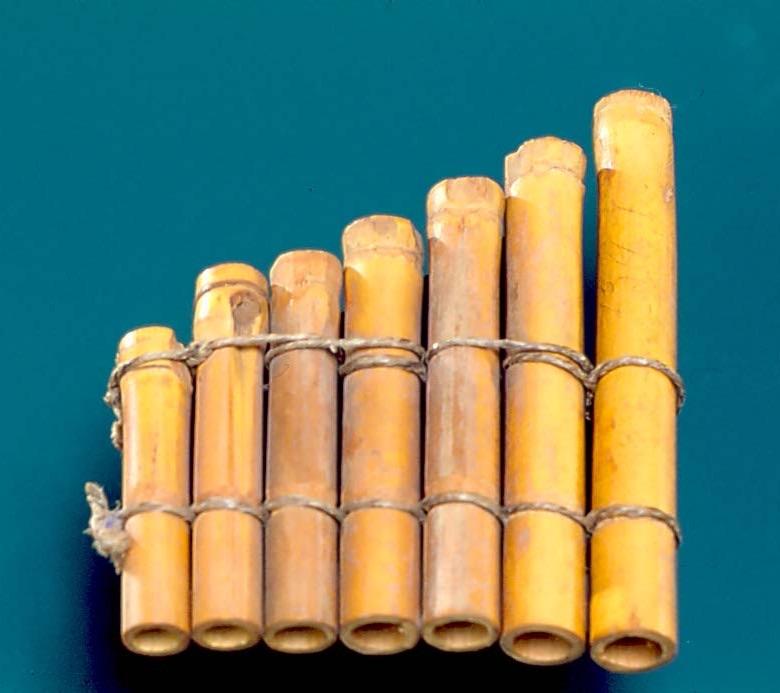
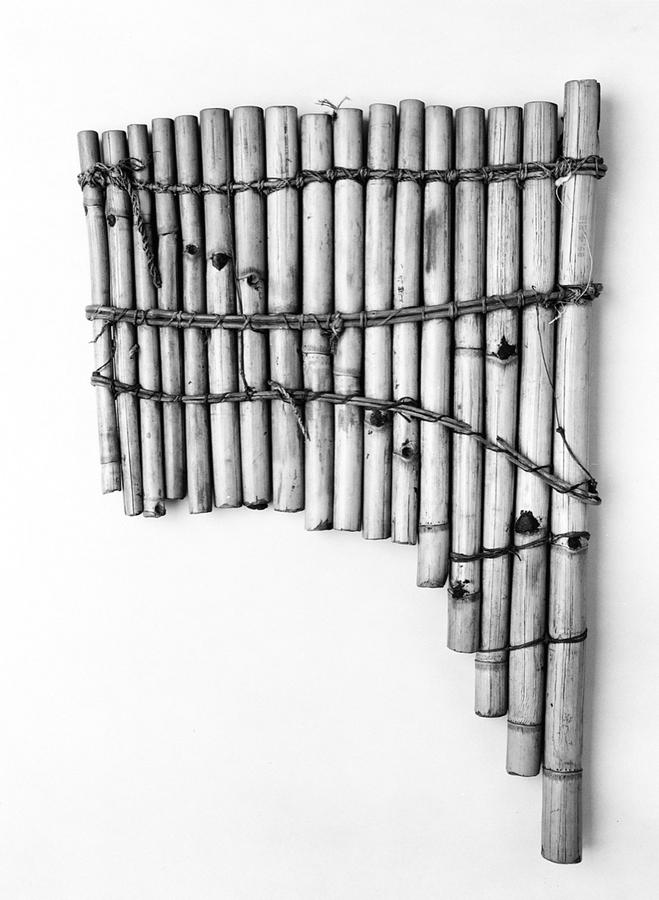
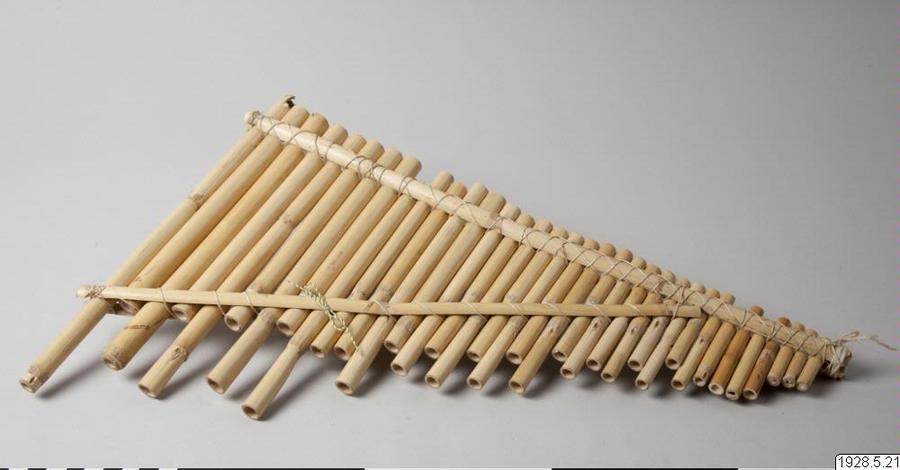
These 4 photographs span 1801–1900, 3 places of origin and 2 museums. 1 of them carry no date in the museum record. Every photograph is public domain or openly licensed, and links to the museum’s own record.
-
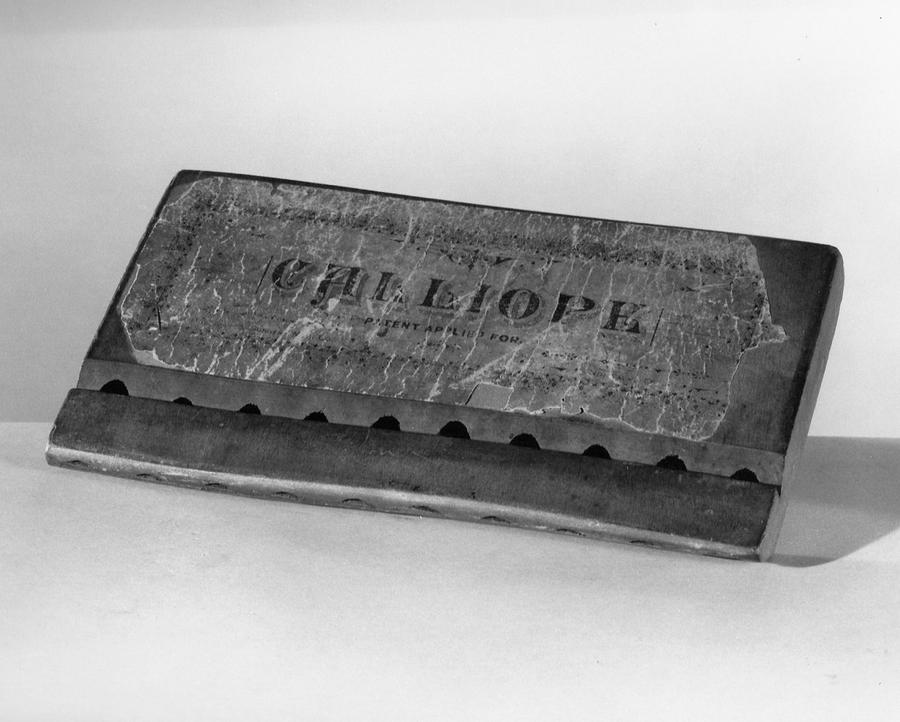
Panpipesca. 1889 · American (United States) -
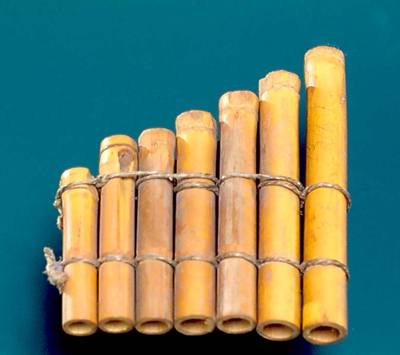
Panpipes19th century · American (United States) -
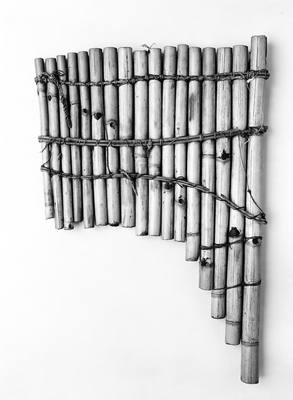
Enkwanzi (panpipe)late 19th century · Usoga (Uganda) -
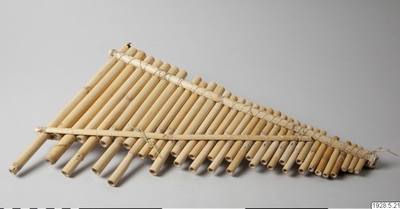
Panflute, flute, panpipeUndated · Sweden
Facts at a glance
| Hornbostel–Sachs number | 421.112 |
|---|---|
| Hornbostel–Sachs group | Aerophones › Non-free aerophones (wind instruments proper) › Edge-blown aerophones or flutes |
| Also known as | Panflute, Pan-pipe, Panpipe, Pan pipe, Pan's pipe, sets of end-blown flutes, panpipes, syrinx, paixiao, p'ai-hsiao |
| Wikidata labels | 51 languages |
| Wikipedia article | Pan flute |
| Wikidata item | Q218802 |
| Wikimedia Commons category | Pan flutes |
| MusicBrainz instrument | 6b5b72d8-6e9c-4e31-bd21-062d10bcf661 |
| Encyclopaedia Britannica | art/panpipe |
Sources: Wikidata (CC0 1.0) — classification number, aliases, identifiers (dump of 2026-07-22); Wikipedia (CC BY-SA 4.0) — infobox fields (description of the classification number, development, inventors) and the names of the Hornbostel–Sachs groups (article “Hornbostel–Sachs”, revision of 2026-01-04).
The name in other languages
| Language | Name | Also written |
|---|---|---|
| English | pan flute | Panflute, Pan-pipe, Panpipe |
| French | flûte de Pan | Flute de pan |
| German | Panflöte | Längsflötenspiele |
| Spanish | Antara | flauta de Pan |
| Italian | flauto di Pan | siringa, zampoña |
| Portuguese | Flauta de pã | Zamponha, Flauta de pan, Flauta-de-pã |
| Dutch | panfluit | Syrinx, Pansfluit |
| Russian | флейта Пана | Пан-флейта, Панфлейта, Многоствольная флейта |
| Japanese | パンパイプ | パンの笛, 葦笛, パンフルート |
| Chinese | 排簫 | 潘笛, 排笛, páixiāo |
| Korean | 팬파이프 | 팬플루트, 판의 피리, 팬플룻 |
| Arabic | مصفار | سيرينكس, بان بايب, بان فلوت |
Sources: Wikidata (CC0 1.0) — labels and aliases; MusicBrainz (CC0 1.0) — instrument aliases (names only).
About the pan flute: history, construction and playing
A pan flute (also known as panpipes or syrinx) is a musical instrument based on the principle of the closed tube, consisting of multiple pipes of gradually increasing length (and occasionally girth). Numerous varieties of pan flutes have been popular as folk instruments. The pipes are typically made from bamboo, giant cane, or local reeds. Other materials include wood, plastic, metal, and clay.
Name
The pan flute is named after Pan, the Greek god of nature and shepherds, often depicted with such an instrument. The pan flute has become widely associated with the character Peter Pan created by Sir James Matthew Barrie, whose name was inspired by the god Pan.
In Greek mythology, Syrinx (Σύριγξ) was a forest nymph. In her attempt to escape the affection of god Pan (a creature half goat and half man), she was transformed into a water-reed or calamos (cane-reed). Then, Pan cut several reeds, placed them in parallel one next to the other, and bound them together to make a melodic musical instrument. Ancient Greeks called this instrument Syrinx, in honour of the Muse, and Pandean, or Pan-pipes and Pan-flute, after Pan. (Syrinx was a different musical instrument from Aulos. Aulos is often translated as "flute" or "double flute" in English).
The Syrinx, a predominantly pastoral instrument for the Greeks, was adopted by the Etruscans who played it at their festivals and banquets; the Etruscans called it fistula. The Romans adopted the Syrinx from the Greeks and the Etruscans, and they too played it at their banquets, festivals, as well as in religious and funeral processions.
Structure
The pan flute's tubes are stopped at one end, at which the standing wave is reflected giving a note an octave lower than that produced by an open pipe of equal length. In the traditional South American style, pipes are fine-tuned to correct pitch by placing small pebbles or dry corn kernels into the bottom of the pipes. Contemporary makers of curved Romanian-style panpipes use wax (commonly beeswax) to tune new instruments. Special tools are used to place or remove the wax. Corks and rubber stoppers are also used, and are easier to quickly tune pipes.
Acoustics
The pan flute is an end-blown flute. Sound is produced by the vibration of an air-stream blowing across an open hole at the end of a resonating tube. The length of the tube determines the fundamental frequency. An overblown harmonic register is near a 12th above the fundamental in cylindrical tubes, but can approach an octave jump (8th) if a decreasing taper is used.
According to the Fundamental Principle for pan flutes, the frequency and the length of the tube are inversely proportional. Every time the pitch goes up one octave, the frequency doubles. Because there are 12 notes in a chromatic scale or a full octave, every half-step in a chromatic scale is multiplied by the 12th root of 2 to get the note next to it. By this, it is possible to calculate the length of any pipe, given that one knows the length of any one pipe. The formula for calculating the length of a pan flute pipe is L = (c / f) / 4 (the "theoretical length" L equals the speed of sound c = 343 m/s, divided by the desired frequency in hertz f, that quantity divided by 4; this simplifies and rearranges to: Length of pipe (in centimeters) × Frequency (in hertz) = 8575). Because of a property of compression within the tube, the length must be a little shorter to correct flat pitch. The extra length is helpful for a maker, who can use a cork or plug at the bottom to adjust the pitch. Some instruments use wax or pellets to tune the fundamental pitch of each tube. A tube that has a diameter 1/10 of its length yields a typical tone colour. An inner diameter range between 1/7 and 1/14 of the length L is acceptable. A narrow tube will sound "reedy", while a wide one will sound "flutey". A more exact method is to multiply the bore diameter by 0.82 and subtract this value from the tube length. This compensates for internal compression slowing frequency and the lips partially covering the voicing. Only tiny adjustments will be needed then to adjust fundamental pitch for air density and temperature.
Playing
The pan flute is played by blowing horizontally across an open end against the sharp inner edge of the pipes. Each pipe is tuned to a keynote, called the fundamental frequency. By overblowing, that is, increasing the pressure of breath and tension of lips, odd harmonics (notes whose frequencies are odd-number multiples of the fundamental), near a 12th in cylindrical tubes, may also be produced. The Romanian pan flute has the pipes arranged in a curved array, solidly glued together, unlike Andean versions, which are usually tied together. Thus, the player can easily reach all the notes by simply swiveling the head, or by moving the instrument with the hands. These instruments can also play all the sharps and flats, with a special technique of both tilting the pipes and jaw movement, thus reducing the size of the pipe's opening and producing a change in pitch. A very advanced player can play any scale and in any key. There are two styles of vibrato possible, hand vibrato and breath vibrato. In hand vibrato, the pitch is shifted up and down, like a vocal vibrato. The player gently moves one end of the pan flute (usually the high end) somewhat similar to violin vibrato. Breath, or throat vibrato, which is more accurately described as a tremolo or volume swell, is the same technique used by players of the flute and other woodwinds by use of the player's diaphragm, or throat muscles.
Variations
The curved-style pan flute was popularized by the Romanian musician Gheorghe Zamfir, who toured extensively and recorded many albums of pan flute music in the 1970s, and by several other artists who began recording at the same time. Today there are thousands of devoted players across Europe, Asia and the Americas. Both the curved and traditional South American variations are also very popular in Peruvian traditional groups and other Andean music. In Bolivia, the panpipes of the altiplano are known as jula-jula, and those of the Andean range as julu-julu.
In Laos and Thailand, there is a cylindrical version called the wot, used in folk music from the Isaan region of the country. The player alters notes by rotating the instrument with the hands, rather than by head movements.
Panpipes are used in varieties of African traditional music, typically constructed from bamboo. The ngororombe, often accompanied by percussion instruments in ensembles, is found in northeastern Zimbabwe. The Nyungwa tribe in Malawi also use the ngororombe and use the same term to refer to the dance that accompanies playing of the instrument; the term nyanga is also employed for the instrument.
Some new designs are beginning to appear, as designers and makers take advantage of computer-aided design and 3D additive manufacturing, to move past the limitations of traditional tool and materials. These new pan flutes address some long-standing issues to make it an easier instrument to learn and to play accurately.
Source: Wikipedia, “Pan flute” — CC BY-SA 4.0 — text excerpted as published (references, images and tables removed); see the article for the full text and the list of authors. Revision of 2026-07-03.
From Grove’s Dictionary (1900)
PANDEAN PIPE (Fr. Flûte de Pan; Ger. Syrinx). A simple instrument, of many forms and materials, which is probably the oldest and the most widely disseminated of any. It is thought to be identical with the Ugab, the first wind-instrument mentioned in the Bible (Gen. iv. 21, and Psalm cl.), in the former of these passages translated 'organ,' in the latter, 'pipe.' It was well known to the Greeks under the name of syrinx, being made with from three to nine tubes,Theocritus, Idyll ix. but usually with seven, a number which is also mentioned by Virgil.'Est mini disparibus septem compacta cicutis Fistula.' It is depicted in a MS. of the 11th century preserved in the Bibliothèque Royale of Paris, and is probably the frestele, frêtel or frêtiau, of the Menétriers in the 12th and 13th centuries. It is known in China as Koan-tfee, with twelve tubes of bamboo; was used by the Peruvians under the name of huayra-puhura, being made of cane, and also of a greenish steatite or soapstone. Of the former material is a fine specimen now in the British Museum,See Catalogue of Instruments in South Kensington Museum, by C. Engel, p. 65. for a woodcut of this specimen. consisting of fourteen reed pipes of a brownish colour tied together with thread in two rows, so as to form a double set of seven reeds. Both sets are of almost exactly the same dimensions, and are placed side by side, the shortest measuring 3, the longest 6½ inches. One set is open at the bottom, the other closed, in consequence of which arrangement octaves are produced. The scale is pentatonic.
Source: Wikisource, A Dictionary of Music and Musicians (Grove, 1900) — “Pandean Pipe” (entry by William H. Stone) — Public domain (published 1879–1910; authors died before 1929) — the first paragraphs of the entry, as transcribed; see the page for the full entry.
Sources and licences
- Panpipes, Bostwick & Burgess Manufacturing Company, ca. 1889, American (United States). wood. Purchase, Anonymous Gift, 1977 (1977.246.2). Museum record · CC0 1.0 (public domain dedication)
- Panpipes, 19th century, American (United States). Cane or bamboo, twine. The Crosby Brown Collection of Musical Instruments, 1889 (89.4.1347). Museum record · CC0 1.0 (public domain dedication)
- Enkwanzi (panpipe), late 19th century, Usoga (Uganda). Bamboo, fiber. The Crosby Brown Collection of Musical Instruments, 1889 (89.4.518). Museum record · CC0 1.0 (public domain dedication)
- Panflute, flute, panpipe, Undated, Sweden. Museum of Ethnography / Swedish Open Cultural Heritage (via Europeana). Museum record · CC0 1.0 (public domain dedication)
Photographs: open-access collections of the museums named above; each is shown here reduced in size, otherwise unchanged. Text: Wikipedia (CC BY-SA 4.0), Grove’s Dictionary (public domain), Wikidata and MusicBrainz (CC0). The full list of sources and licences is on the credits page.