
Instruments · Aerophones
Bagpipes
The bagpipes are a musical instrument. They are sometimes just called "pipes". They have a bag that holds air. The player keeps the bag full of air by blowing into it with a tube or pumping it with a bellows. To make music, the bag is pressed and the air comes out through a kind of flute or "chanter". There are usually one or more other tubes coming from the bag that make sounds whenever the bag is squeezed, called "drones". Each drone normally plays a different note, and stays on the same note the whole time it is playing, to play a harmony with the "chanter". The sounds are made by a single or, more commonly, double reed which vibrates when air is blown over it.
Summary: Simple English Wikipedia, “Bagpipes” — CC BY-SA 4.0. Revision of 2025-06-05.
Museum photographs
These 8 photographs span 1633–1900, 7 places of origin and 3 museums. 1 of them carry no date in the museum record. Every photograph is public domain or openly licensed, and links to the museum’s own record.
-
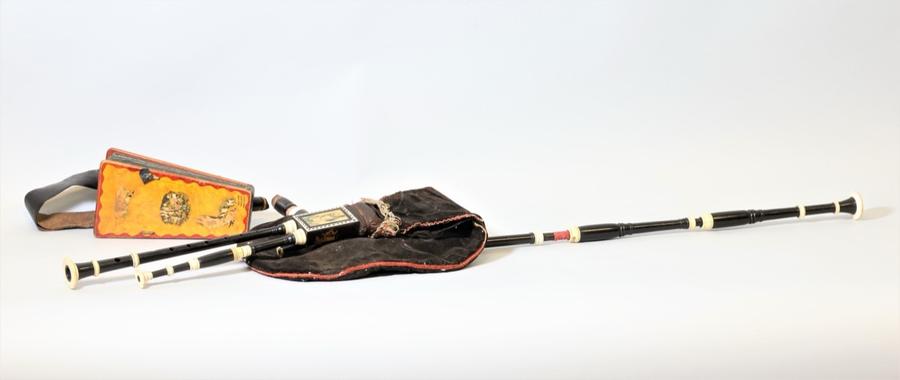
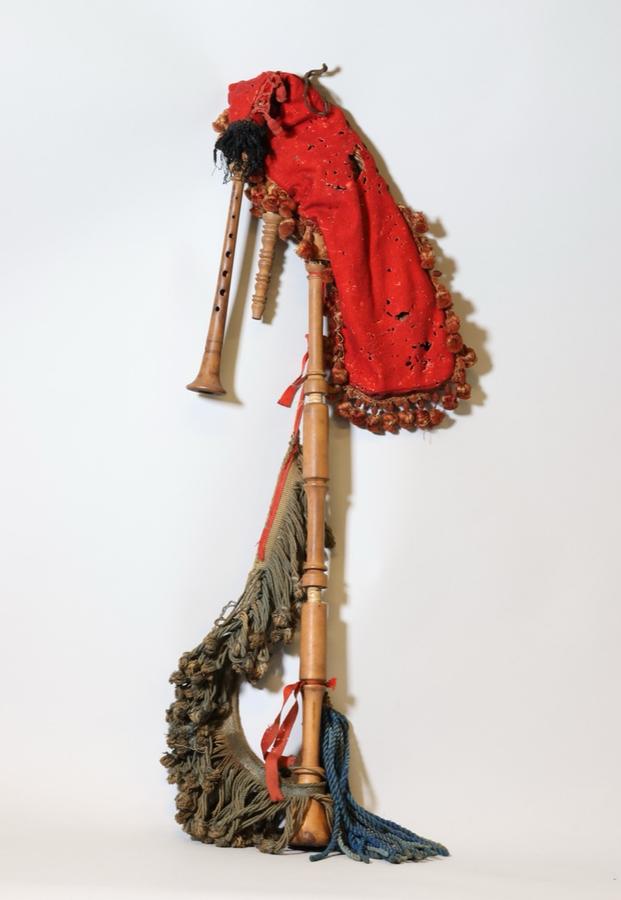
Cornemuse1874 · French (France) -
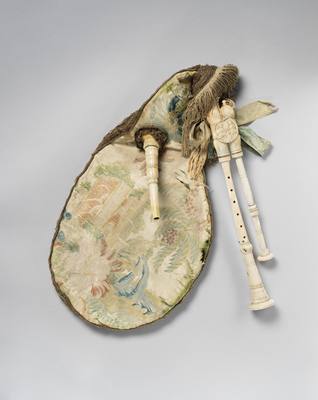
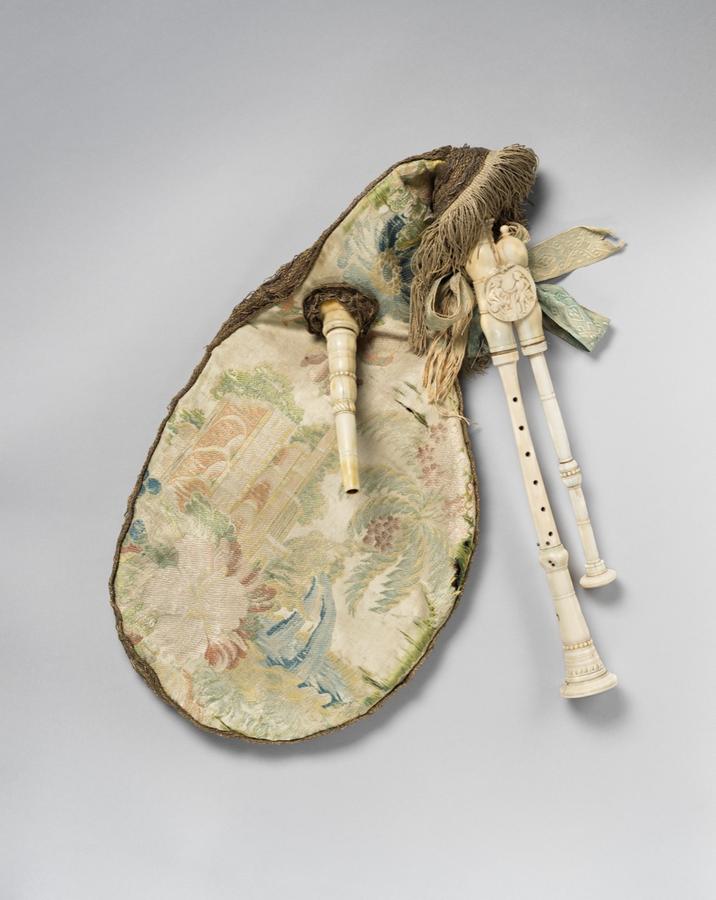
Cornemusemid-17th century · French (France) -
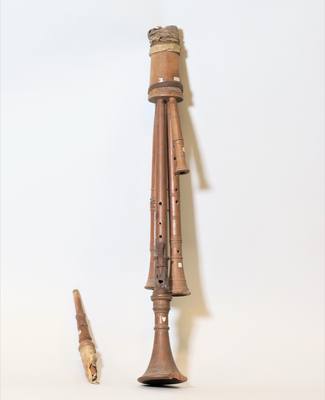
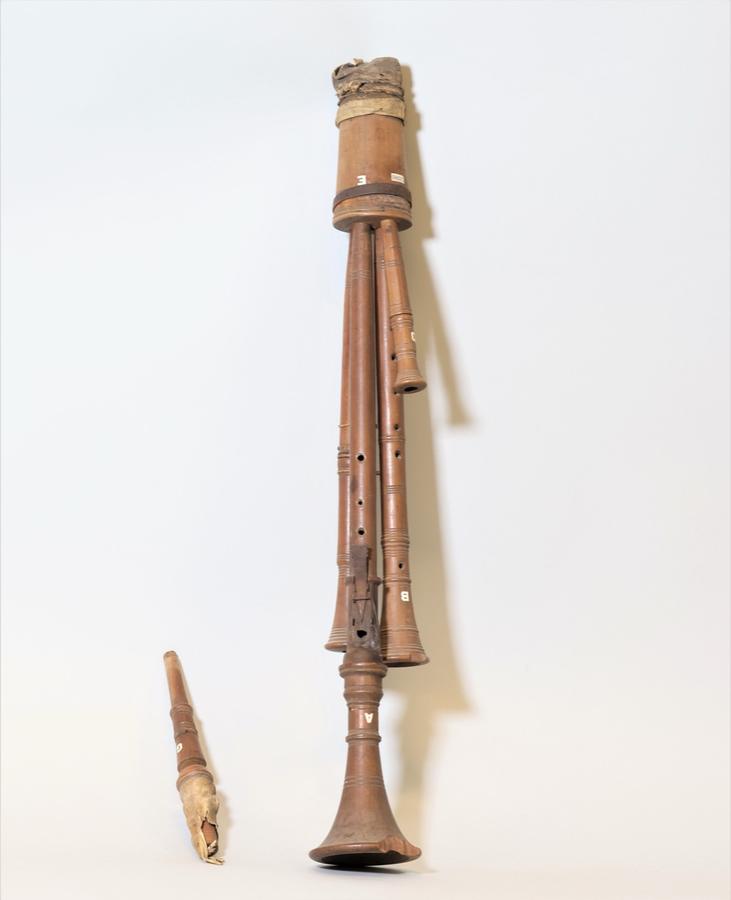
Zampogna18th century · Italian (Italy) -
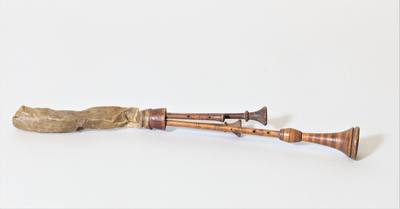
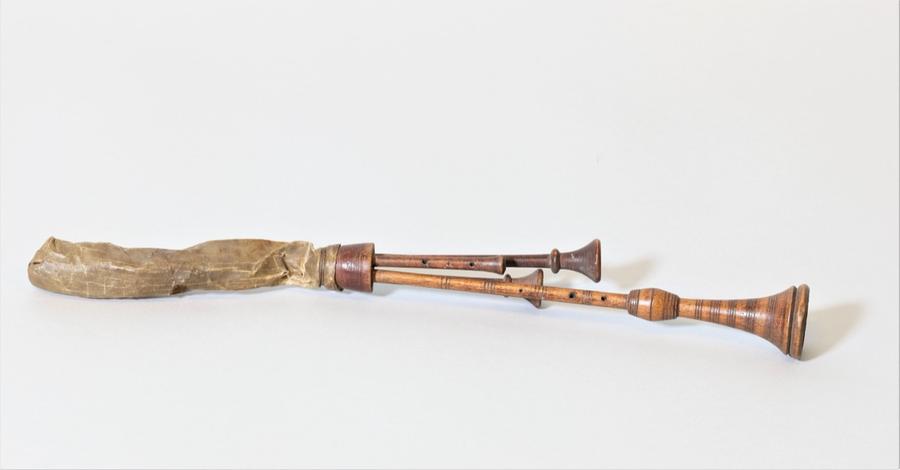
Miniature Toy Zampogna19th century · possibly Italian (Italy or France) -
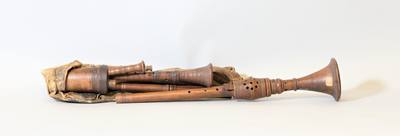
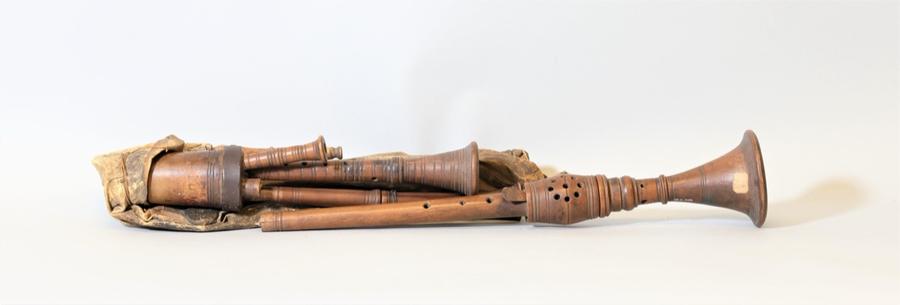
Zampogna19th century · Italian (Italy or Sicily) -
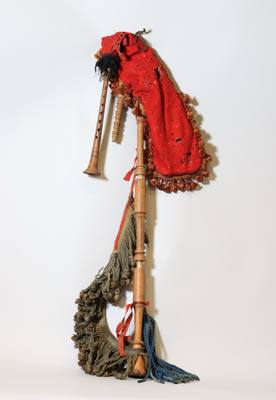
Gaitalate 19th century · Spanish (Spain) -
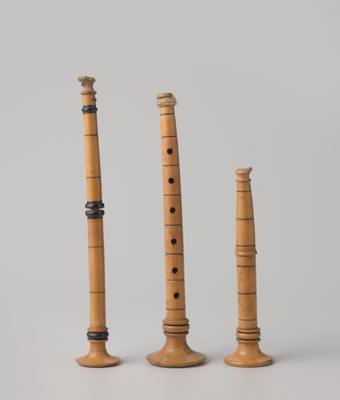
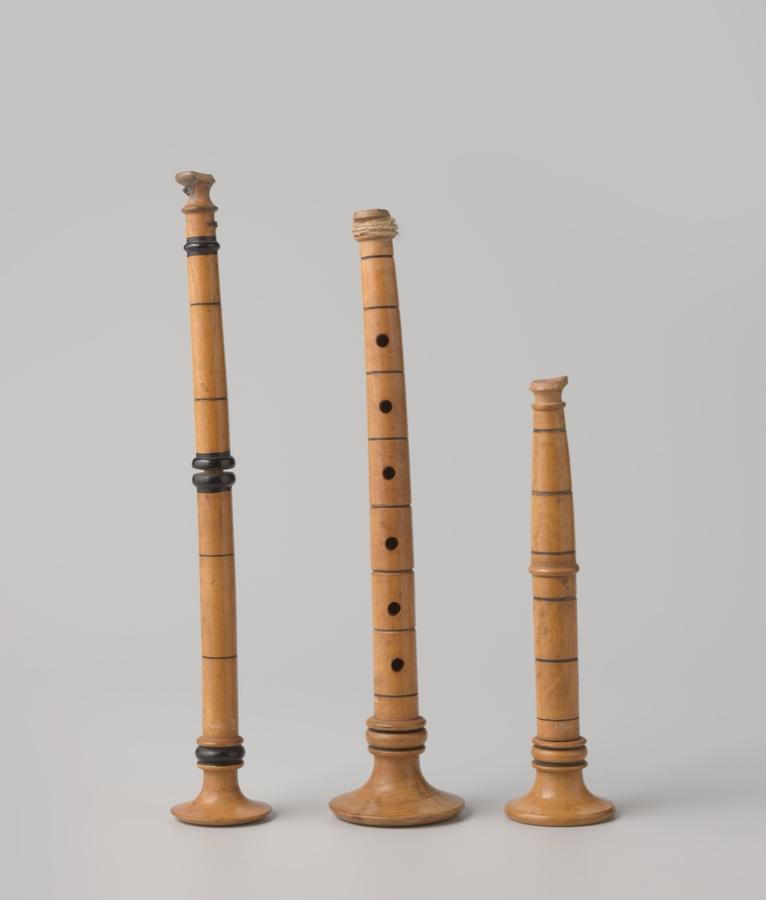
Toy bagpipe (three chanters)c. 1850 - c. 1896 · England -
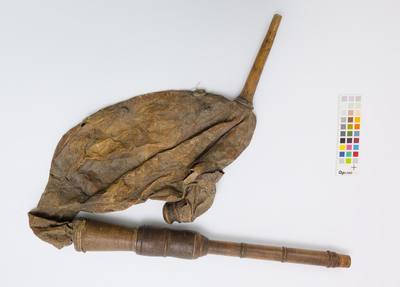
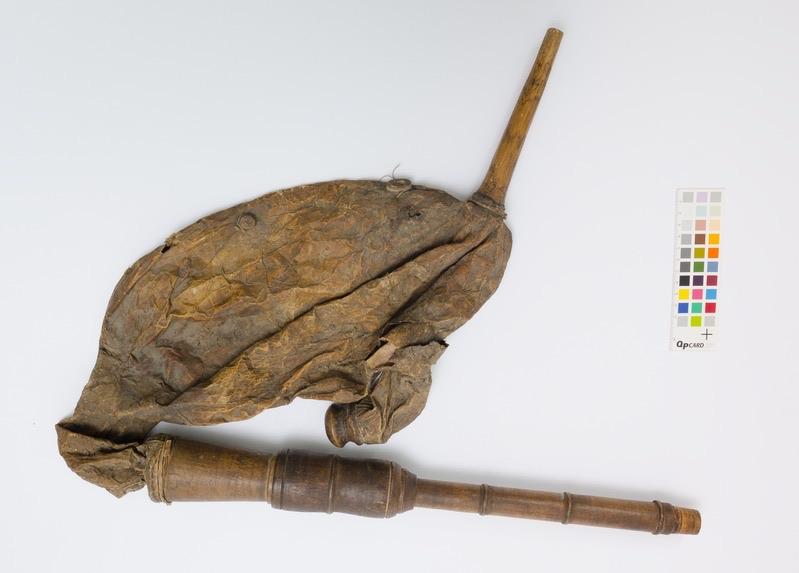
BagpipeUndated · Estonia
Facts at a glance
| Hornbostel–Sachs number | 422.112+422.22-62 — Reed aerophone with conical bore |
|---|---|
| Hornbostel–Sachs group | Aerophones › Non-free aerophones (wind instruments proper) › Reed aerophones |
| Also known as | pipes, biniou, cornemuse, musette, set of bagpipes |
| Classification (Wikipedia infobox) | Aerophone, Wind, Woodwind |
| Wikidata labels | 91 languages |
| Wikipedia article | Bagpipes |
| Wikidata item | Q8347 |
| Wikimedia Commons category | Bagpipes |
| MusicBrainz instrument | 1d865ced-d86a-4277-8914-009740e37887 |
| Encyclopaedia Britannica | art/bagpipe |
| Audio sample (Wikimedia Commons) | Mari Bagpipe - Erik Juzykain.wav |
Sources: Wikidata (CC0 1.0) — classification number, aliases, identifiers (dump of 2026-07-22); Wikipedia (CC BY-SA 4.0) — infobox fields (description of the classification number, development, inventors) and the names of the Hornbostel–Sachs groups (article “Hornbostel–Sachs”, revision of 2026-01-04).
The name in other languages
| Language | Name | Also written |
|---|---|---|
| English | bagpipe | pipes, biniou, cornemuse |
| French | cornemuse | cornemuses à soufflet |
| German | Sackpfeife | Dudelsack, Bockpfeife, Biniou |
| Spanish | gaita | gaita de fuelle |
| Italian | cornamusa | |
| Portuguese | gaita de foles | gaita-de-foles, gaita de fole |
| Dutch | doedelzak | doedelzakken met balg |
| Russian | волынка | |
| Japanese | バグパイプ | ガイダ |
| Chinese | 风笛 | |
| Korean | 백파이프 | |
| Arabic | مزمار القربة | ذات القربة, مزمار القرب |
Sources: Wikidata (CC0 1.0) — labels and aliases; MusicBrainz (CC0 1.0) — instrument aliases (names only).
About the bagpipes: history, construction and playing
The bagpipe is a woodwind instrument using enclosed reeds fed from a constant reservoir of air in the form of a bag. The Scottish Great Highland bagpipe is well known, but people have played bagpipes for centuries throughout large parts of Europe, North Africa, West Asia, around the Persian Gulf and northern parts of South Asia.
The term bagpipes is also used, though pipers usually refer to the bagpipes as "the pipes", "a set of pipes" or "a stand of pipes".
Bagpipes are part of the aerophone group because to play the instrument, air must be blown into it to produce a sound.
Construction
A set of bagpipes minimally consists of an air supply, a bag, a chanter, and usually at least one drone. Many bagpipes have more than one drone (sometimes, more than one chanter) in various combinations, held in place in stocks—sockets that fasten the various pipes to the bag.
Air supply
The most common method of supplying air to the bag is through blowing into a blowpipe or blowstick. In some pipes the player must cover the tip of the blowpipe with the tongue while inhaling, in order to prevent unwanted deflation of the bag, but most blowpipes have a non-return valve that eliminates this need. In recent times, there are many instruments that assist in creating a clean air flow to the pipes and assist the collection of condensation.
The use of a bellows to supply air is an innovation dating from the 16th or 17th century. In these pipes, sometimes called "cauld wind pipes", air is not heated or moistened by the player's breathing, so bellows-driven bagpipes can use more refined or delicate reeds. Such pipes include the Irish uilleann pipes; the border or Lowland pipes, Scottish smallpipes, Northumbrian smallpipe and pastoral pipe in Britain; the musette de cour, the musette bechonnet and the cabrette in France; and the Dudy, koziol bialy, and koziol czarny in Poland.
Chanter reed
The note from the chanter is produced by a reed installed at its top. The reed may be a single (a reed with one vibrating tongue) or double reed (of two pieces that vibrate against each other). Double reeds are used with both conical- and parallel-bored chanters while single reeds are generally (although not exclusively) limited to parallel-bored chanters. In general, double-reed chanters are found in pipes of Western Europe while single-reed chanters appear in most other regions.
They are made from reed (arundo donax or Phragmites), bamboo, or elder. A more modern variant for the reed is a combination of a cotton phenolic (Hgw2082) material from which the body of the reed is made and a clarinet reed cut to size in order to fit the body. These types of reeds produce a louder sound and are not so sensitive to humidity and temperature changes.
Possible ancient origins
The evidence for bagpipes prior to the 13th century is still uncertain, but several textual and visual clues have been suggested. The Oxford History of Music posits that a sculpture of bagpipes has been found on a Hittite slab at Euyuk in Anatolia, dated to 1000 BCE. Another interpretation of this sculpture suggests that it instead depicts a pan flute played along with a friction drum.
Several authors identify the ancient Greek askaulos (ἀσκός askos – wine-skin, αὐλός aulos – reed pipe) with the bagpipe.
Dio Chrysostom wrote in the 1st century CE of a contemporary sovereign (possibly the Roman emperor Nero) who could play a pipe (tibia, Roman reedpipes similar to Greek and Etruscan instruments) with his mouth as well as by tucking a bladder beneath his armpit.
In the 2nd century CE, Suetonius also described Nero as a player of the tibia utricularis.
Modern scholarship suggests that such instruments, rather than being seen as an independent class, were understood as variants on mouth-blown instruments that used a bag as an alternative blowing aid, and that it was not until drones were added in the European Medieval era that bagpipes were seen as a distinct class.
Spread and development in Europe
In the early part of the second millennium, representations of bagpipes began to appear with increasing frequency in Western European art and iconography. The Cantigas de Santa Maria, written in Galician-Portuguese and compiled in Castile in the mid-13th century, depicts several types of bagpipes.
Several illustrations of bagpipes also appear in the Chronique dite de Baudoin d’Avesnes, a 13th-century manuscript of northern French origin.
A baggepype wel coude he blowe and sowne, /And ther-with-al he broghte us out of towne.
Bagpipes were also frequent subjects for carvers of wooden choir stalls in the late 15th and early 16th century throughout Europe, sometimes with animal musicians.
Actual specimens of bagpipes from before the 18th century are extremely rare; however, a substantial number of paintings, carvings, engravings, and manuscript illuminations survive. These artefacts are clear evidence that bagpipes varied widely throughout Europe, and even within individual regions. Many examples of early folk bagpipes in continental Europe can be found in the paintings of Brueghel, Teniers, Jordaens, and Durer.
The earliest known artefact identified as a part of a bagpipe is a chanter found in 1985 at Rostock, Germany, that has been dated to the late 14th century or the first quarter of the 15th century.
The first clear reference to the use of the Scottish Highland bagpipe is from a French history that mentions their use at the Battle of Pinkie in 1547. George Buchanan (1506–82) claimed that the bagpipe had replaced the trumpet on the battlefield. This period saw the creation of the ceòl mór (great music) of the bagpipe, which reflected its martial origins, with battle tunes, marches, gatherings, salutes and laments. The Highlands of the early 17th century saw the development of piping families including the MacCrimmonds, MacArthurs, MacGregors, and the Mackays of Gairloch.
The earliest Irish mention of the bagpipe is in 1206, approximately thirty years after the Anglo-Norman invasion; another mention attributes their use to Irish troops in Henry VIII's siege of Boulogne. Illustrations in the 1581 book The Image of Irelande by John Derricke clearly depict a bagpiper. Derricke's illustrations are considered to be reasonably faithful depictions of the attire and equipment of the English and Irish population of the 16th century.
Recent history
During the 19th and 20th centuries, as a result of the participation of Scottish regiments in the expansion of the British Empire, the bagpipe became well known worldwide. This surge in the bagpipe's popularity was boosted by large numbers of Allied pipers which served in World War I and World War II. This coincided with a decline in the popularity of many traditional forms of bagpipe throughout Europe, which began to be displaced by instruments from the classical tradition and later by gramophone and radio.
As pipers were easily identifiable, combat losses were high, estimated at one thousand in World War I. A front line role was prohibited following high losses in the Second Battle of El Alamein in 1943, though a few later instances occurred.
In the United Kingdom and Commonwealth Nations such as Canada, New Zealand and Australia, the Great Highland bagpipe is commonly used in the military and is often played during formal ceremonies. Foreign militaries patterned after the British army have also adopted the Highland bagpipe, including those of Uganda, Sudan, India, Pakistan, Sri Lanka, Jordan, and Oman. Many police and fire services in Scotland, Canada, Australia, New Zealand, Hong Kong, and the United States have also adopted the tradition of fielding pipe bands.
In recent years, often driven by revivals of native folk music and dance, many types of bagpipe have enjoyed a resurgence in popularity and, in many cases, instruments that had fallen into obscurity have become extremely popular. In Brittany, the Great Highland bagpipe and concept of the pipe band were appropriated to create a Breton interpretation known as the bagad. The pipe-band idiom has also been adopted and applied to the Galician gaita as well. Bagpipes have often been used in various films depicting moments from Scottish and Irish history; the film Braveheart and the theatrical show Riverdance have served to make the uilleann pipe more commonly known.
The bagpipe is sometimes played at formal events at Commonwealth universities, particularly in Canada. Because of Scottish influences on the sport of curling, the bagpipe is also the official instrument of the World Curling Federation and is commonly played during a ceremonial procession of teams before major curling championships.
Types of bagpipe
Numerous types of bagpipe today are widely spread across Europe, the Middle East and North Africa as well as through much of the former British Empire. The name bagpipe has almost become synonymous with its best-known form, the Great Highland bagpipe, overshadowing the great number and variety of traditional forms of bagpipe. Despite the decline of these other types of pipes over the last few centuries, in recent years many of these pipes have seen a resurgence or revival as musicians have sought them out; for example, the Irish piping tradition, which by the mid 20th century had declined to a handful of master players is today alive, well, and flourishing, a situation similar to that of the Asturian gaita, the Galician gaita, the Portuguese gaita transmontana, the Aragonese gaita de boto, Northumbrian smallpipe, the Breton biniou, the Balkan gaida, the Romanian cimpoi, the Black Sea tulum, the Scottish smallpipes and pastoral pipe, as well as other varieties. Bulgaria has the Kaba gaida, a large bagpipe of the Rhodope mountains with a hexagonal and rounded drone, often described as a deep-sounding gaida and the Dzhura gaida with a straight conical drone and of a higher pitch. The Macedonian gaida is structurally between a kaba and dzhura gaida and described as a medium pitched gaida.
In Southeastern Europe and Eastern Europe bagpipes known as gaida include: the gajde, mishnica, bishnica, gaidã, гайда (gaida), γκάιντα (gáida) τσαμπούνα (tsaboúna) or ασκομαντουρα (askomandoura), гајда (gajda), gajda/гајда, gayda also tulum and gayda / ґайда.
In Tunisia, it is known by the name "mezwed". It is used in the Tunisian pop music genre, also called mezwed, that is named after the instrument.
Source: Wikipedia, “Bagpipes” — CC BY-SA 4.0 — text excerpted as published (references, images and tables removed); see the article for the full text and the list of authors. Revision of 2026-06-27.
From Grove’s Dictionary (1900)
BAGPIPE (Fr. Cornemuse; Ital. Cornamusa; Germ. Sackpfeife). An instrument, in one or other of its forms, of very great antiquity. By the Greeks it was named άσκανλοs or σνμφώνεια; by the Romans Tibia utricularis. Mersennus calls it Surdeline, and Bonani Piva or Ciaramella. In Lower Brittany it is termed Bignou, from a Breton word bigno—'se renfler beaucoup.' It has been named Musette (possibly after Colin Muset, an officer of Thibaut do Champagne, king of Navarre). Corruptions of these names, such as Samponia or Samphoneja, and Zampugna, are also common.
Shakespeare often alludes to it. He speaks of 'the drone of a Lincolnshire bagpipe,' of the antipathy some people have to its sound, and of some who laugh like parrots at a bagpiper. At the close of the 15th century the bagpipe seems to have come into general favour in Scotland.
Until recently music for the bagpipe was not written according to the usual system of notation, but was taught by a language of its own, the notes having each names, such as hodroho, hananin, hiechin, hachin, etc. A collection of piobaireachd (pibrochs) in this form was published by Capt. Niel Macleod at Edinburgh in 1828.
Source: Wikisource, A Dictionary of Music and Musicians (Grove, 1900) — “Bagpipe” (entry by William H. Stone) — Public domain (published 1879–1910; authors died before 1929) — the first paragraphs of the entry, as transcribed; see the page for the full entry.
Sources and licences
- Cornemuse, Joseph Bechonnet, 1874, French (France). Wood, ivory, sheep or cowhide, leather, velvet. Gift of Joseph W. Drexel, 1889 (89.2.165). Museum record · CC0 1.0 (public domain dedication)
- Cornemuse, P. Gaillard, mid-17th century, French (France). Ivory, leather, silk. The Crosby Brown Collection of Musical Instruments, 1889 (89.4.865). Museum record · CC0 1.0 (public domain dedication)
- Zampogna, 18th century, Italian (Italy). Wood, metal. The Crosby Brown Collection of Musical Instruments, 1889 (89.4.1096). Museum record · CC0 1.0 (public domain dedication)
- Miniature Toy Zampogna, 19th century, possibly Italian (Italy or France). wood, leather. The Crosby Brown Collection of Musical Instruments, 1889 (89.4.862). Museum record · CC0 1.0 (public domain dedication)
- Zampogna, 19th century, Italian (Italy or Sicily). Wood, goatskin, metal. The Crosby Brown Collection of Musical Instruments, 1889 (89.4.1568). Museum record · CC0 1.0 (public domain dedication)
- Gaita, late 19th century, Spanish (Spain). Wood, goat- or deerskin, leather, cloth. The Crosby Brown Collection of Musical Instruments, 1889 (89.4.3350). Museum record · CC0 1.0 (public domain dedication)
- Toy bagpipe (three chanters), Anonymous, c. 1850 - c. 1896, England. wood (plant material). Purchased with the support of the State of the Netherlands and the Vereeniging van Noord-Nederlandsche Muziekgeschiedenis. Museum record · Public Domain Mark 1.0
- Bagpipe, Undated, Estonia. Estonian History Museum / Estonian e-Repository and Conservation of Collections (via Europeana). Museum record · CC0 1.0 (public domain dedication)
Photographs: open-access collections of the museums named above; each is shown here reduced in size, otherwise unchanged. Text: Wikipedia (CC BY-SA 4.0), Grove’s Dictionary (public domain), Wikidata and MusicBrainz (CC0). The full list of sources and licences is on the credits page.