
Instruments · Aerophones
Natural trumpet
A natural trumpet is a valveless brass instrument that is able to play the notes of the harmonic series.
Summary: Wikipedia, “Natural trumpet” — CC BY-SA 4.0. Revision of 2026-05-10.
Museum photographs
These 9 photographs span 1675–1889, 6 places of origin and 2 museums. Every photograph is public domain or openly licensed, and links to the museum’s own record.
-
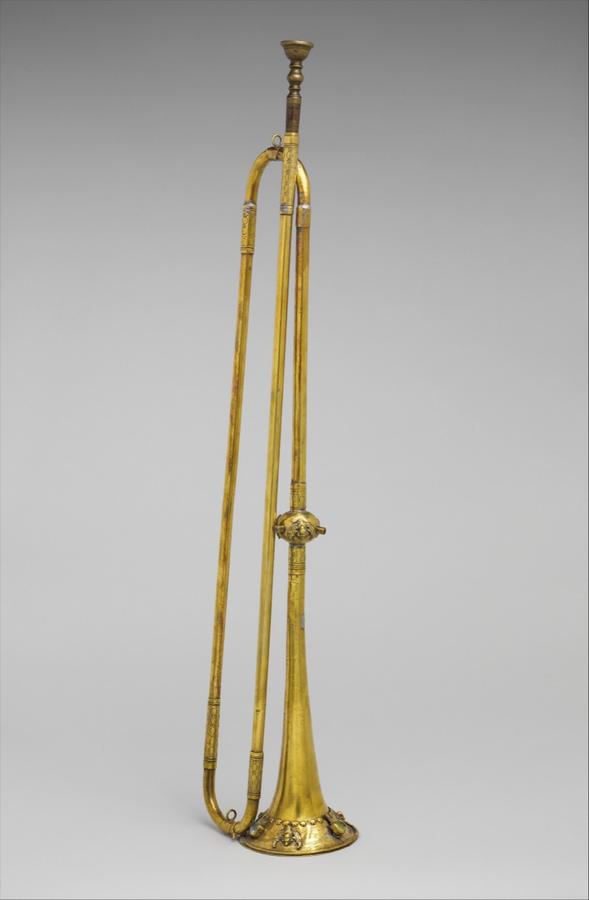
Natural Trumpet in D1790 · Germany -
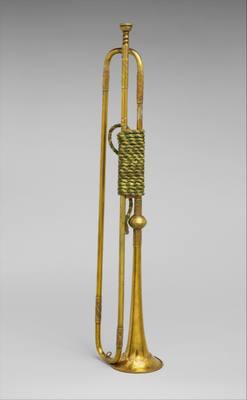
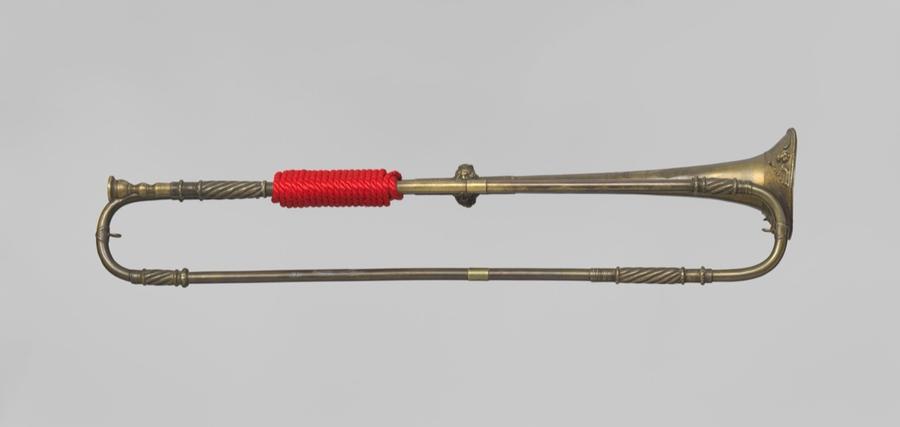
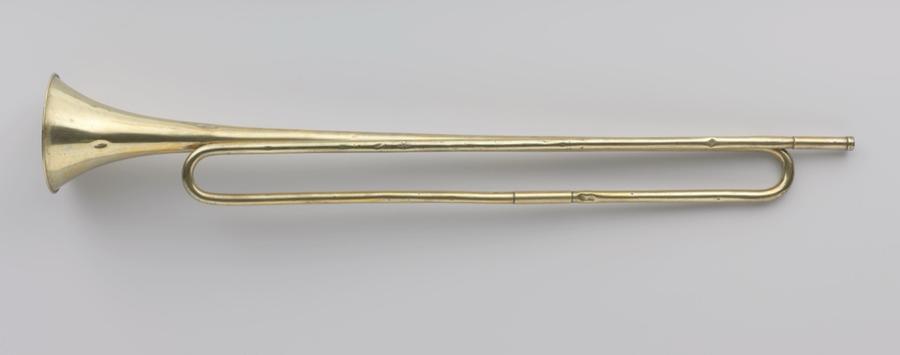
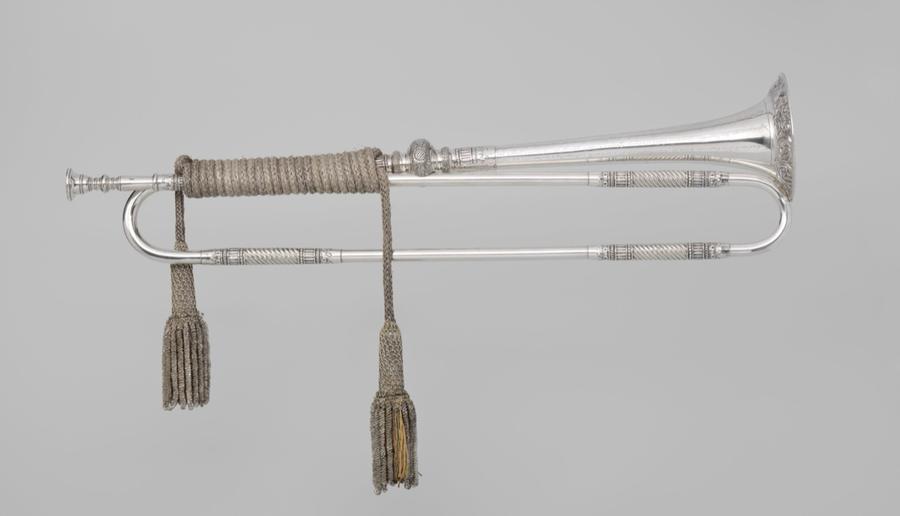
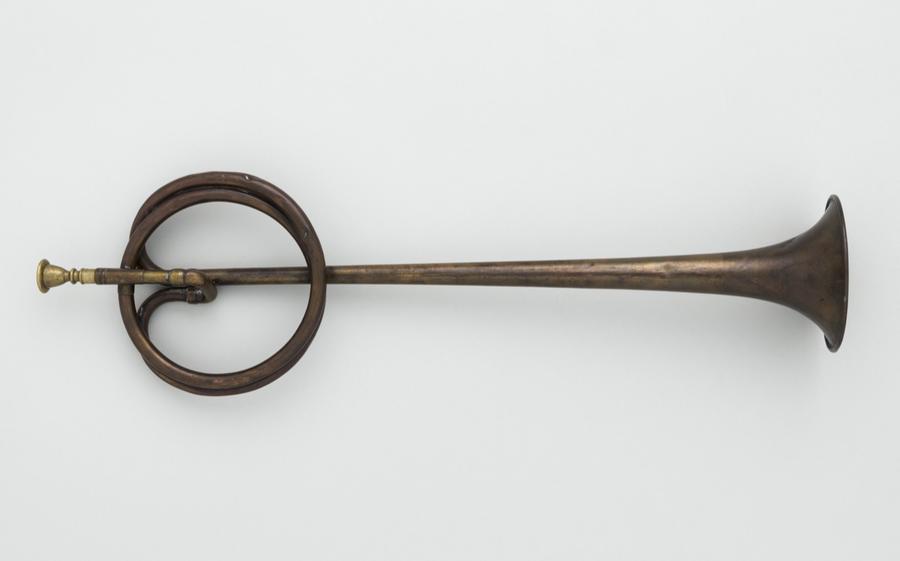
Natural Trumpetlate 17th century · Germany -
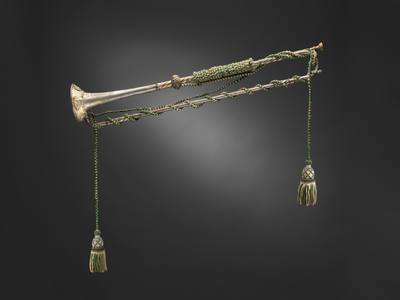
Natural Trumpetca. 1700 · Germany -
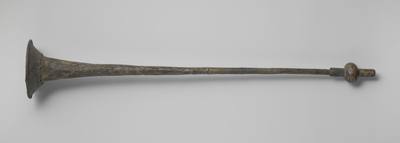
Natural Trumpet from the wreck of the Dutch East India ship Hollandia, made by Georg Friedrich Steinmetz1700 - 1735 -
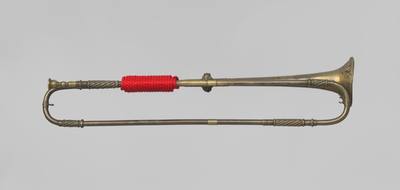
Trumpetc. 1714 - in or before 1722 · Neurenberg -
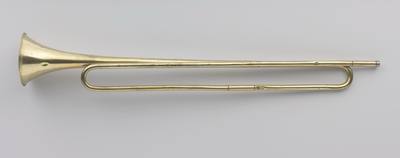
Natural trumpet (signal trumpet)c. 1800 - c. 1830 · Netherlands -
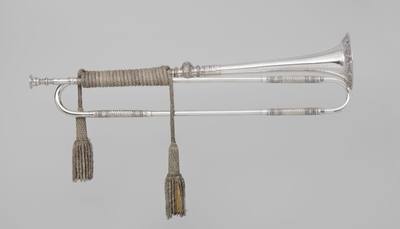
Natural trumpetc. 1813 · London -
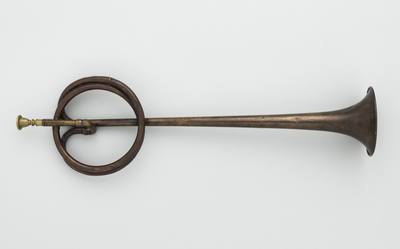
Natural Trumpet in Dlate 19th century · French or Italian (France, Italy) -
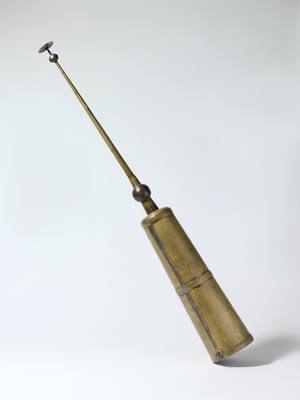
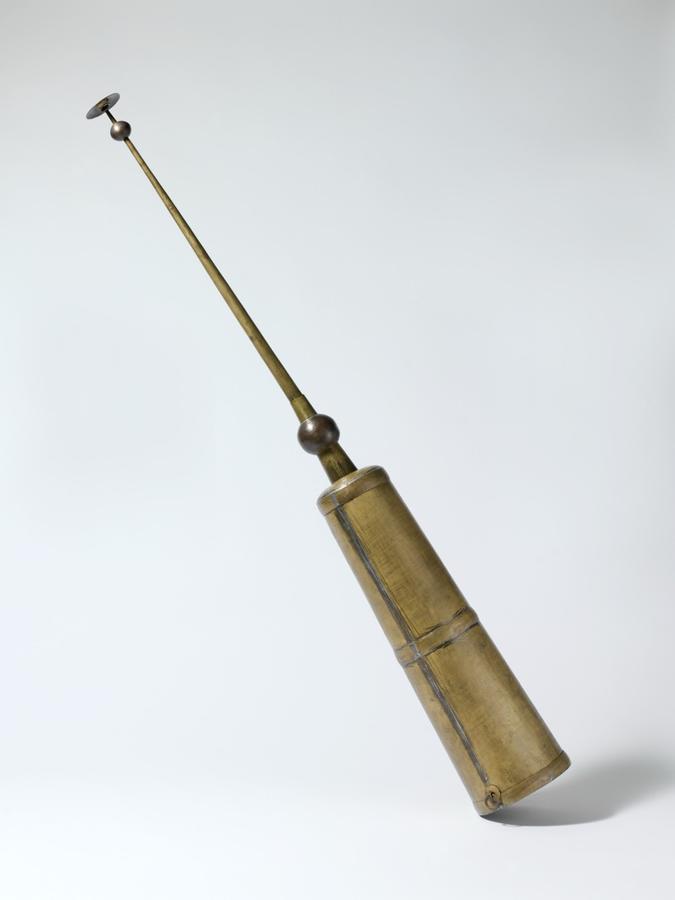
Da Tongjiao (Trumpet)late 19th century · Chinese (China)
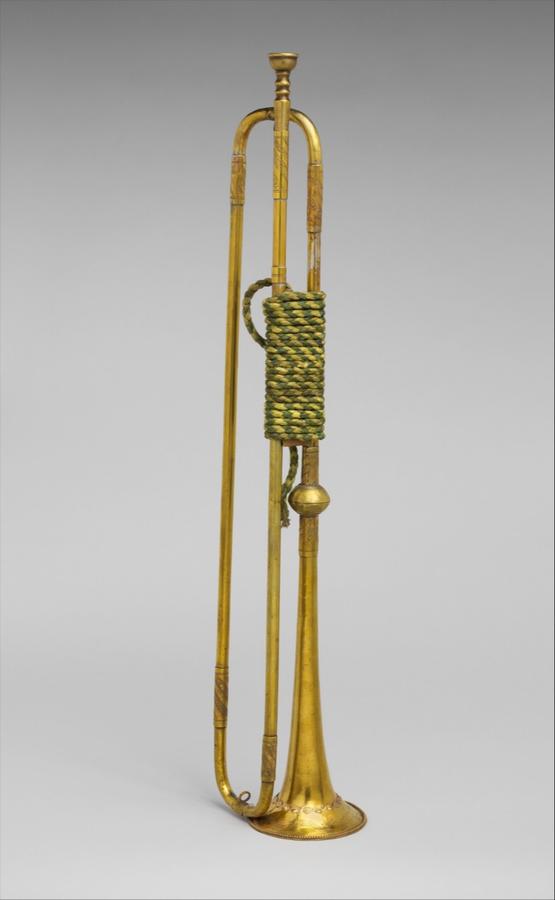
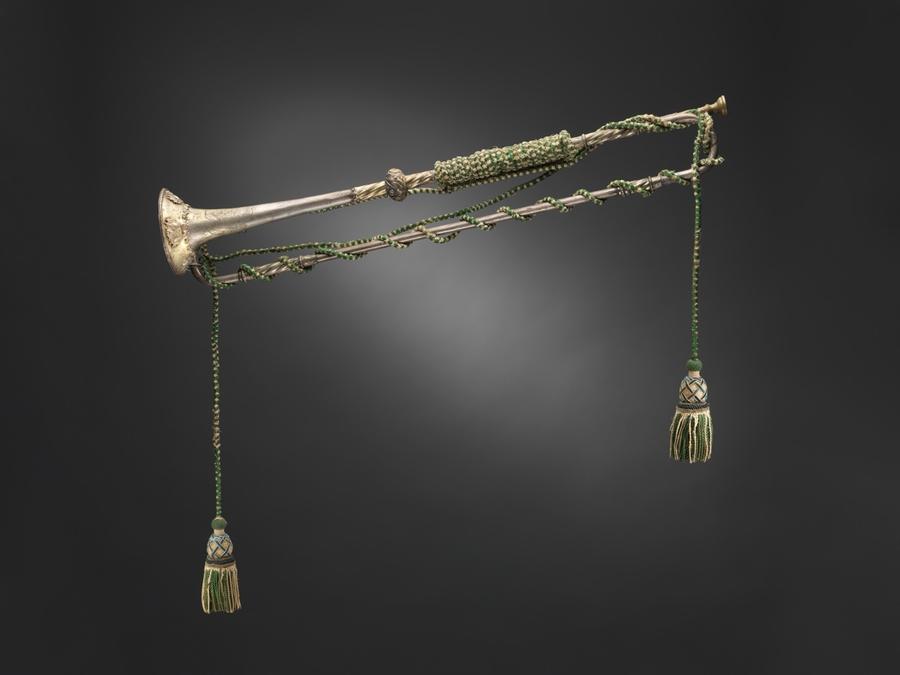
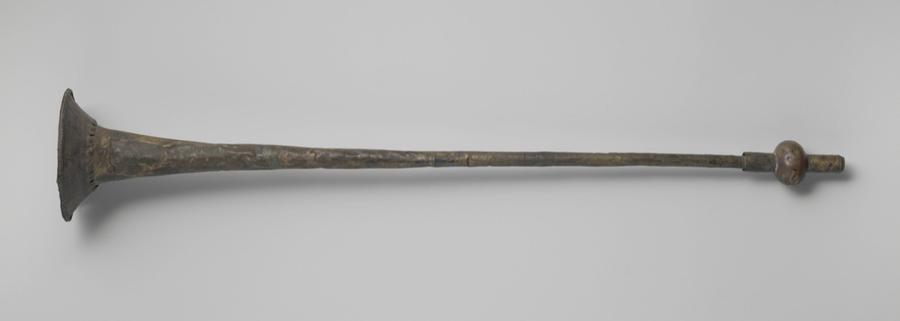
Facts at a glance
| Hornbostel–Sachs number | 423.1 — Natural trumpets – There are no means of changing the pitch apart from the player's lips; end-blown trumpets – The mouth-hole faces the axis of the trumpet. |
|---|---|
| Hornbostel–Sachs group | Aerophones › Non-free aerophones (wind instruments proper) › Trumpets |
| Also known as | natural labrosone |
| Classification (Wikipedia infobox) | Brass instrument |
| Wikidata labels | 23 languages |
| Wikipedia article | Natural trumpet |
| Wikidata item | Q1662735 |
| Wikimedia Commons category | Natural trumpet family instruments |
| MusicBrainz instrument | c55f5f41-a4e1-4b9a-971a-6f79324cb2a0 |
| Encyclopaedia Britannica | art/natural-trumpet |
Sources: Wikidata (CC0 1.0) — classification number, aliases, identifiers (dump of 2026-07-22); Wikipedia (CC BY-SA 4.0) — infobox fields (description of the classification number, development, inventors) and the names of the Hornbostel–Sachs groups (article “Hornbostel–Sachs”, revision of 2026-01-04).
The name in other languages
| Language | Name | Also written |
|---|---|---|
| English | natural trumpet | natural labrosone |
| French | trompette naturelle | |
| German | Naturtrompete | Natuurdrumbeete |
| Spanish | trompeta natural | |
| Italian | trombe naturali | ottoni naturali |
| Dutch | natuurtrompet | |
| Russian | естественная труба | природный лаброзон |
| Japanese | ナチュラルトランペット | ナチュラル トランペット |
| Chinese | 自然小號 | 自然小号 |
Sources: Wikidata (CC0 1.0) — labels and aliases; MusicBrainz (CC0 1.0) — instrument aliases (names only).
About the natural trumpet: history, construction and playing
A natural trumpet is a valveless brass instrument that is able to play the notes of the harmonic series.
History
See: Clarion The natural trumpet was used as a military instrument to facilitate communication (e.g. break camp, retreat, etc.).
Even before the late Baroque period the natural trumpet had been accepted into Western art music. There is evidence, for example, of extensive use of trumpet ensembles in Venetian ceremonial music of the 16th century. Although neither Andrea nor Giovanni Gabrieli wrote music specifically for the trumpet, they would have been very familiar with its technical possibilities.
Later, talented players such as the early baroque composer Girolamo Fantini demonstrated that by playing in the extreme upper register and "lipping" the notes of the 11th and 13th harmonics (that is, flattening or sharpening those impure harmonics into tune with the embouchure), it was possible to play diatonic major and minor scales (hence, actual melodies rather than arpeggios) on a natural trumpet. The most talented players were even able to produce certain chromatic notes outside the harmonic series by this process (such as lipping a natural C down to B), although these notes were mostly used as brief passing tones. (In Germany, this technique was called Heruntertreiben, literally "driving down".) Other "impure" harmonics (such as the 7th and 14th – B♭ on an instrument pitched in C – which are very flat) were avoided by most composers, but were sometimes deliberately used, for example, where their unusual sonic qualities would complement the accompanying text in a sacred work.
Baroque composers – such as Antonio Vivaldi, Georg Philipp Telemann, George Frideric Handel and Johann Sebastian Bach – made frequent use of trumpets in sacred, orchestral, and even solo works. Many of these trumpet parts are technically quite difficult to play on a natural instrument, and were often written with a specific virtuoso performer in mind, such as Gottfried Reiche (Bach's chief trumpeter and the subject of a famous painting of the era) or Valentine Snow, for whom Handel composed some of his more noted trumpet parts. Indeed, highly skilled trumpeters were a prized commodity in the era, held in high esteem and avidly sought after by musical patrons.
Period instruments
Some of the finest surviving examples of pre-Baroque and Baroque era trumpets date back as far as the 1580s, and were made by Anton Schnitzer of Nuremberg. Other notable trumpet makers include the Hainlein family of Nuremberg, the Haas family of Nuremberg, the Ehe family of Nuremberg, and William Bull of London. All of these instrument makers built what are now called natural trumpets. During the period, however, these instruments were simply called trumpets, not "natural trumpets", as a valved instrument had yet to be developed.
Historical development of the instrument
The Natural trumpet was originally a holeless instrument. These instruments were first used in combat on horse back, so there really was no use for the vent holes. Composers in the 1600s then wrote music for the natural trumpet, often writing very high and fast trumpet parts. Musicians were asked to play these parts on holeless instruments, making the chromatic tones in the upper register sound very out of tune. The vent holes on the yard were introduced in 1950 to help with tuning tendencies and note accuracy. Modern day replicas have vent holes, but holeless yards are still available upon request as well. The valve, along with extra tubing, was introduced in 1818. The valve allowed for the trumpet to play chromatic notes, giving it the ability to play in different keys.
Modern replicas
In the second half of the 20th century as historically-informed performance came into fashion, modern instrument makers began building instruments based on historical instruments. Among the pioneers were Meinl & Lauber, Adolf Egger, Robert Barclay, Frank Tomes. Makers active as of 2021 include Matthew Parker, Graham Nicholson, Markus Raquet, Geert Jan van der Heide, Cristian Bosc, Rainer Egger, Bernhard (Ewald) Meinl, Tony Esparis, Nikolai Mänttäri, Nathaniel Wood, and Gunther Cogen.
Construction
The natural trumpet has a mouthpiece, which is inserted into the receiver. The receiver is attached to the long tubing, called the first yard, with a short connector, called a ferrule. The first yard is connected with a ferrule to the first bow, followed by another ferrule and the second yard. The second yard is attached with a ferrule to the second bow. On the baroque trumpet, the vent holes are located at the top of the second yard, and possibly on the second bow. After the second bow are the bellpipe, the ball, the bell, garland, and bezel. The bellpipe and first yard are separated by a wood block, and over that there is a cord for binding.
Teachings of the Natural Trumpet
The natural trumpet is rarely used in the United States, making it very difficult to find a teacher or University that offers lessons and beginning courses on how to learn the natural trumpet. The University of Kentucky offers a 15 credit hour program that provides one with the fundamentals of the natural trumpet, as well as the basic understanding of Baroque music. Juilliard also offers a historical performance graduate program that teaches one to play historical instruments. This graduate program allows one to play in historical ensembles, like operas and classical orchestras, all while being helped by Juilliard faculty. Europe still uses historical instruments frequently, making it more accessible to learn these instruments. The University of Music Würzburg offers a program to undergraduate and graduate students that refine one's skills on historical instruments. This course prepares one for real-life auditions and performances.
Source: Wikipedia, “Natural trumpet” — CC BY-SA 4.0 — text excerpted as published (references, images and tables removed); see the article for the full text and the list of authors. Revision of 2026-05-10.
Sources and licences
- Natural Trumpet in D, Andreas Naeplaesnigg, 1790, Germany. Brass, colored rock. The Crosby Brown Collection of Musical Instruments, 1889 (89.4.1097). Museum record · CC0 1.0 (public domain dedication)
- Natural Trumpet, Johann Wilhelm Haas, late 17th century, Germany. Brass. The Crosby Brown Collection of Musical Instruments, 1889 (89.4.2375). Museum record · CC0 1.0 (public domain dedication)
- Natural Trumpet, Johann Wilhelm Haas, ca. 1700, Germany. Silver. Funds from various donors, 1954 (54.32.1). Museum record · CC0 1.0 (public domain dedication)
- Natural Trumpet from the wreck of the Dutch East India ship Hollandia, made by Georg Friedrich Steinmetz, Georg Friedrich Steinmetz, 1700 - 1735. brass (alloy). Rijksmuseum, Amsterdam. Museum record · Public Domain Mark 1.0
- Trumpet, Wolf Magnus Ehe, c. 1714 - in or before 1722, Neurenberg. brass (alloy), lenyard. On loan from the Kunstmuseum Den Haag. Museum record · Public Domain Mark 1.0
- Natural trumpet (signal trumpet), Anonymous, c. 1800 - c. 1830, Netherlands. copper (metal). Gift of the Koninklijke Militaire Academie. Museum record · Public Domain Mark 1.0
- Natural trumpet, c. 1813, London. silver (metal), silver thread. Rijksmuseum, Amsterdam. Museum record · Public Domain Mark 1.0
- Natural Trumpet in D, late 19th century, French or Italian (France, Italy). Brass. The Crosby Brown Collection of Musical Instruments, 1889 (89.4.2642). Museum record · CC0 1.0 (public domain dedication)
- Da Tongjiao (Trumpet), late 19th century, Chinese (China). brass. The Crosby Brown Collection of Musical Instruments, 1889 (89.4.63). Museum record · CC0 1.0 (public domain dedication)
Photographs: open-access collections of the museums named above; each is shown here reduced in size, otherwise unchanged. Text: Wikipedia (CC BY-SA 4.0), Wikidata and MusicBrainz (CC0). The full list of sources and licences is on the credits page.