
Instruments · Aerophones
Accordion
An accordion is a musical instrument that has keys similar to a piano, but is small enough for a person to hold. It makes sounds using air pushed and pulled through reeds using bellows. The accordion can also have buttons instead of keys. The 6-plus-6-system with three rows has the same fingering in all twelve scales.
On May 6, 1829, in Austria, Cyrill Demain and his sons presented a new instrument to the authorities for patent. The patent was granted to Cyrill for the accordion in 1829.
Summary: Simple English Wikipedia, “Accordion” — CC BY-SA 4.0. Revision of 2025-10-26.
Hear the real instrument
These are recordings of a real accordion, not a synthesiser. Click or tap a key to hear that note, or press Play the range to hear every note the instrument was recorded on, from lowest to highest.
| Recorded instrument | Accordion |
|---|---|
| Range recorded | E1 to D♭8 |
| Notes | 82 recorded notes, one for every semitone from lowest to highest. Middle C is C4. |
Accordion range depends on the model and on the register switches; this is the whole span IRCAM recorded, not the range of any one accordion.
Without JavaScript: play the lowest note (E1) or the highest note (D♭8) as MP3 files.
Recordings: IRCAM SOL (TinySOL), CC BY 4.0, Cella et al. Each note is cut from the original recording, levelled in loudness and converted to a short MP3; the playing technique is ordinary (ordinario), mostly at mezzo-forte.
Museum photographs
These 4 photographs span 1800–1890, 4 places of origin and 1 museum. Every photograph is public domain or openly licensed, and links to the museum’s own record.
-
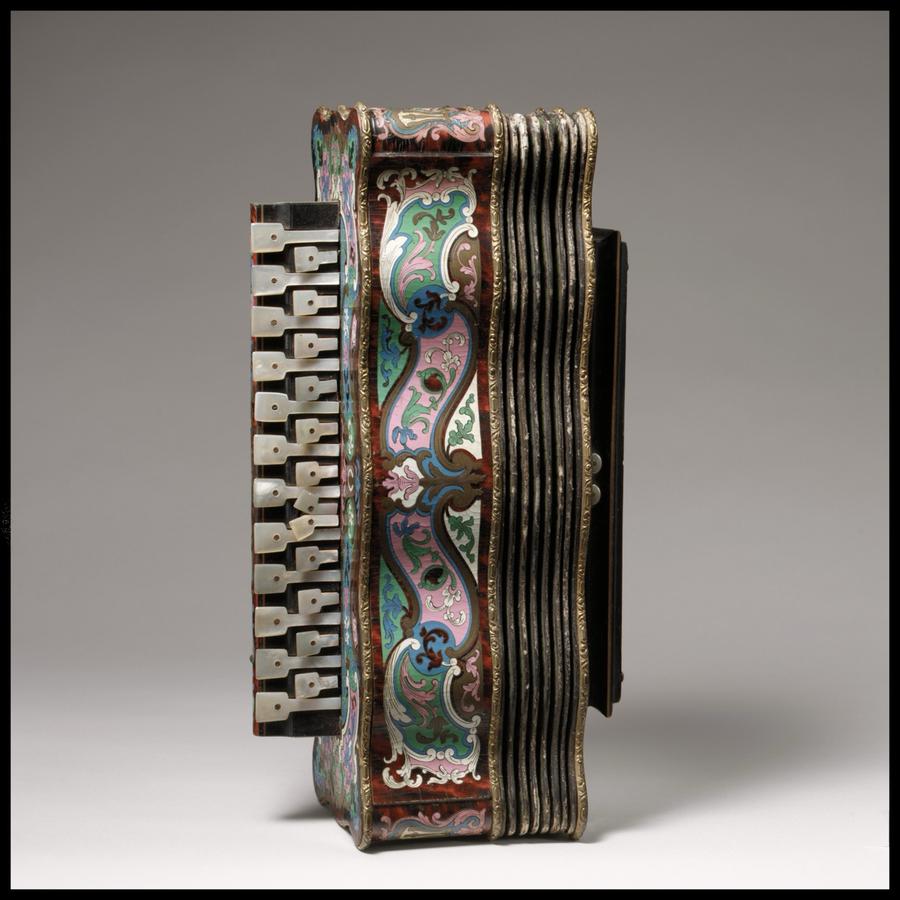
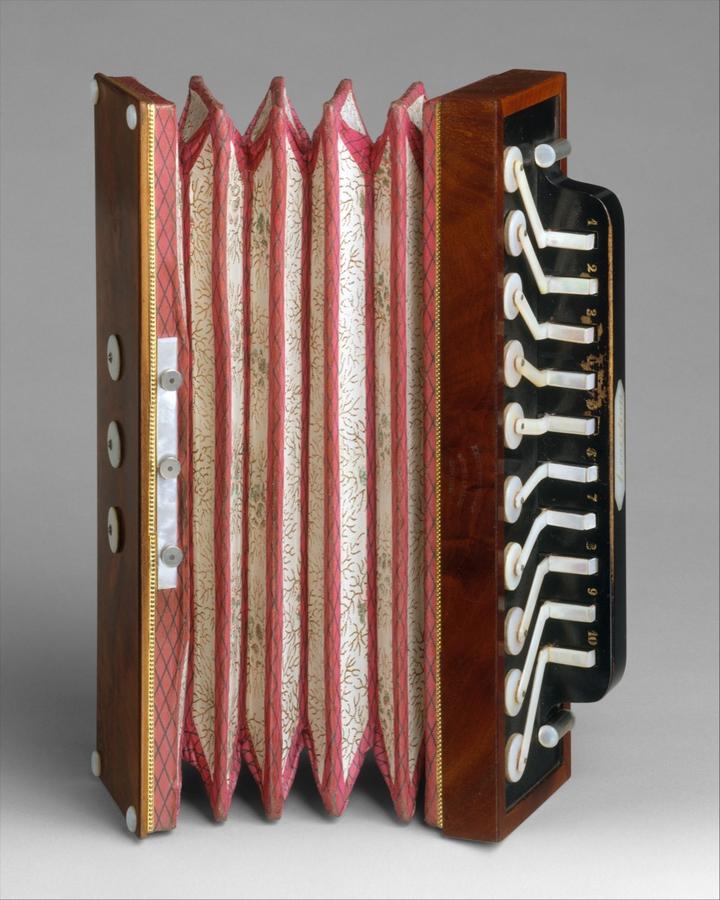
Accordion1850–55 · French (France) -
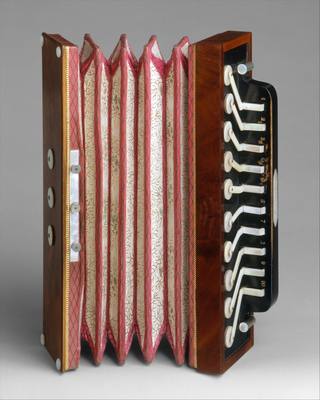
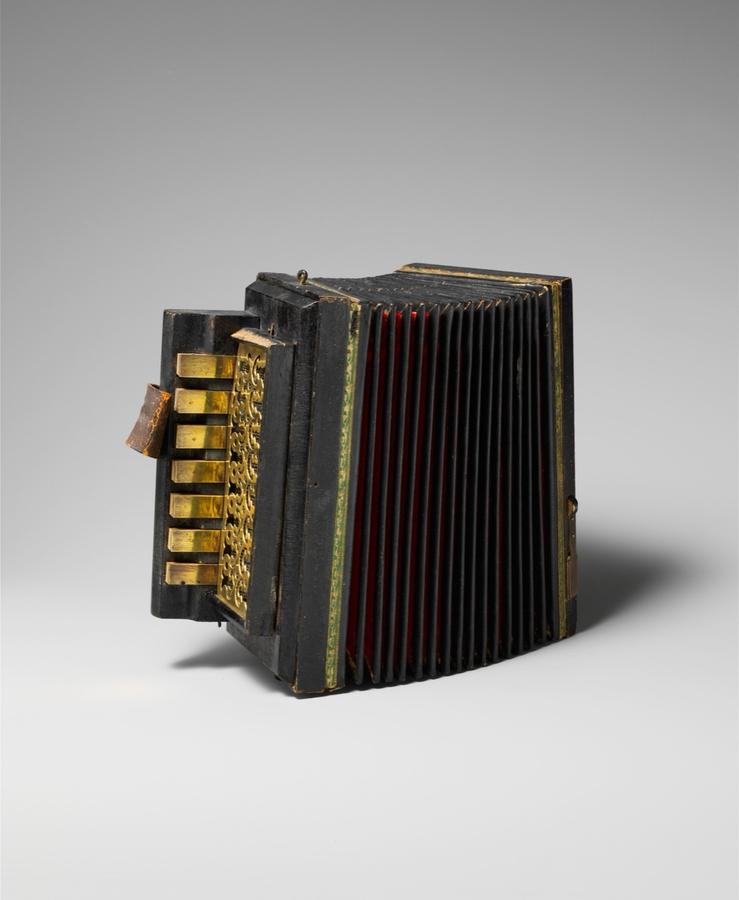
Accordionca. 1835 · British (United Kingdom) -
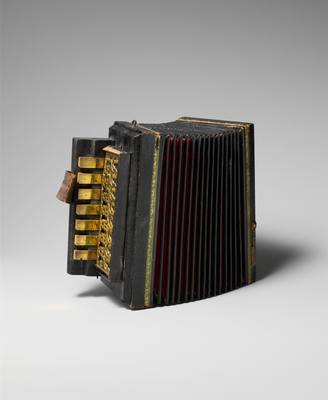
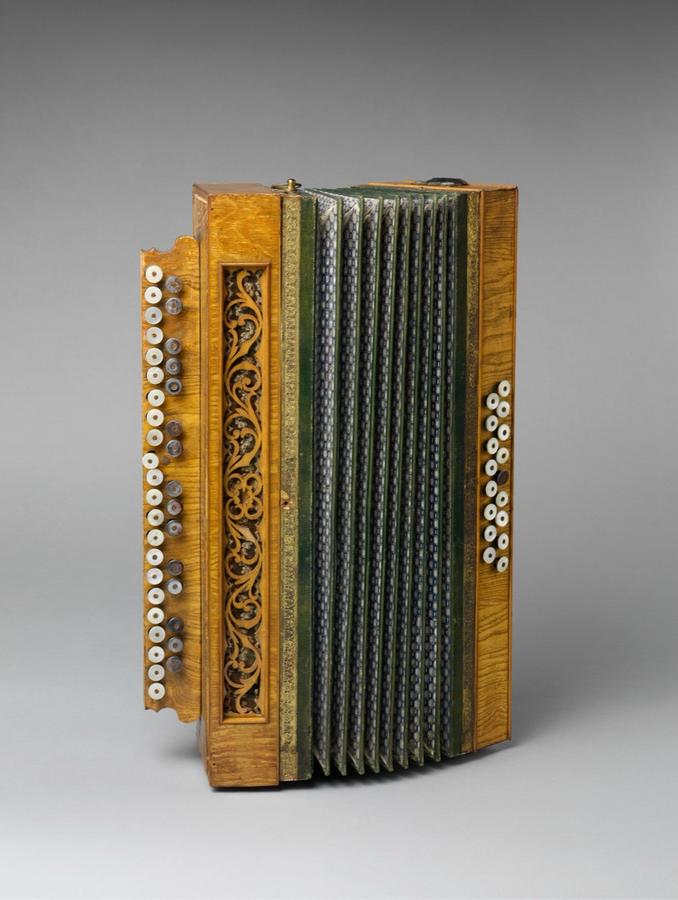
Accordion1870–80 · Russian (Russia) -
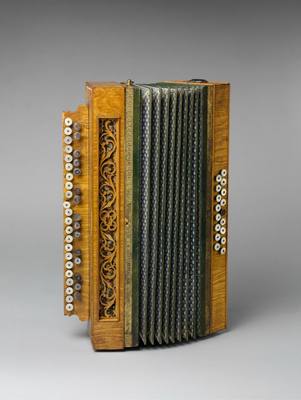
Accordionca. 1890 · Possibly Belgian (Belgium?)
Facts at a glance
| Hornbostel–Sachs number | 412.132, 412.132-62-8 — Free reed aerophone |
|---|---|
| Hornbostel–Sachs group | Aerophones › Free aerophones › Interruptive free aerophones |
| Also known as | musette-type, Accordion |
| Developed | Early 19th century |
| Wikidata labels | 112 languages |
| Wikipedia article | Accordion |
| Wikidata item | Q79838 |
| Wikimedia Commons category | Accordions |
| MusicBrainz instrument | bdf08ac2-b9c2-4391-85e5-9a7716bdd690 |
| Encyclopaedia Britannica | art/accordion |
| Audio sample (Wikimedia Commons) | AccordionBellowsSounds.ogg |
Sources: Wikidata (CC0 1.0) — classification number, aliases, identifiers (dump of 2026-07-22); Wikipedia (CC BY-SA 4.0) — infobox fields (description of the classification number, development, inventors) and the names of the Hornbostel–Sachs groups (article “Hornbostel–Sachs”, revision of 2026-01-04).
The name in other languages
| Language | Name | Also written |
|---|---|---|
| English | accordion | musette-type |
| French | accordéon | akordeons, fisarmonica, akkordeon |
| German | Akkordeon | Kwetschn, Handorgel, Ziehorgel |
| Spanish | acordeón | acordeones, acordeon, acordeon a piano |
| Italian | fisarmonica | fisarmoniche |
| Portuguese | acordeão | acordeom, acordionista, acordeon |
| Dutch | accordeon | squeeze-box, accordion |
| Russian | аккордеоны | баяны, гармоники |
| Japanese | アコーディオン | 手風琴 |
| Chinese | 手风琴 | 手風琴 |
| Korean | 아코디언 | 수풍금, 손풍금 |
| Arabic | أكورديون | أوكورديون, الأكورديون, اكورديون |
Sources: Wikidata (CC0 1.0) — labels and aliases; MusicBrainz (CC0 1.0) — instrument aliases (names only).
About the accordion: history, construction and playing
Accordions (from 19th-century German Akkordeon, from Akkord—"musical chord, concord of sounds") are a family of box-shaped musical instruments of the bellows-driven free reed aerophone type (producing sound as air flows past a reed in a frame). The essential characteristic of the accordion is to combine in one instrument a melody section, also called the diskant, usually on the right-hand keyboard, with an accompaniment or basso continuo functionality on the left-hand. The musician normally plays the melody on buttons or keys on the right-hand side (referred to as the keyboard or sometimes the manual), and the accompaniment on bass or pre-set chord buttons on the left-hand side. A person who plays the accordion is called an accordionist.
The accordion belongs to the free-reed aerophone family. Other instruments in this family include the concertina, harmonica, and bandoneon. The concertina and bandoneon do not have the melody–accompaniment duality. The harmoneon is also related and, while having the descant vs. melody dualism, tries to make it less pronounced. The harmonium and American reed organ are in the same family, but are typically larger than an accordion and sit on a surface or the floor.
The accordion is played by compressing or expanding the bellows while pressing buttons or keys, causing pallets to open, which allow air to flow across strips of brass or steel, called reeds. These vibrate to produce sound inside the body. Valves on opposing reeds of each note are used to make the instrument's reeds sound louder without air leaking from each reed block.
Original name
The oldest name for this group of instruments is harmonika, from the ἁρμονικός meaning "harmonic, musical".
Today, native versions of the name accordion are more common. These names refer to the type of accordion patented by Cyrill Demian, which concerned "automatically coupled chords on the bass side".
History
The accordion's basic form is believed to have been invented in Berlin, in 1822, by Christian Friedrich Ludwig Buschmann, although one instrument was discovered in 2006 that appears to have been built earlier.
The accordion is one of several European inventions of the early 19th century that use free reeds driven by a bellows. An instrument called accordion was first patented in 1829 by Cyrill Demian in Vienna.
Cyrill Demian's instrument bore little resemblance to modern instruments. It only had a left-hand buttonboard, with the right hand simply operating the bellows. One key feature for which Demian sought the patent was the sounding of an entire chord by depressing one key. His instrument could also sound two chords with the same key, one for each bellow direction (a bisonoric action). At that time in Vienna, mouth harmonicas with Kanzellen (chambers) had already been available for many years, along with bigger instruments driven by hand bellows. The diatonic key arrangement was also already used on mouth-blown instruments. Demian's patent thus covered an accompanying instrument: an accordion played with the left hand, opposite to how contemporary chromatic hand harmonicas were played, small and light enough for travelers to take with them and used to accompany singing. The patent also described instruments with both bass and treble sections, although Demian preferred the bass-only instrument owing to its cost and weight advantages.
The accordion was introduced from Germany into Britain in about the year 1828. The instrument was noted in The Times in 1831 as one new to British audiences and was not favourably reviewed, but nevertheless it soon became popular. It had also become popular with New Yorkers by the mid-1840s.
Construction
Accordions have many configurations and types. What may be easy to do with one type of accordion could be technically challenging or impossible with another, and proficiency with one layout may not translate to another.
The most obvious difference between accordions is their right-hand sides. Piano accordions use a piano-style musical keyboard; button accordions use a buttonboard. Button accordions are furthermore differentiated by their usage of a chromatic or diatonic buttonboard for the right-hand side.
Accordions may be either bisonoric, producing different pitches depending on the direction of bellows movement, or unisonoric, producing the same pitch in both directions. Piano accordions are unisonoric. Chromatic button accordions also tend to be unisonoric, while diatonic button accordions tend to be bisonoric, though notable exceptions exist.
Accordion size is not standardized, and may vary significantly from model to model. Accordions vary not only in their dimensions and weight, but also in the number of buttons or keys present in the right- and left-hand keyboards. For example, piano accordions may have as few as 8 bass buttons (two rows of four), or up to 140 (seven rows of twenty) or beyond. Accordions also vary by their available registers and by their specific tuning and voicing.
Despite these differences, all accordions share several common components.
Bellows
The bellows is the most recognizable part of the instrument, and the primary means of articulation. The production of sound in an accordion is in direct proportion to the motion of the bellows by the player. In a sense, the role of the bellows can be compared to the role of moving a violin's bow on bowed strings. For a more direct analogy, the bellows can be compared to the role of breathing for a singer. The bellows is located between the right- and left-hand keyboards, and is made from pleated layers of cloth and cardboard, with added leather and metal. It is used to create pressure and vacuum, driving air across the internal reeds and producing sound by their vibrations, applied pressure increases the volume.
The keyboard touch is not expressive and does not affect dynamics: all expression is effected through the bellows. Bellows effects include:
- Volume control, including swells and fades
- Repeated short, rapid changes of direction ("bellows shake"), which has been popularized by musicians such as Renato Borghetti (gaucho music) and Luiz Gonzaga, and extensively used in Forró, called resfulego in Brazil
- Constant bellows motion while applying pressure at intervals
- Constant bellows motion to produce clear tones with no resonance
- Subtly changing the intonation to mimic the expressiveness of a singer
- Using the bellows with the silent air button gives the sound of air moving ("whooshing"), which is sometimes used in contemporary compositions for this instrument
Body
The accordion's body consists of two boxes, commonly made of wood, joined by the bellows. These boxes house reed chambers for the right- and left-hand keyboards. Each side has grilles in order to facilitate the transmission of air in and out of the instrument and to allow the sound to project. The grille at the right-hand side is usually larger and is often shaped for decorative purposes. The right-hand keyboard is normally used for playing the melody and the left-hand one for playing the accompaniment; however, skilled players can reverse these roles and play melodies with the left hand.
The size and weight of an accordion varies depending on its type, layout and playing range, which can be as small as to have only one or two rows of basses and a single octave on the right-hand keyboard, to the most common 120-bass accordion and through to large and heavy 160-bass free-bass converter models.
Variable components
The term accordion covers a wide range of instruments, with varying components. All instruments have reed ranks of some format, apart from reedless digital accordions. Not all have switches to change registers or ranks, as some have only one treble register and one bass register. The most typical accordion is the piano accordion, which is used for many musical genres. Another type of accordion is the button accordion, which is used in musical traditions including Cajun, Conjunto and Tejano music, Swiss and Slovenian-Austro-German Alpine music, and Argentinian tango music. The Helikon-style accordion has multiple flared horns projecting out of the left side to strengthen the bass tone. The word "Helikon" refers to a deep-pitched tuba.
Reed ranks and switches
Inside the accordion are the reeds that generate the instrument tones. These are organized in different sounding banks, which can be further combined into registers producing differing timbres. All but the smaller accordions are equipped with switches that control which combination of reed banks operate, organized from high to low registers. Each register stop produces a separate sound timbre, many of which also differ in octaves or in how different octaves are combined. See the accordion reed ranks and switches article for further explanation and audio samples. All but the smaller accordions usually have treble switches. The larger and more expensive accordions often also have bass switches to give options for the reed bank on the bass side.
Classification of chromatic and piano type accordions
In describing or pricing an accordion, the first factor is size, expressed in number of keys on either side. For a piano type, this could for one example be 37/96, meaning 37 treble keys (three octaves plus one note) on the treble side and 96 bass keys. A second aspect of size is the width of the white keys, which means that even accordions with the same number of keys have keyboards of different lengths, ranging from 14 in for a child's accordion to 19 in for an adult-sized instrument. After size, the price and weight of an accordion is largely dependent on the number of reed ranks on either side, either on a cassotto or not, and to a lesser degree on the number of combinations available through register switches. The next, but important, factor is the quality of the reeds, the highest grade called "a mano" (meaning "hand-made"), the next "tipo a mano" ("like hand-made"), lower grades including "export" and several more.
Price is also affected by the use of costly woods, luxury decorations, and features such as a palm switch, grille mute, and so on. Some accordion makers sell a range of different models, from a less-expensive base model to a more costly luxury model. Typically, the register switches are described as Reeds: 5 + 3, meaning five reeds on the treble side and three on the bass, and Registers: 13 + M, 7, meaning 13 register buttons on the treble side plus a special "master" that activates all ranks, like the "tutti" or "full organ" switch on an organ, and seven register switches on the bass side. Another factor affecting the price is the presence of electronics, such as condenser microphones, volume and tone controls, or MIDI sensors and connections.
Source: Wikipedia, “Accordion” — CC BY-SA 4.0 — text excerpted as published (references, images and tables removed); see the article for the full text and the list of authors. Revision of 2026-06-09.
Composers who played it
22 composers on this site list the accordion as an instrument they played. A selection:
- Blaž Arnič 1901–1970
- John Serry Sr. 1915–2003
- Tony Muréna 1915–1971
- Robert Davine 1924–2001
- Manos Hatzidakis 1925–1994
- Francis Lai 1932–2018
- Pauline Oliveros 1932–2016
- Nachum Heiman 1934–2016
- Armando Manzanero 1935–2020
- Aníbal Velásquez 1936–
- Benny Andersson 1946–
- Gérard Grisey 1946–1998
Composers with a page on this site whose Wikidata record lists this instrument; featured and best-dated first. Data: Wikidata (property “instrument”, P1303), CC0 1.0.
Sources and licences
- Accordion, Alexandre Pere & Fils, 1850–55, French (France). Wood, metal, mastic, brass, tortoiseshell, gilt brass, mother-of-pearl, silver foil. Funds from various donors, 1998 (1998.70). Museum record · CC0 1.0 (public domain dedication)
- Accordion, ca. 1835, British (United Kingdom). Mahogany, tortoiseshell, paper, leather. Purchase, Robert Alonzo Lehman Bequest, 2003 (2003.379a, b). Museum record · CC0 1.0 (public domain dedication)
- Accordion, 1870–80, Russian (Russia). Various materials. The Crosby Brown Collection of Musical Instruments, 1889 (89.4.1308). Museum record · CC0 1.0 (public domain dedication)
- Accordion, ca. 1890, Possibly Belgian (Belgium?). wood, mother-of-pearl, leather, paper.. The Crosby Brown Collection of Musical Instruments, 1889 (89.4.3352). Museum record · CC0 1.0 (public domain dedication)
Photographs: open-access collections of the museums named above; each is shown here reduced in size, otherwise unchanged. Text: Wikipedia (CC BY-SA 4.0), Wikidata and MusicBrainz (CC0). The full list of sources and licences is on the credits page.