
Instruments · Aerophones
Reed organ
The pump organ or reed organ is a type of organ that uses free reeds to generate sound, with air passing over vibrating thin metal strips mounted in a frame. Types include the pressure-based harmonium, the suction reed organ (which employs a vacuum system), and the Indian harmonium. Historical examples include the Kunstharmonium and the American reed organ, while earlier forms include the physharmonica and the seraphine.
Summary: Wikipedia, “Pump organ” — CC BY-SA 4.0. Revision of 2026-05-23.
Museum photographs
These 7 photographs span 1801–1900, 5 places of origin and 2 museums. 1 of them carry no date in the museum record. Every photograph is public domain or openly licensed, and links to the museum’s own record.
-
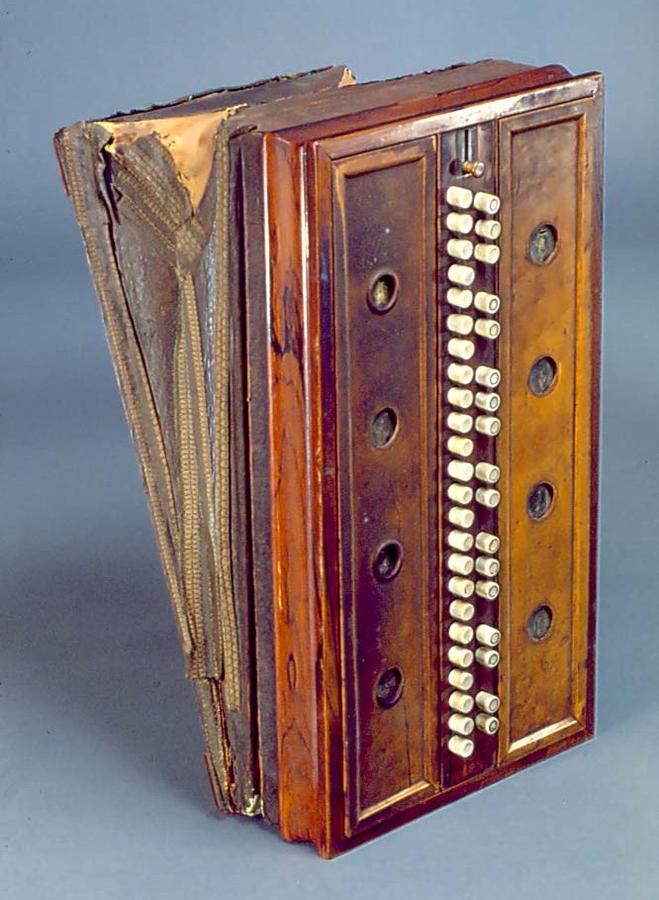
Rocking Melodeon1825 · American (United States) -
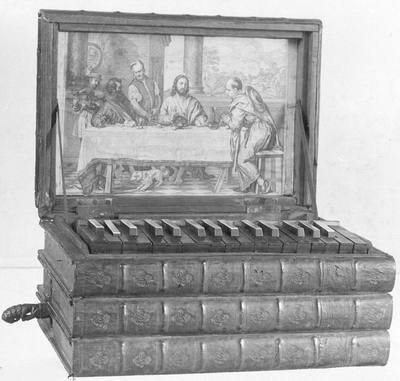
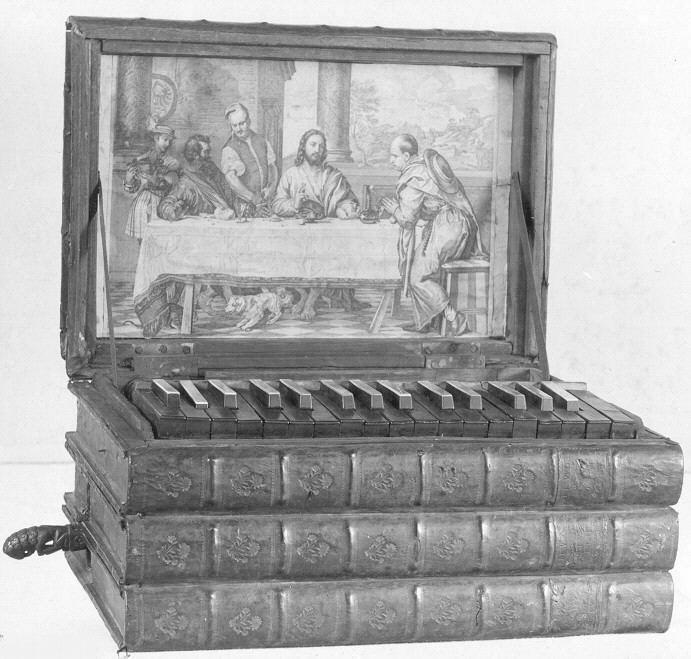
Book Harmonium19th century · French or German (France or Germany) -
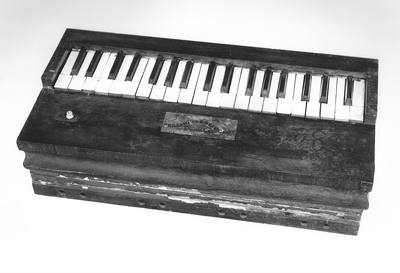
Rocking Melodeonca. 1843 · American (United States) -
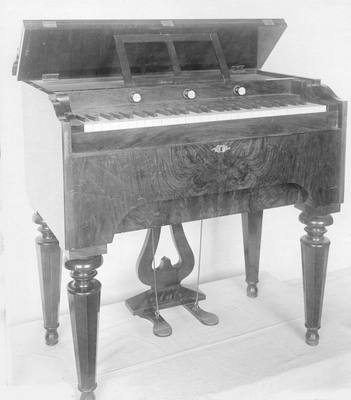
Harmoniummid-19th century · Germany -
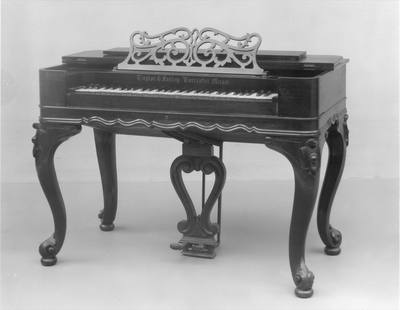
Melodeon1867 · American (United States) -
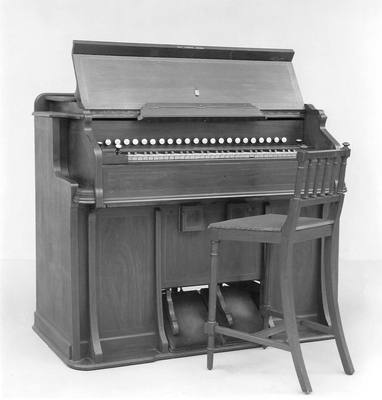
Harmoniumafter 1886 · French (France) -
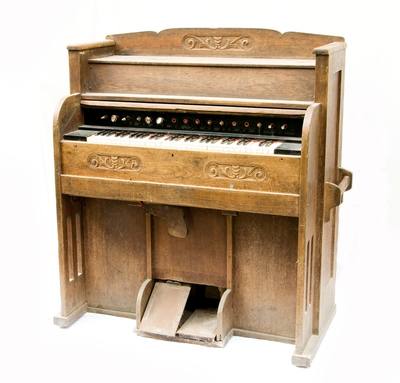
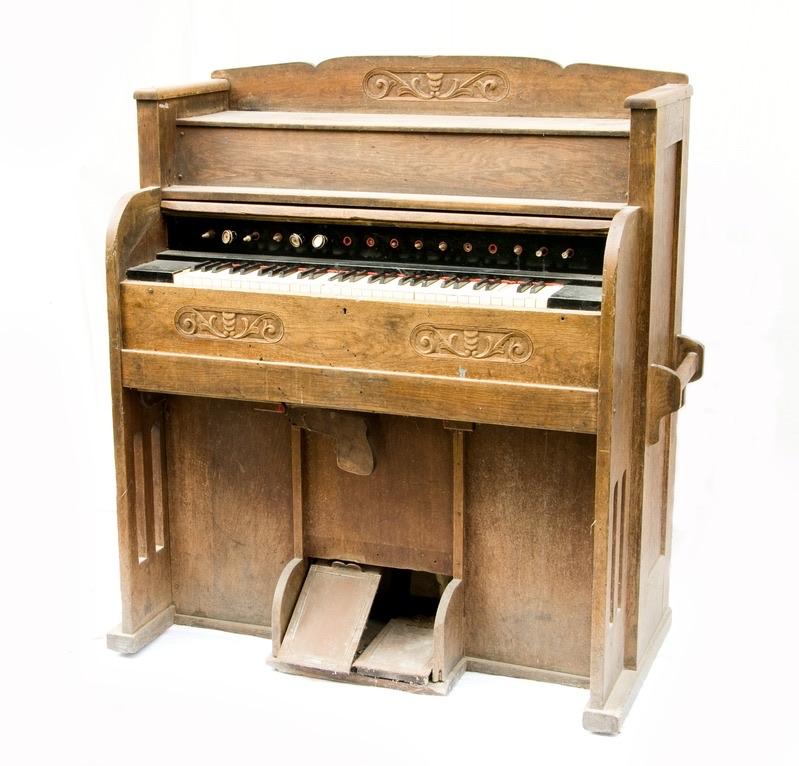
HarmoniumUndated · Estonia
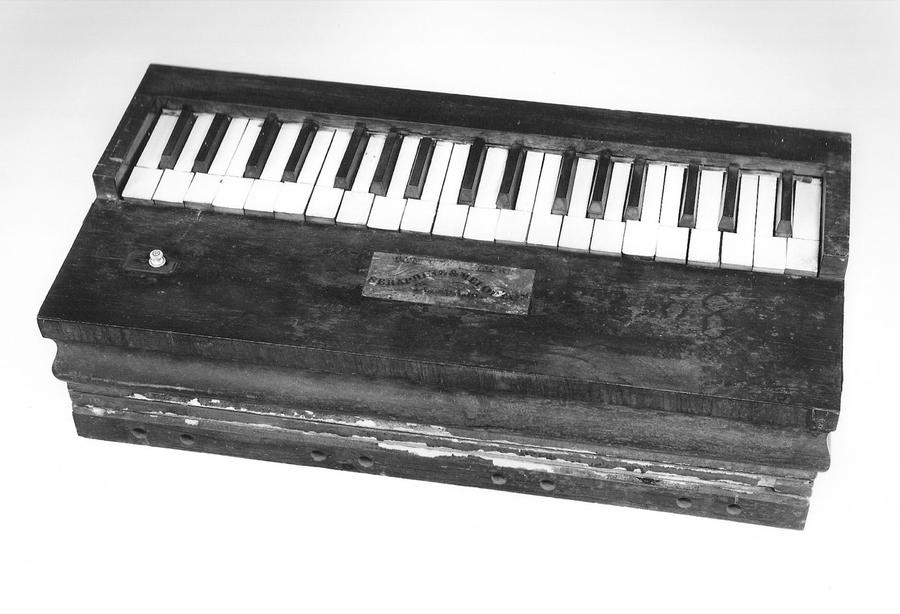
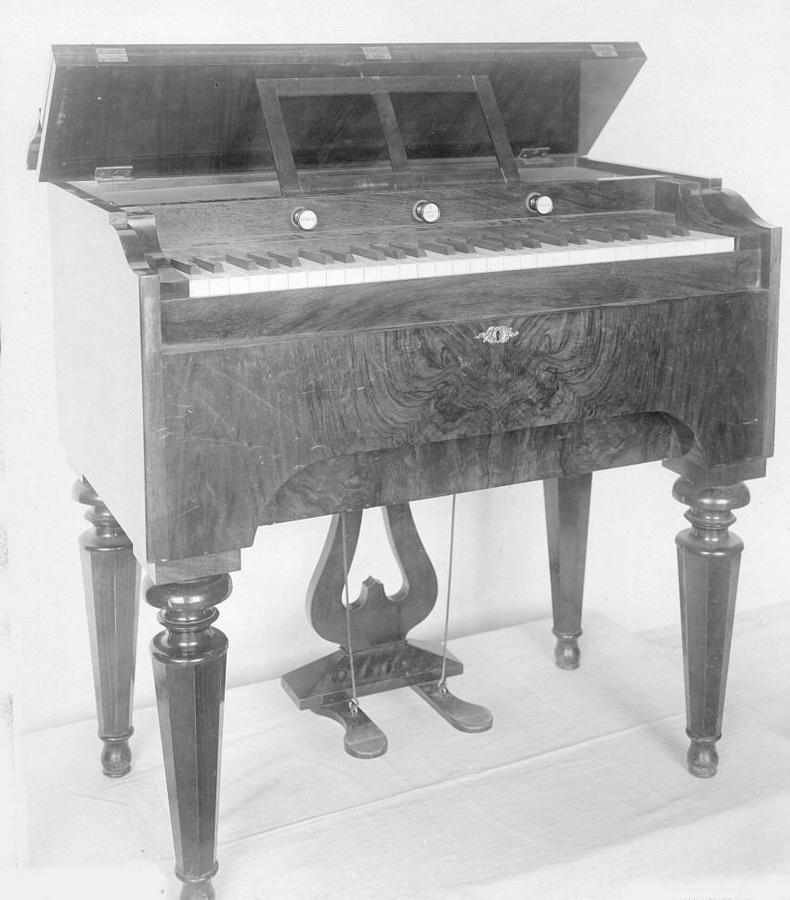
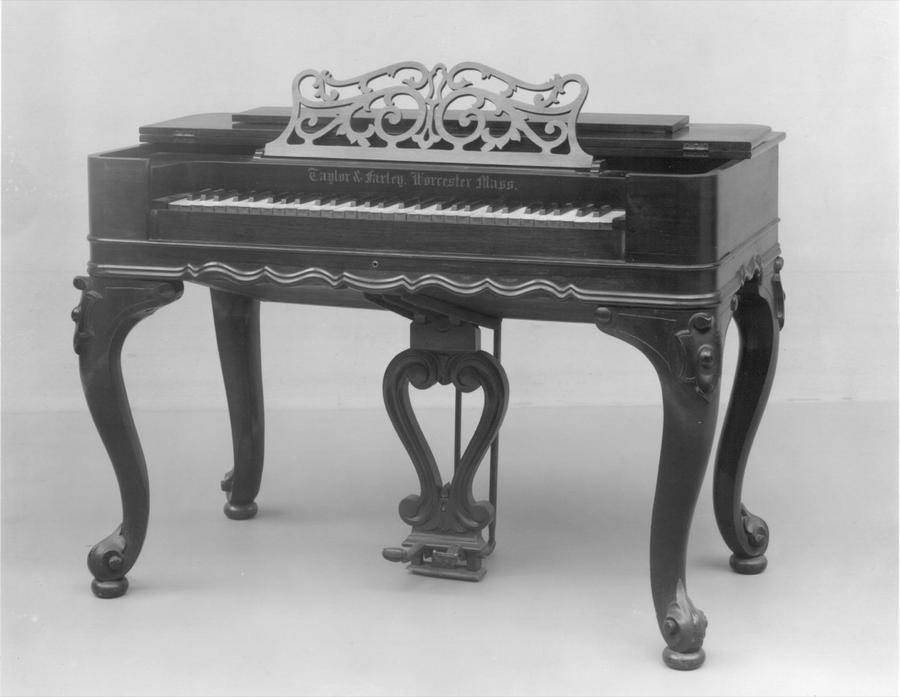
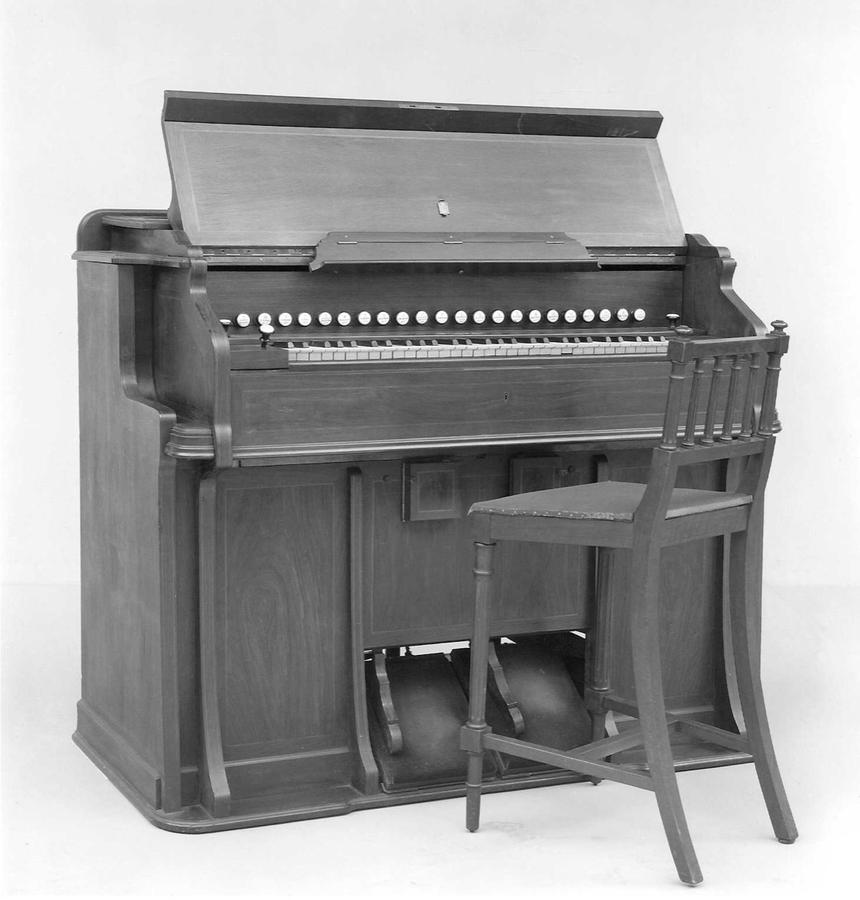
Facts at a glance
| Hornbostel–Sachs number | 412.132 — Free reed aerophone |
|---|---|
| Hornbostel–Sachs group | Aerophones › Free aerophones › Interruptive free aerophones |
| Also known as | harmonium, pump organ |
| Classification (Wikipedia infobox) | Aerophone |
| Developed | 19th century |
| Wikidata labels | 70 languages |
| Wikipedia article | Pump organ |
| Wikidata item | Q12460259 |
| Wikimedia Commons category | Pump organs |
| MusicBrainz instrument | 20443ce3-cde1-4968-b7cc-65e45bb9714f |
| Encyclopaedia Britannica | art/reed-organ |
Sources: Wikidata (CC0 1.0) — classification number, aliases, identifiers (dump of 2026-07-22); Wikipedia (CC BY-SA 4.0) — infobox fields (description of the classification number, development, inventors) and the names of the Hornbostel–Sachs groups (article “Hornbostel–Sachs”, revision of 2026-01-04).
The name in other languages
| Language | Name | Also written |
|---|---|---|
| English | reed organ | harmonium, pump organ, melodeon |
| French | harmonium | orgue-expressif |
| German | Harmonium | |
| Spanish | armonio | Órgano de bomba, harmonio, armonium |
| Italian | armonium | armonio, harmonium, organo a pompa |
| Portuguese | harmônio | |
| Dutch | harmonium | harmonium (instrument), rietorgel |
| Russian | язычковый орган | фисгармония, фисгармоника, гармониум |
| Japanese | リード オルガン | ハーモニウム |
| Chinese | 簧风琴 | 簧風琴 |
| Korean | 하모늄 | |
| Arabic | القدمية |
Sources: Wikidata (CC0 1.0) — labels and aliases; MusicBrainz (CC0 1.0) — instrument aliases (names only).
About the reed organ: history, construction and playing
The pump organ or reed organ is a type of organ that uses free reeds to generate sound, with air passing over vibrating thin metal strips mounted in a frame. Types include the pressure-based harmonium, the suction reed organ (which employs a vacuum system), and the Indian harmonium. Historical examples include the Kunstharmonium and the American reed organ, while earlier forms include the physharmonica and the seraphine.
More portable than pipe organs, free-reed organs became widespread in smaller churches and private homes during the 19th century, although their volume and tonal range were limited. They generally featured one, or occasionally two, manuals, while pedal-boards were rare. Higher-end pump organs offered a broader range of tones, and models intended for churches or affluent households were often housed in finely crafted cabinets.
Between the 1850s and the 1920s, several million reed organs and melodeons were manufactured in the United States and Canada, with some exported abroad. Major manufacturers included the Cable Piano Company, Estey Organ, and Mason & Hamlin.
In addition to the larger, furniture-sized instruments popular in the West, more compact designs also developed. The portable, hand-pumped Indian harmonium, adapted from Western designs such as the guide-chant in the 19th century, became a central instrument across the Indian subcontinent. Today, the Indian harmonium is widely employed by Sikhs, Hindus, and Muslims for devotional music such as qawwali, ghazal, kirtan, and bhajan. It is also commonly used in Indian classical music and within Western yoga and kirtan subcultures.
History
During the first half of the 18th century, a free-reed mouth organ called a sheng was brought to Russia. The instrument attracted attention through its use by Johann Wilde. At the time, the free-reed mechanism was unknown in Europe, and the concept quickly spread westward from Russia.
Christian Gottlieb Kratzenstein (1723–1795), a professor of physiology at the University of Copenhagen, is credited with the creation of the first free-reed instrument in the Western world, having won the annual prize in 1780 from the Imperial Academy of St. Petersburg.
The first free-reed organ was built by Abbé Georg Joseph Vogler in Darmstadt after a concept suggested by Kratzenstein. The design of the harmonium, employing free reeds, derives from the earlier regal. A harmonium-like instrument was exhibited by Gabriel-Joseph Grenié (1756–1837) in 1810, which he named the orgue expressif ("expressive organ") due to its capability for greater expression, including crescendos and diminuendos.
Alexandre Debain improved Grenié's design and patented his version under the name harmonium in 1840. There was concurrent development of similar instruments. Jacob Alexandre and his son Édouard introduced the orgue mélodium in 1844. Hector Berlioz discussed it in his Grand traité d'instrumentation et d'orchestration modernes, published in Paris in [1843?] or [1844?], and reprinted in 1856 (critical edition by Peter Bloom, 2003, Bärenreiter, Vol.24). Berlioz also wrote about it in later journals (Bloom, p.472, nn. 1 & 2) and incorporated it into L'enfance du Christ, Part 1, Scene vi, where it was played off-stage. Franz Liszt performed the part during a concert conducted by Berlioz in Weimar on 21 February 1855 (Bloom, p.474, n.3).
A mechanic who had worked at Alexandre's factory emigrated to the United States and conceived the idea of a suction bellows, replacing the outward-blowing bellows. After 1885, the firm of Mason & Hamlin of Boston adopted the suction bellows, which soon became the standard construction technique in America.
The term melodeon came to be associated with concert saloons in Victorian-era America, named after the reed instrument. The word later became a general term for entertainment venues catering to men.
Reed organ in Japan
The foot pump organ (足踏みオルガン, ashibumi organ) was first introduced to Japan during the early Meiji period, brought by foreign Christian missionaries as part of their evangelisation efforts. Initially used in churches and schools, the reed organ quickly became an important tool for music education, offering Japanese people their first widespread exposure to Western musical instruments.
The first domestically manufactured reed organs were produced by Nishikawa Organ Company in Yokohama. Shortly thereafter, Yamaha founder Torakusu Yamaha, originally a medical equipment repairman, began manufacturing reed organs in Hamamatsu following his successful repair of an imported American model. These efforts helped establish Hamamatsu as a major centre for musical instrument production in Japan.
Throughout the late 19th and early 20th centuries, reed organs were installed in schools nationwide and became central to public singing education. Their affordability, durability, and relatively simple maintenance compared to pianos made them ideal for widespread use. By the early Shōwa period, reed organs were a familiar fixture in most Japanese elementary schools, contributing significantly to the spread of Western music literacy.
Domestically produced reed organs ranged from simple, affordable models with 39 or 49 keys to larger, more elaborate designs with multiple stops, swells, and even pedalboards, primarily intended for teacher training colleges and music schools.
Although the popularity of reed organs declined after the mid-20th century with the rise of more accessible pianos and electronic instruments, they remain fondly remembered by generations who grew up with them. Today, institutions such as the Hamamatsu Museum of Musical Instruments preserve and exhibit historical reed organs, celebrating their cultural and educational significance in Japan's modernisation and musical history.
In several Asian countries, particularly former Japanese colonies such as Taiwan and South Korea, the use of treadle-operated reed organs became widespread under Japanese influence.
Reed organ in China
In China, the reed organ was introduced around 1897. Following the Opium Wars, the spread of Christianity and the increasing presence of European expatriates contributed to the broader dissemination of Western music. Church schools, in particular, played a major role in introducing European musical forms, such as hymns, salon music, and elementary piano pieces.
In 1872, Christian missionary J. D. Collins published the Hymn Book through the American Presbyterian Mission Press in Shanghai, featuring over 360 religious hymns with musical notation, alongside an introduction to Western musical theory, all employing the five-line staff notation system. In 1883, British missionary Timothy Richard published the Supplement to Hymns, which incorporated familiar Chinese folk melodies to facilitate religious outreach.
The activities of these missionaries contributed positively to the early development of Western music education in China.
It is beyond doubt that, at one point, the People's Republic of China was very likely the country where the pump organ was most widely used. Following the establishment of the People's Republic of China, treadle-operated reed organs gained renewed popularity as affordable tools for mass music education. Factories were established in various cities to produce reed organs, such as the "Danfeng" Organ Factory in Shanghai and the "Baihua" Organ Factory in Sichuan. It became common for primary school teachers, particularly female teachers, to be trained in reed organ playing to support classroom music education.
By the 1990s, however, reed organs were gradually supplanted by pianos in Chinese primary and secondary schools as the primary instrument for music instruction. Today, many treadle-operated reed organs in mainland China have been dismantled, although a small number of artisanal workshops continue to produce new instruments, primarily for enthusiasts who collect and perform with them.
Acoustics
"Among musical instruments, the harmonium, on account of its uniformly sustained tone, the piercing character of its quality of tone, and its tolerably distinct combinational tones, is particularly sensitive to inaccuracies of intonation. And as its vibrators also admit of a delicate and durable tuning, it appeared to me peculiarly suitable for experiments on a more perfect system of tones."
Using two manuals and two differently tuned stop sets, Helmholtz was able to compare Pythagorean, just, and equal temperament tunings simultaneously, and observe the varying degrees of inharmonicity inherent in different temperaments. He subdivided the octave into 28 tones, allowing modulation in just intonation across 12 minor and 17 major keys without encountering the harsh dissonances typically caused by standard octave divisions. This system, however, proved difficult to play. Additional modified instruments were constructed for experimental use, notably Bosanquet's Generalised keyboard (1873) for a 53-tone scale, employing 84 keys for easier fingering. Another notable experimental reed organ was built by Poole.
Lord Rayleigh also used the harmonium to devise a method of indirectly measuring frequencies, using approximated equal temperament intervals and their overtone beats. The harmonium's clear overtones enabled reliable beat counting by two listeners, although Rayleigh acknowledged that maintaining constant pressure in the bellows was difficult and could cause pitch fluctuation.
In tone generation, a reed organ is similar to an accordion or concertina, but differs in installation; while accordions are hand-held, reed organs are typically placed on the floor within a wooden casing (which may initially resemble a piano). Reed organs are operated using either pressure or suction bellows. Pressure bellows allow greater dynamic control through varying pedalling speed. In North America and Britain, pressure-bellows organs are termed harmoniums, while in continental Europe, any reed organ is generally referred to as a harmonium, regardless of its bellows type. Because pressure-bellows instruments were more complex and expensive to produce, most North American and British reed organs and melodeons employed suction bellows.
The frequencies produced by reed organs are influenced by the blowing pressure: the fundamental frequency slightly decreases under medium pressure compared to low pressure, but increases again at high pressures, particularly for bass notes. Measurements have shown sinusoidal oscillations of the reed with sharp transitions when it bends through its frame.
Repertory
The harmonium was considered by Curt Sachs to be an important instrument for music of Romanticism (1750s–1900), which "vibrated between two poles of expression" and "required the overwhelming power and strong accents of wind instruments".
Harmonium compositions are available by European and American composers of classical music. It was also used often in the folk music of the Appalachians and South of the United States.
Harmoniums played a significant part in the new rise of Nordic folk music, especially in Finland. In the late 1970s, a harmonium could be found in most schools where the bands met, and it became natural for the bands to include a harmonium in their setup. A typical folk band then—particularly in Western Finland—consisted of violin(s), double bass and harmonium. There was a practical limitation that prevented playing harmonium and accordion in the same band: harmoniums were tuned to 438 Hz, while accordions were tuned to 442 Hz. Some key harmonium players in the new rise of Nordic folk have been Timo Alakotila and Milla Viljamaa.
In the Netherlands, the introduction of the harmonium triggered a boom in religious house music. Its organ-like sound quality allowed Reformed families to sing psalms and hymns at home. Many new hymns were composed expressly for voice and harmonium, notably those by Johannes de Heer.
Source: Wikipedia, “Pump organ” — CC BY-SA 4.0 — text excerpted as published (references, images and tables removed); see the article for the full text and the list of authors. Revision of 2026-05-23.
From Grove’s Dictionary (1900)
HARMONIUM (French, also Orgue expressif). A well-known popular keyed instrument, the tones of which are produced by thin tongues of brass or steel, set in periodic motion by pressure of air, and called 'vibrators.' They are known also as 'free reeds'; reeds, because their principle is that of the shepherd's pipe; free, because they do not entirely close the openings in which they vibrate at any period of their movement, while those generally used in the organ, known as 'beating or striking reeds,' close the orifice at each pulsation. It is not however the vibration of the tongue itself that we hear as the tone: according to Helmholtz this is due to the escape of the air in puffs near its point, the rapidity of alternation of the puffs determining the pitch. The timbre of the note is conditioned in the first place by this opening, and then by the size and form of the channel above the tongue and its pallet hole, through which the air immediately passes. The Harmonium is the most modern of keyed instruments, if we include the nearly related American Organ, in which the vibrator is set in motion by reverse power, that is by drawing in the air; for if we go back to the earliest attempts to make instruments of the kind we are still within the I9th century. The usefulness and convenience of the harmonium have gone far to establish it, almost as a rival, in a commercial sense, to the pianoforte. It has been too much the practice to regard the harmonium only as a handy substitute for the organ, and this has been fostered by interested persons to the detriment of its individuality and the loss of the perception that it has reason to exist from its own merits as a musical instrument. It is true that like the organ the tones of the harmonium may be sustained at one power so long as the keys are kept down, and variety of timbre is obtained by using the stops; but when the Expression stop is used, by which the air reservoir is cut off and the pressure made to depend entirely upon the management of the bellows, the harmonium gains the power of increase and decrease of tone under the control of the player, who by the treadles can graduate the condensation of the wind almost as a violin-player manages his tone by the bow. To use this power artistically the harmonium-player must have skill; and few take to this instrument with anything like the high technical aim with which the pianoforte and violin are studied. There is however no reason that there should not be a school of composers and players competent to realise and develop the individual character of the instrument.
Source: Wikisource, A Dictionary of Music and Musicians (Grove, 1900) — “Harmonium” (entry by A. J. Hipkins) — Public domain (published 1879–1910; authors died before 1929) — the first paragraphs of the entry, as transcribed; see the page for the full entry.
Sources and licences
- Rocking Melodeon, Abraham Prescott, 1825, American (United States). Wood, various materials. The Crosby Brown Collection of Musical Instruments, 1889 (89.4.1194). Museum record · CC0 1.0 (public domain dedication)
- Book Harmonium, 19th century, French or German (France or Germany). Wood, various materials. The Crosby Brown Collection of Musical Instruments, 1889 (89.4.1668). Museum record · CC0 1.0 (public domain dedication)
- Rocking Melodeon, Caleb Packard, ca. 1843, American (United States). Wood, various materials. The Crosby Brown Collection of Musical Instruments, 1889 (89.4.1522). Museum record · CC0 1.0 (public domain dedication)
- Harmonium, F. Kaufmann & Sohn; Ph. I. Trayser & Co., mid-19th century, Germany. Wood, various materials. The Crosby Brown Collection of Musical Instruments, 1889 (89.4.3553). Museum record · CC0 1.0 (public domain dedication)
- Melodeon, Taylor & Farley, 1867, American (United States). Wood, various materials. Gift of Mrs. Russell Law, 1945 (45.54). Museum record · CC0 1.0 (public domain dedication)
- Harmonium, Victor and Auguste Mustel, after 1886, French (France). Wood, various materials. Gift of Miss Helen Sears through Mrs. Alma Birmingham (44.59a, b). Museum record · CC0 1.0 (public domain dedication)
- Harmonium, Undated, Estonia. Foundation of Hiiumaa Museum / Estonian e-Repository and Conservation of Collections (via Europeana). Museum record · CC0 1.0 (public domain dedication)
Photographs: open-access collections of the museums named above; each is shown here reduced in size, otherwise unchanged. Text: Wikipedia (CC BY-SA 4.0), Grove’s Dictionary (public domain), Wikidata and MusicBrainz (CC0). The full list of sources and licences is on the credits page.