
Instruments · Membranophones
Timpani
The timpani or kettledrums (also informally called timps) are musical instruments in the percussion family. A type of drum categorised as a hemispherical drum, they consist of a membrane called a head stretched over a large bowl traditionally made of copper. Thus, timpani are an example of kettledrums, also known as vessel drums and semispherical drums, whose body is similar to a section of a sphere whose cut conforms the head. Most modern timpani are pedal timpani and can be tuned quickly and accurately to specific pitches by skilled players through the use of a movable foot-pedal. They are played by striking the head with a specialized beater called a timpani stick or timpani mallet. Timpani evolved from military drums to become a staple of the classical orchestra by the last third of the 18th century. Today, they are used in many types of ensembles, including concert bands, marching bands, orchestras, and even in some rock bands.
Summary: Wikipedia, “Timpani” — CC BY-SA 4.0. Revision of 2026-07-01.
Museum photographs
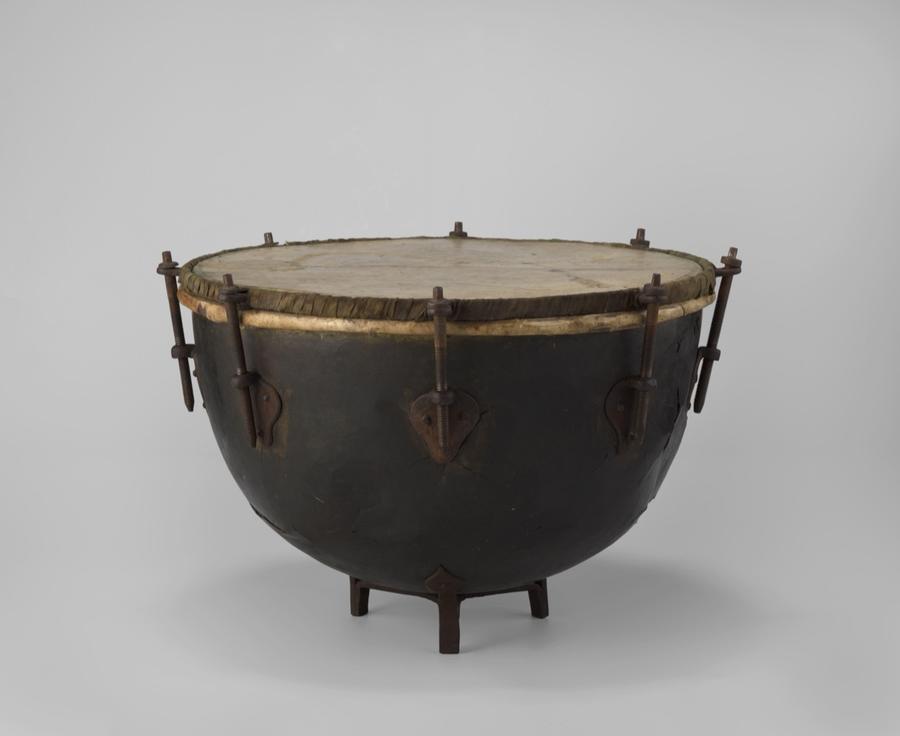
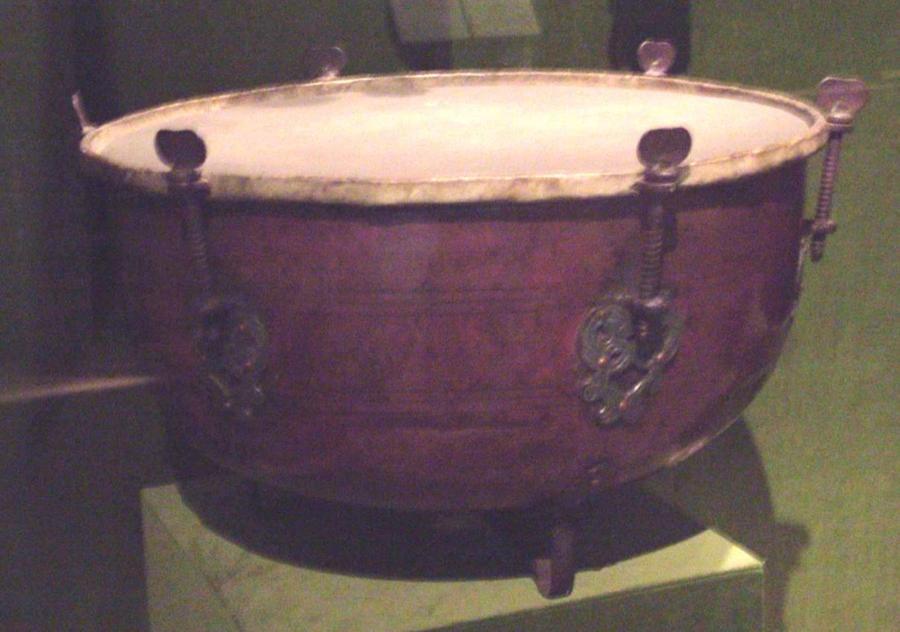
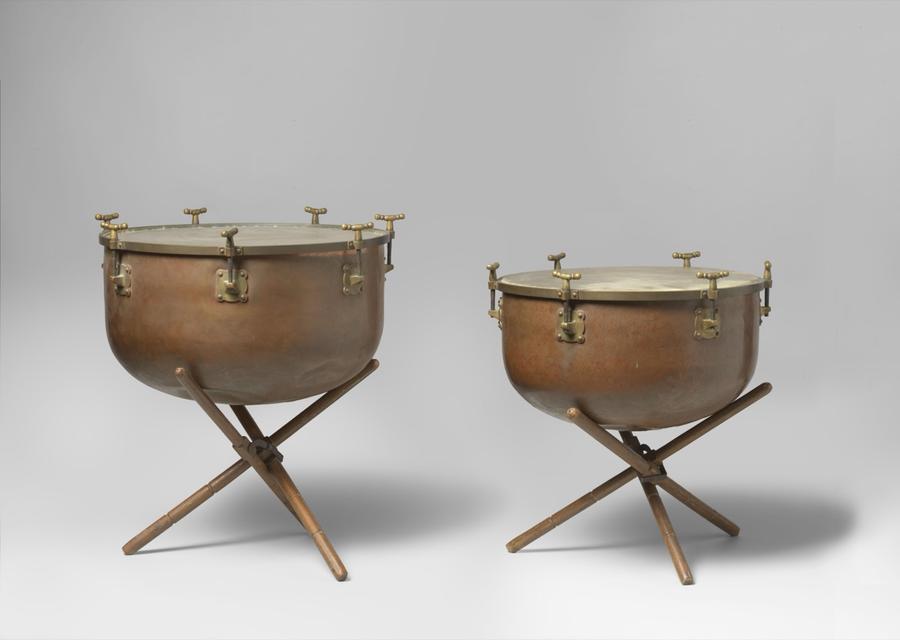
These 4 photographs span 1700–1899, 1 place of origin and 2 museums. Every photograph is public domain or openly licensed, and links to the museum’s own record.
-
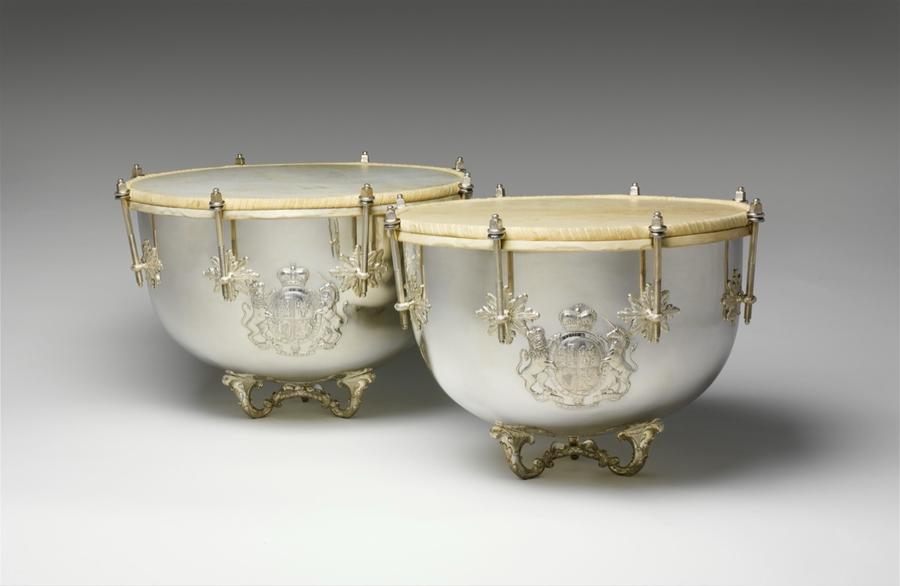
Kettle Drums1780 · Hanoverian (German) (Germany) -
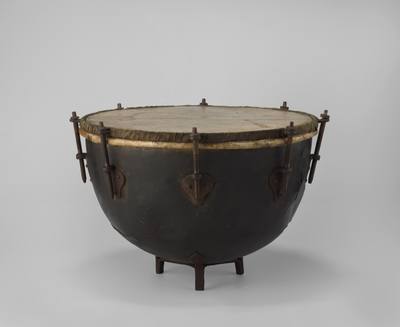
Kettledrumc. 1700 - c. 1800 · Europe -
Kettledrumlate 18th century (?) · probably German (Germany?) -
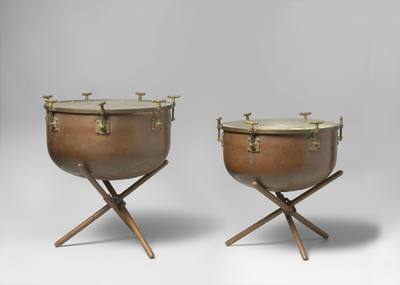
Kettle drums1850 - 1899 · Europe
Facts at a glance
| Hornbostel–Sachs number | 211.11-922 — (Separate) kettledrums |
|---|---|
| Hornbostel–Sachs group | Membranophones › Struck membranophones › Directly struck membranophones |
| Also known as | kettledrums, timps, timpano, tympani, kettledrum, tympany, timpany, kettle drum, timpanum |
| Developed | at least 6th century AD |
| Wikidata labels | 72 languages |
| Wikipedia article | Timpani |
| Wikidata item | Q189737 |
| Wikimedia Commons category | Timpani |
| MusicBrainz instrument | 7d86c75c-bccd-4c9d-a73d-4bb443e5110b |
| Encyclopaedia Britannica | art/timbales |
Sources: Wikidata (CC0 1.0) — classification number, aliases, identifiers (dump of 2026-07-22); Wikipedia (CC BY-SA 4.0) — infobox fields (description of the classification number, development, inventors) and the names of the Hornbostel–Sachs groups (article “Hornbostel–Sachs”, revision of 2026-01-04).
The name in other languages
| Language | Name | Also written |
|---|---|---|
| English | timpani | kettledrums, timps, timpano |
| French | timbales | timbales symphoniques, timbale classique |
| German | Pauke | Kesselpauke, Timpano, Paukist |
| Spanish | timbal de concierto | Timbal, Timbal grande, Timpani |
| Italian | timpano | timpano sinfonico, timpano da orchestra |
| Portuguese | tímpano | |
| Dutch | pauk | pauken |
| Russian | литавры | Литавра |
| Japanese | ティンパニ | ティンパニイ, ケトルドラム, ティンパニー |
| Chinese | 定音鼓 | |
| Korean | 팀파니 | |
| Arabic | دفية | نقّارية |
Sources: Wikidata (CC0 1.0) — labels and aliases; MusicBrainz (CC0 1.0) — instrument aliases (names only).
About the timpani: history, construction and playing
The timpani or kettledrums (also informally called timps) are musical instruments in the percussion family. A type of drum categorised as a hemispherical drum, they consist of a membrane called a head stretched over a large bowl traditionally made of copper. Thus, timpani are an example of kettledrums, also known as vessel drums and semispherical drums, whose body is similar to a section of a sphere whose cut conforms the head. Most modern timpani are pedal timpani and can be tuned quickly and accurately to specific pitches by skilled players through the use of a movable foot-pedal. They are played by striking the head with a specialized beater called a timpani stick or timpani mallet. Timpani evolved from military drums to become a staple of the classical orchestra by the last third of the 18th century. Today, they are used in many types of ensembles, including concert bands, marching bands, orchestras, and even in some rock bands.
Timpani is an Italian plural, the singular of which is timpano, though the singular may also be referred to as a timpanum. In English, the term timpano is only widely used by practitioners: a single drum is often referred to as a timpani, leading many to incorrectly pluralize the word as timpanis. A musician who plays timpani is a timpanist.
Etymology and alternative spellings
First attested in English in the late 19th century, the Italian word timpani derives from the Latin tympanum (pl. tympana), which is the Latinisation of the Greek word τύμπανον (tumpanon, pl. tumpana), ‘a hand drum’, which in turn derives from the verb τύπτω (tuptō), meaning ‘to strike, to hit’. Alternative spellings with y in place of either or both is—tympani, tympany, or timpany—are occasionally encountered in older English texts. Although the word timpani has been widely adopted in the English language, some English speakers choose to use the word kettledrums. The German word for timpani is Pauken; the French and Spanish term is timbales, not to be confused with the Latin percussion instrument, which would supersede timpani in certain traditional Cuban ensembles.
Tympanum est pellis vel corium ligno ex una parte extentum. Est enim pars media symphoniae in similitudinem cribri. Tympanum autem dictum quod medium est, unde et margaritum medium tympanum dicitur; et ipsud ut symphonia ad virgulam percutitur. The tympanum is a skin or hide stretched over one end of a wooden frame. It is half of a symphonia (i.e. another type of drum) and it looks like a sieve. The tympanum is so named because it is a half, whence also the half-pearl is called a tympanum. Like the symphonia, it is struck with a drumstick.
The reference comparing the tympanum to half a pearl is borrowed from Pliny the Elder.
Basic timpani
The basic timpano consists of a drum head stretched across the opening of a bowl typically made of copper or, in less expensive models, fiberglass or aluminium. In the Hornbostel–Sachs classification, this makes timpani membranophones. The head is affixed to a hoop (also called a flesh hoop), which in turn is held onto the bowl by a counter hoop. The counter hoop is usually held in place with a number of tuning screws called tension rods placed regularly around the circumference. The head's tension can be adjusted by loosening or tightening the rods. Most timpani have six to eight tension rods.
The shape and material of the bowl's surface help to determine the drum's timbre. For example, hemispheric bowls produce brighter tones while parabolic bowls produce darker tones. Modern timpani are generally made with copper due to its efficient regulation of internal and external temperatures relative to aluminium and fiberglass.
Timpani come in a variety of sizes from about 84 cm in diameter down to piccoli timpani of 30 cm or less. A 33-inch drum can produce C2 (the C below the bass clef), and specialty piccoli timpani can play up into the treble clef. In Darius Milhaud's 1923 ballet score La création du monde, the timpanist must play F♯4 (at the bottom of the treble clef).
Heads
Like most drumheads, timpani heads can be made from two materials: animal skin (typically calfskin or goatskin) or plastic (typically PET film). Plastic heads are durable, weather-resistant, and relatively inexpensive. Thus, they are more commonly used than skin heads. However, many professional timpanists prefer skin heads because they produce a "warmer" timbre. Timpani heads are determined based on the size of the head, not the bowl. For example, a 23 in drum may require a 25 in head. This 2 in size difference has been standardized by most timpani manufacturers since 1978.
Tuning
Prior to playing, the timpanist must clear the heads by equalizing the tension at each tuning screw. This is done so every spot is tuned to exactly the same pitch. When the head is clear, the timpani will produce an in-tune sound. If the head is not clear, the pitch will rise or fall after the initial impact of a stroke, and the drum will produce different pitches at different dynamic levels. Timpanists are required to have a well-developed sense of relative pitch and must develop techniques to tune in an undetectable manner and accurately in the middle of a performance. Tuning is often tested with a light tap from a finger, which produces a near-silent note.
Some timpani are equipped with tuning gauges, which provide a visual indication of the pitch. They are physically connected either to the counterhoop, in which case the gauge indicates how far the counterhoop is pushed down, or the pedal, in which case the gauge indicates the position of the pedal. These gauges are accurate when used correctly. However, when the instrument is disturbed in some fashion (transported, for example), the overall pitch can change, thus the markers on the gauges may not remain reliable unless they have been adjusted immediately preceding the performance. The pitch can also be changed by room temperature and humidity. This effect also occurs due to changes in weather, especially if an outdoor performance is to take place. Gauges are especially useful when performing music that involves fast tuning changes that do not allow the timpanist to listen to the new pitch before playing it. Even when gauges are available, good timpanists will check their intonation by ear before playing. Occasionally, timpanists use the pedals to retune while playing.
Portamento effects can be achieved by changing the pitch while it can still be heard. This is commonly called a glissando, though this use of the term is not strictly correct. The most effective glissandos are those from low to high notes and those performed during rolls. One of the first composers to call for a timpani glissando was Carl Nielsen, who used two sets of timpani playing glissandos at the same time in his Symphony No. 4 ("The Inextinguishable").
Extended techniques
It is typical for only one timpani to be struck at a time, but occasionally composers will ask for two notes. This is called a double stop, a term borrowed from the string instrument vocabulary. Ludwig van Beethoven uses this effect in the slow third movement of his Ninth Symphony, as do Johannes Brahms in the second movement of his German Requiem and Aaron Copland in El Salón México. Some modern composers occasionally require more than two notes. In this case, a timpanist can hold two sticks in one hand, much like a marimbist, or more than one timpanist can be employed. In his Overture to Benvenuto Cellini, for example, Hector Berlioz realizes fully voiced chords from the timpani by requiring three timpanists and assigning one drum to each. He goes as far as ten timpanists playing three- and four-part chords on sixteen drums in his Requiem, although with the introduction of pedal tuning, this number can be reduced.
Modern composers will often specify the beating spot to alter the sound of the drum. When the timpani are struck directly in the center, they have a sound that is almost completely devoid of tone and resonance. George Gershwin uses this effect in An American in Paris. Struck close to the edge, timpani produce a very thin, hollow sound. This effect is used by composers such as Bartók, Bernstein, and Kodály.
A variation of this is to strike the head while two fingers of one hand lightly press and release spots near the center. The head will then vibrate at a harmonic much like the similar effect on a string instrument.
Resonance can cause timpani not in use to vibrate, causing a quieter sound to be produced. Timpanists must normally avoid this effect, called sympathetic resonance, but composers have exploited it in solo pieces such as Elliott Carter's Eight Pieces for Four Timpani. Resonance is reduced by damping or muting the drums, and in some cases composers will specify that timpani be played con sordino (with mute) or coperti (covered), both of which indicate that mutes – typically small pieces of felt or leather – should be placed on the head.
Pre-orchestral history
The first recorded use of early Tympanum was in "ancient times when it is known that they were used in religious ceremonies by Hebrews."
In 1188, Cambro-Norman chronicler Gerald of Wales wrote, "Ireland uses and delights in two instruments only, the harp namely, and the tympanum."
Arabian nakers, the direct ancestors of most timpani, were brought to 13th-century Continental Europe by Crusaders and Saracens. These drums, which were small (with a diameter of about 8 to) and mounted to the player's belt, were used primarily for military ceremonies. This form of timpani remained in use until the 16th century. In 1457, a Hungarian legation sent by King Ladislaus V carried larger timpani mounted on horseback to the court of King Charles VII in France. This variety of timpani had been used in the Middle East since the 12th century. These drums evolved together with trumpets to be the primary instruments of the cavalry. This practice continues to this day in sections of the British Army, and timpani continued to be paired with trumpets when they entered the classical orchestra.
The medieval European timpani were typically put together by hand in the southern region of France. Some drums were tightened together by horses tugging from each side of the drum by the bolts. Over the next two centuries, a number of technical improvements were made to the timpani. Originally, the head was nailed directly to the shell of the drum. In the 15th century, heads began to be attached and tensioned by a counterhoop tied directly to the shell. In the early 16th century, the bindings were replaced by screws. This allowed timpani to become tunable instruments of definite pitch. The Industrial Revolution enabled the introduction of new construction techniques and materials, in particular machine and pedal tuning mechanisms. Plastic heads were introduced in the mid-20th century, led by Remo.
Source: Wikipedia, “Timpani” — CC BY-SA 4.0 — text excerpted as published (references, images and tables removed); see the article for the full text and the list of authors. Revision of 2026-07-01.
Composers who played it
6 composers on this site list the timpani as an instrument they played. A selection:
- Georg Druschetzky 1745–1819
- Ernest Fanelli 1860–1917
- Warren Benson 1924–2005
- Michel Perrault 1925–2010
- John Barnes Chance 1932–1972
- Jan Faulkner 1953–2013
Composers with a page on this site whose Wikidata record lists this instrument; featured and best-dated first. Data: Wikidata (property “instrument”, P1303), CC0 1.0.
Sources and licences
- Kettle Drums, Franz Peter Bundsen, 1780, Hanoverian (German) (Germany). Silver, iron, calfskin, textiles, gilding,. Purchase, Robert Alonzo Lehman Bequest, Acquisitions Fund, and Frederick M. Lehman Bequest, 2010 (2010.138.1–.4). Museum record · CC0 1.0 (public domain dedication)
- Kettledrum, Anonymous, c. 1700 - c. 1800, Europe. leather, skin (collagenous material), ribbon, iron (metal). Rijksmuseum, Amsterdam. Museum record · Public Domain Mark 1.0
- Kettledrum, late 18th century (?), probably German (Germany?). Copper, iron, skin, fabric. Purchase, Kay T. Krechmer Bequest, in memory of her husband, Harold H. Krechmer, 1991 (1991.137.1a, b). Museum record · CC0 1.0 (public domain dedication)
- Kettle drums, Anonymous, 1850 - 1899, Europe. brass (alloy), leather, wood (plant material). Gift of Elly Lammers and Gerrit van der Veer, Lelystad. Museum record · Public Domain Mark 1.0
Photographs: open-access collections of the museums named above; each is shown here reduced in size, otherwise unchanged. Text: Wikipedia (CC BY-SA 4.0), Wikidata and MusicBrainz (CC0). The full list of sources and licences is on the credits page.