
Instruments · Chordophones
Koto
The koto is a Japanese plucked half-tube zither instrument, and the national instrument of Japan. It is derived from the Chinese zheng and se, and similar to the Mongolian yatga, the Korean gayageum and ajaeng, the Vietnamese đàn tranh, the Sundanese kacapi and the Kazakh jetigen. Koto are roughly 180 cm in length, and made from Paulownia wood (Paulownia tomentosa, known as kiri). The most common type uses 13 strings strung over movable bridges used for tuning, different pieces possibly requiring different tuning. Seventeen-string koto are also common, and act as bass in ensembles. Koto strings are generally plucked using three fingerpicks (tsume), worn on the first three fingers of the right hand.
Summary: Wikipedia, “Koto (instrument)” — CC BY-SA 4.0. Revision of 2026-06-01.
Museum photographs
These 6 photographs span 1600–1900, 2 places of origin and 3 museums. 1 of them carry no date in the museum record. Every photograph is public domain or openly licensed, and links to the museum’s own record.
-
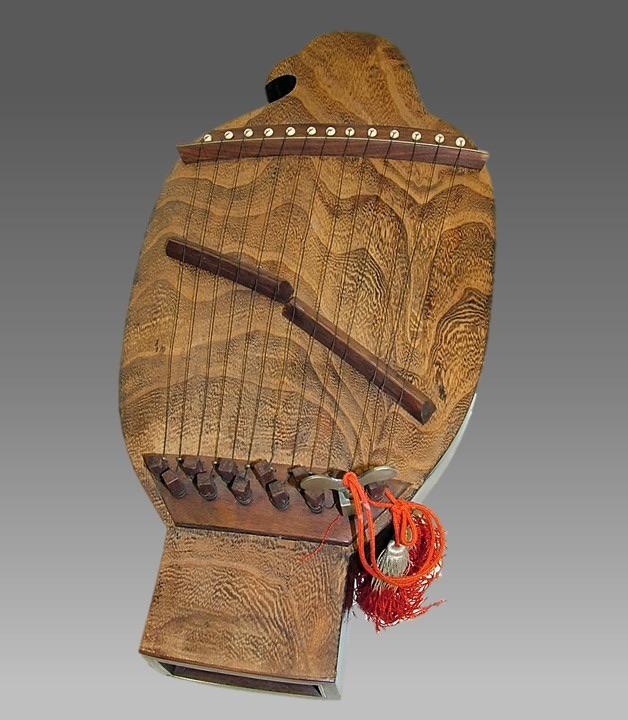
Kotolate 19th century · Japanese (Japan) -
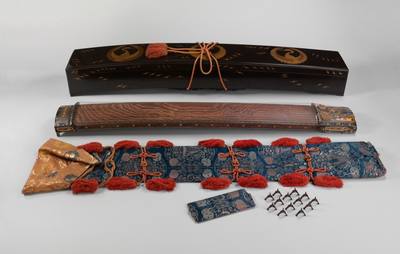
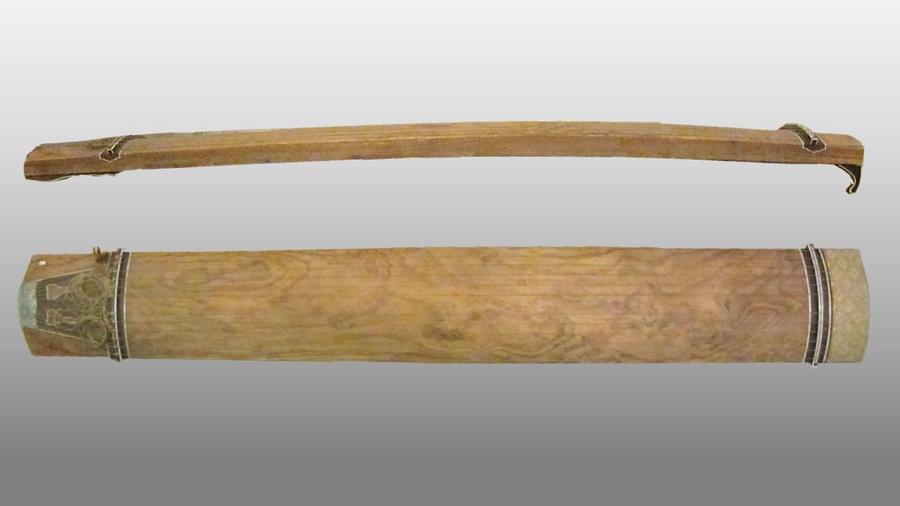
Koto (箏)early 17th century · Japanese (Japan) -
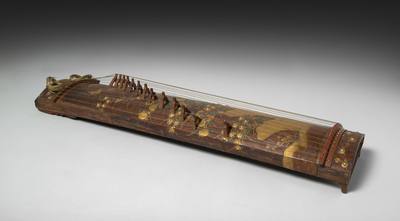
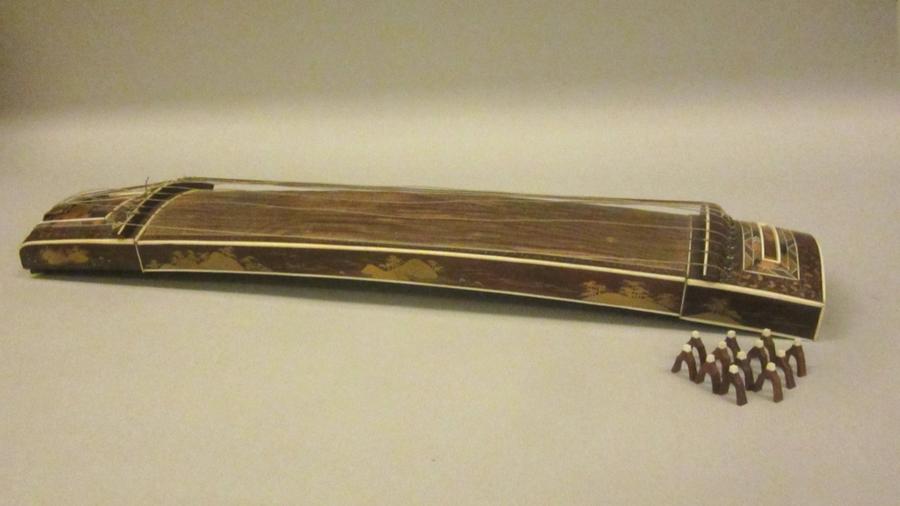
Koto (Zither)early to mid-1800s · Japan, Edo period (1615–1868) (Japan) -
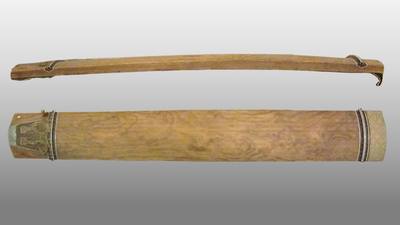
Yamada Koto19th century · Japanese (Japan) -
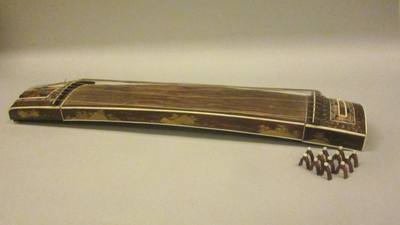
Miniature Koto (箏)mid 19th–late 19th century · Japanese (Japan) -
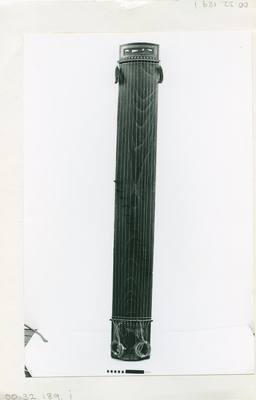
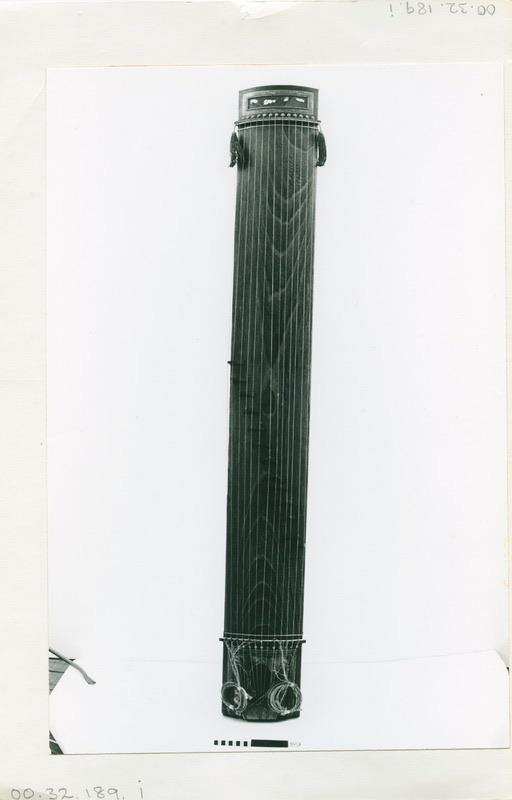
KotoUndated · Sweden
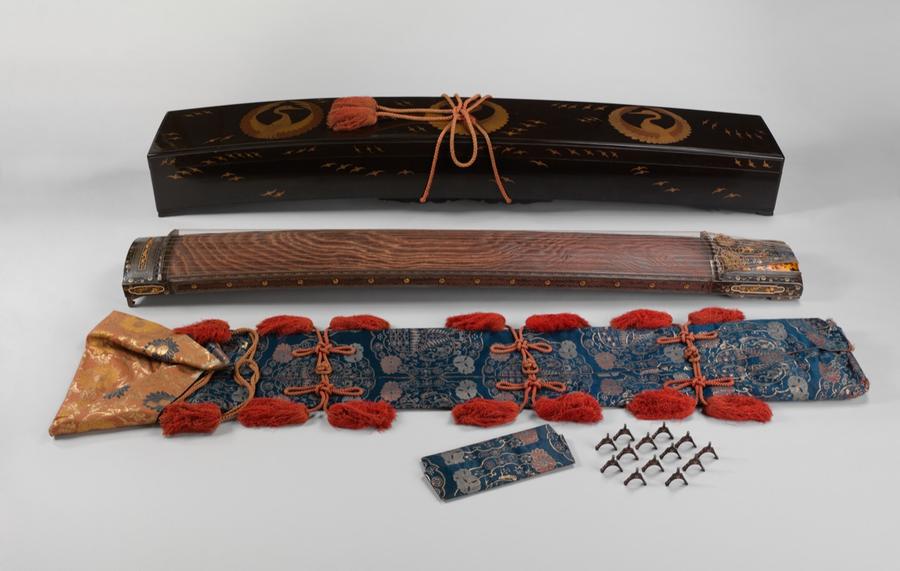
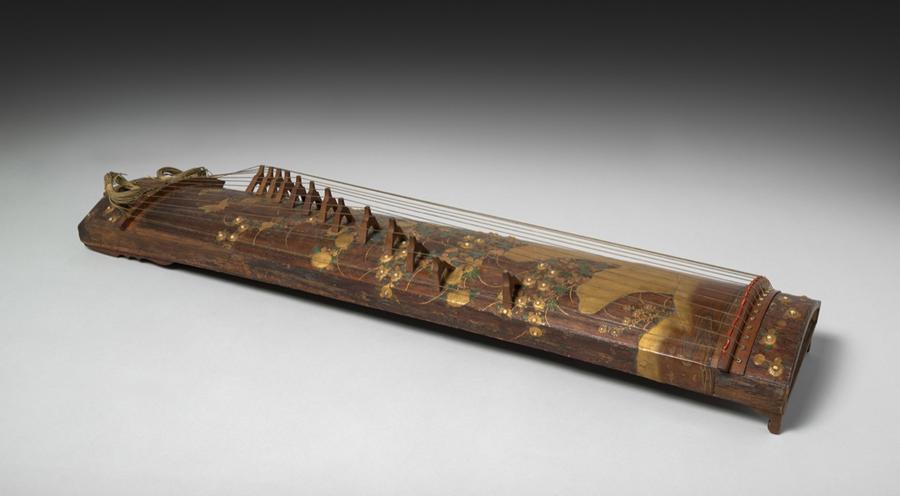
Facts at a glance
| Hornbostel–Sachs number | 312.22-6 — Heterochord half-tube zither sounded with three plectrums |
|---|---|
| Hornbostel–Sachs group | Chordophones › Simple chordophones or zithers › Tube zithers |
| Also known as | sō |
| Classification (Wikipedia infobox) | Stringed instrument |
| Developed | 12th century |
| Inventor | Kenjun |
| Wikidata labels | 51 languages |
| Wikipedia article | Koto (instrument) |
| Wikidata item | Q289037 |
| Wikimedia Commons category | Koto |
| MusicBrainz instrument | 274717c1-b2d8-4a6a-8eaf-eb0c1e11b757 |
| Encyclopaedia Britannica | art/koto |
| Audio sample (Wikimedia Commons) | Koto performance.ogg |
Sources: Wikidata (CC0 1.0) — classification number, aliases, identifiers (dump of 2026-07-22); Wikipedia (CC BY-SA 4.0) — infobox fields (description of the classification number, development, inventors) and the names of the Hornbostel–Sachs groups (article “Hornbostel–Sachs”, revision of 2026-01-04).
The name in other languages
| Language | Name | Also written |
|---|---|---|
| English | koto | sō |
| French | koto | |
| German | Koto | |
| Spanish | Koto | |
| Italian | koto | |
| Portuguese | koto | |
| Dutch | koto | |
| Russian | кото | |
| Japanese | 箏 | |
| Chinese | 日本箏 | 山田流 |
| Korean | 고토 | |
| Arabic | كوتو |
Sources: Wikidata (CC0 1.0) — labels and aliases; MusicBrainz (CC0 1.0) — instrument aliases (names only).
About the koto: history, construction and playing
The koto is a Japanese plucked half-tube zither instrument, and the national instrument of Japan. It is derived from the Chinese zheng and se, and similar to the Mongolian yatga, the Korean gayageum and ajaeng, the Vietnamese đàn tranh, the Sundanese kacapi and the Kazakh jetigen. Koto are roughly 180 cm in length, and made from Paulownia wood (Paulownia tomentosa, known as kiri). The most common type uses 13 strings strung over movable bridges used for tuning, different pieces possibly requiring different tuning. Seventeen-string koto are also common, and act as bass in ensembles. Koto strings are generally plucked using three fingerpicks (tsume), worn on the first three fingers of the right hand.
Names and types
The character for koto is 箏, although 琴 is often used. However, 琴 (koto) is the general term for all string instruments in the Japanese language, including instruments such as the kin no koto, sō no koto, yamato-goto, wagon, nanagen-kin, and so on. When read as kin, it indicates the Chinese instrument guqin. The term is used today in the same way.
The term koto appears in the Kojiki in reference to an ancient string instrument in this usage. Variations of the instrument were eventually created, and eventually a few of them would become the standard variations for modern day koto. The four types of koto (gakuso, chikuso, zokuso, tagenso) were all created by different subcultures, but also adapted to change the playing style.
One regional style of the koto is the Tategoto (竪琴) from the Amami Islands. Unlike other varieties of the koto, it is held upright on the lap and played with one hand, may have more strings, is shorter, and is typically strung with steel strings.
History
The ancestor of the koto was the Chinese guzheng. It was first introduced to Japan from China in the 7th and 8th centuries. The first known version had five strings, which eventually increased to seven strings. The Japanese koto belongs to the Asian zither family that also comprises the Chinese zheng (ancestral to the other zithers in the family), the Korean gayageum, and the Vietnamese đàn tranh. This variety of instrument came in two basic forms, a zither that had bridges and a zither without bridges.
When the koto was first imported to Japan, the native word koto was a generic term for any and all Japanese stringed instruments. As the number of different stringed instruments in Japan grew, the once-basic definition of koto could not describe the wide variety of these instruments and so the meanings changed. The azumagoto or yamatogoto was called the wagon, the kin no koto was called the kin, and the sau no koto (sau being an older pronunciation of 箏) was called the sō or koto.
The modern koto originates from the gakusō used in Japanese court music (gagaku). It was a popular instrument among the wealthy; the instrument was considered a romantic one. Some literary and historical records indicate that solo pieces for koto existed centuries before sōkyoku, the music of the solo koto genre, was established. According to Japanese literature, the koto was used as imagery and other extra music significance. In one part of The Tale of Genji, the titular character falls deeply in love with a mysterious woman whom he has never seen before, after hearing her playing the koto from a distance.
Construction
A koto is typically made of Paulownia wood (known as kiri), although treatment of the wood varies tremendously between artisans. A koto may or may not be adorned. Adornments include inlays of ivory and ebony, tortoise shell, metal figures, etc. The wood is also cut into two patterns, itame (also called mokume), which has a swirling pattern, or straight-lined masame. The straight lined pattern is easier to manufacture, so the swirl raises the cost of production, and is therefore reserved for decorative and elegant models.
The body of a traditional koto is made of Paulownia wood. Every piece of the instrument comes with cultural significance, especially since the koto is the national instrument. The wood is dried and cut into precise measurements. The size of the soundboard on a standard modern koto has remained approximately 182 cm, where in the past it ranged from 152 to 194 cm.
The bridges (ji) used to be made of ivory, but nowadays are typically made of plastic, and occasionally made of wood. One can alter the pitch of a string by manipulating or moving the bridge. For some very low notes, there are small bridges made, as well as specialty bridges with three different heights, depending on the need of the tuning. When a small bridge is unavailable for some very low notes, some players may, as an emergency measure, use a bridge upside down, though this is unstable and not ideal. Bridges have been known to break during playing, and with some older instruments which have the surface where the bridges rest being worn due to much use, the bridges may fall during playing, especially when pressing strings. There are, of course, various sorts of patch materials sold to fill the holes which cause the legs of a bridge to rest on an unstable area. About 6 ft long and 1 ft wide, the koto is traditionally placed on the floor in front of the player, who kneels.
Koto today
The influence of Western pop music has made the koto less prominent in Japan, although it is still developing as an instrument. The 17-string bass koto (jūshichi-gen) has become more prominent over the years since its development by Michio Miyagi. There are also 20-, 21-, and 25-string koto. Works are being written for 20- and 25-string koto and 17-string bass koto. Reiko Obata has also made the koto accessible to Western music readers with the publication of two books for solo koto using Western notation. The current generation of koto players, such as American performers Reiko Obata and Miya Masaoka, Japanese master Kazue Sawai, and Michiyo Yagi, are finding places for the koto in today's jazz, experimental music and even pop music. The members of the band Rin' are popular 17-string koto players in the modern music scene.
June Kuramoto of the jazz fusion group Hiroshima was one of the first koto performers to popularize the koto in a non-traditional fusion style. Reiko Obata, founder of East West Jazz, was the first to perform and record an album of jazz standards featuring the koto. Obata also produced the first-ever English language koto instructional DVD, titled "You Can Play Koto". Obata is one of the few koto performers to perform concertos with United States orchestras, having done so on multiple occasions, including with Orchestra Nova for San Diego's KPBS in 2010.
Other solo performers outside Japan include award-winning recording artist Elizabeth Falconer, who also studied for a decade at the Sawai Koto School in Tokyo, and Linda Kako Caplan, Canadian daishihan (grandmaster) and member of Fukuoka's Chikushi Koto School for over two decades. Another Sawai disciple, Masayo Ishigure, holds down a school in New York City. Yukiko Matsuyama leads her KotoYuki band in Los Angeles. Her compositions blend the timbres of world music with her native Japanese culture. She performed on the Grammy-winning album Miho: Journey to the Mountain (2010) by the Paul Winter Consort, garnering additional exposure to Western audiences for the instrument. In November 2011, worldwide audiences were further exposed to the koto when she performed with Shakira at the Latin Grammy Awards.
Source: Wikipedia, “Koto (instrument)” — CC BY-SA 4.0 — text excerpted as published (references, images and tables removed); see the article for the full text and the list of authors. Revision of 2026-06-01.
Sources and licences
- Koto, Asano Tōshichi, late 19th century, Japanese (Japan). Paulownia wood, metal strings. The Crosby Brown Collection of Musical Instruments, 1889 (89.4.1549). Museum record · CC0 1.0 (public domain dedication)
- Koto (箏), Metalwork by Goto Teijo, 9th generation Goto master, Japan; Gotō Yūjō, early 17th century, Japanese (Japan). Various woods, ivory and tortoiseshell inlays, gold and silver inlays, metalwork, cloth, laquer, paper,. Purchase, Amati Gifts, 2007 (2007.194a–f). Museum record · CC0 1.0 (public domain dedication)
- Koto (Zither), early to mid-1800s, Japan, Edo period (1615–1868) (Japan). Wood with colored lacquer, sprinkled gold powder (maki-e), textile, and silk strings. The Charles G. King Jr. collection; Gift of Ralph King in memory of Charles G. King Jr.. Museum record · CC0 1.0 (public domain dedication)
- Yamada Koto, 19th century, Japanese (Japan). Wood, ivory, metal, silk. The Crosby Brown Collection of Musical Instruments, 1889 (89.4.109). Museum record · CC0 1.0 (public domain dedication)
- Miniature Koto (箏), mid 19th–late 19th century, Japanese (Japan). wood, lacquer, metal, silk, ivory?. The Crosby Brown Collection of Musical Instruments, 1889 (89.4.112). Museum record · CC0 1.0 (public domain dedication)
- Koto, Undated, Sweden. Museum of Ethnography / Swedish Open Cultural Heritage (via Europeana). Museum record · CC0 1.0 (public domain dedication)
Photographs: open-access collections of the museums named above; each is shown here reduced in size, otherwise unchanged. Text: Wikipedia (CC BY-SA 4.0), Wikidata and MusicBrainz (CC0). The full list of sources and licences is on the credits page.