
Instruments · Chordophones
Harpsichord
Harpsichords are keyboard instruments that make sound by having the strings plucked with a plectrum. They are thought to have originated when a keyboard was attached to a psaltery. This makes them different from a clavichord where the strings are hit. The piano is therefore closer to a clavichord than a harpsichord. On a piano it is possible to play louder or quieter by playing the keys with more or less force. On a harpsichord the volume (playing louder or softer) cannot be controlled by the way it is played. However, some large harpsichords have several "stops", each one giving a different kind of sound. The largest harpsichords have two manuals (keyboards) which gives more variety. It makes it possible for the right hand to play the tune on one manual while the left hand plays an accompaniment more quietly on the other.
Summary: Simple English Wikipedia, “Harpsichord” — CC BY-SA 4.0. Revision of 2025-09-01.
Museum photographs
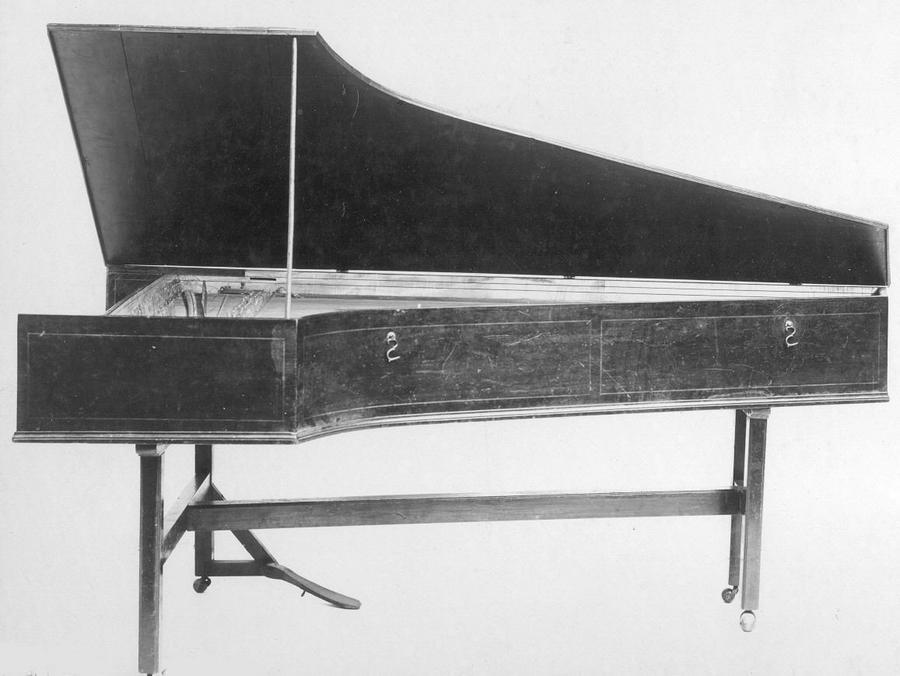
These 11 photographs span 1640–1781, 7 places of origin and 3 museums. Every photograph is public domain or openly licensed, and links to the museum’s own record.
-
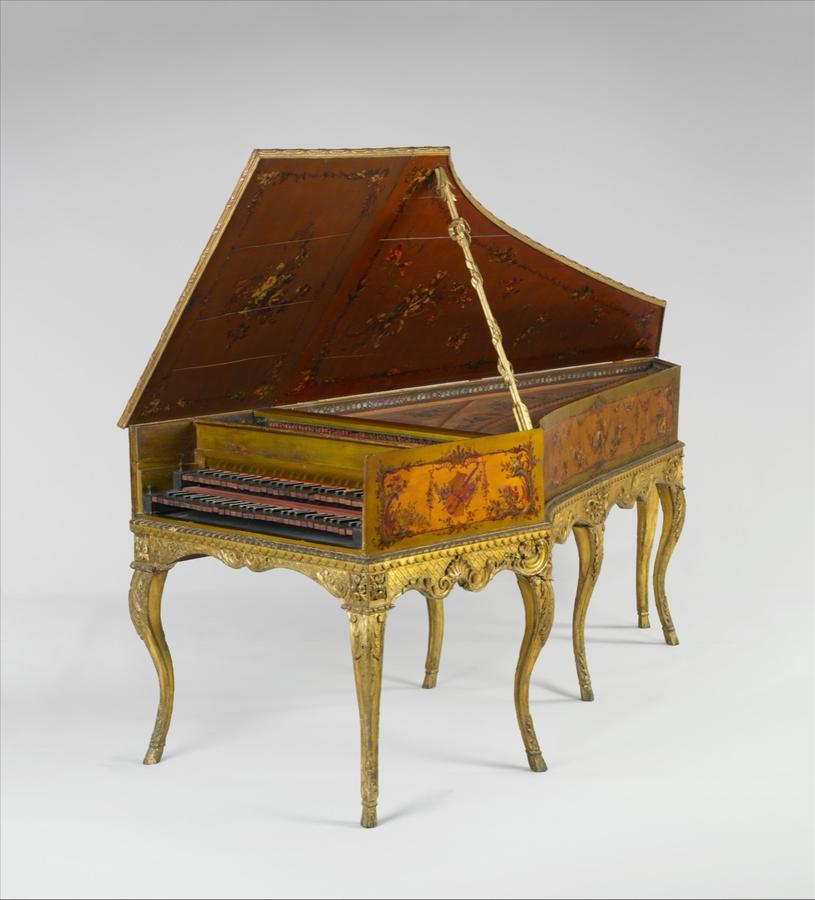
Harpsichord1742 · French (France) -
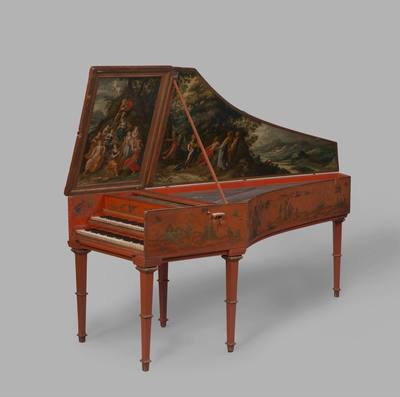
Harpsichord1640 · Antwerp -
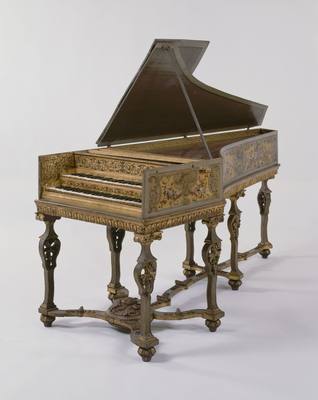
Harpsichordca. 1650 · Flemish -
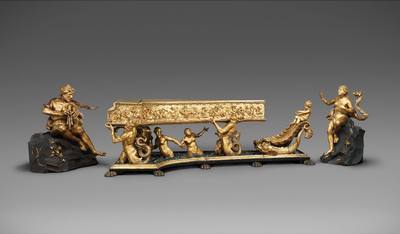
Harpsichordca. 1670 · Italian (Roman) (Italy) -
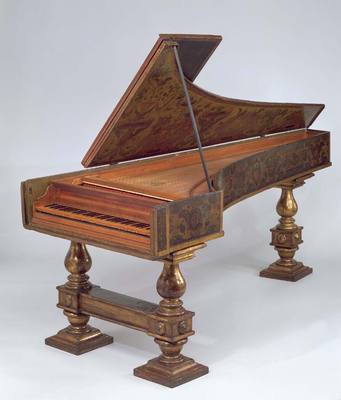
Harpsichord1666 · Italian (Italy) -
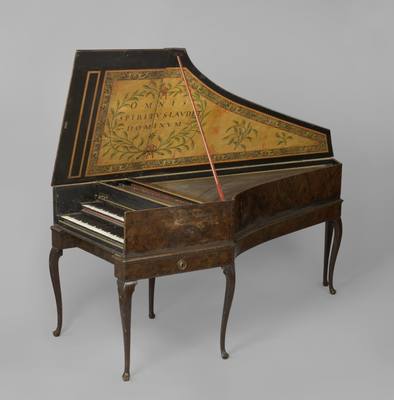
Harpsichord1669 · Amsterdam; Antwerp -
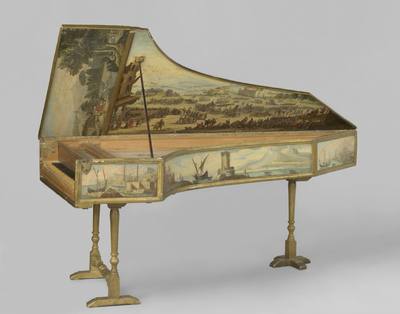
Harpsichordc. 1690 · Naples -
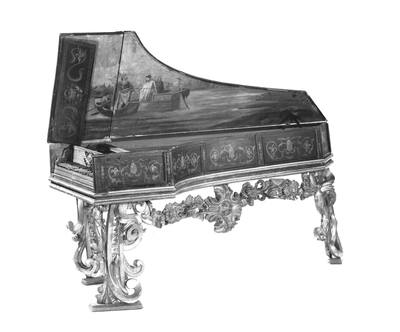
De Quoco Single Manual Harpsichord1694 -
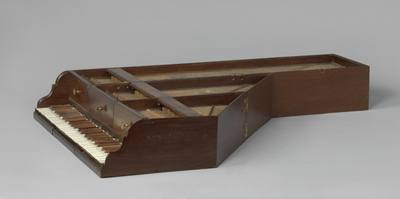
Folding harpsichord1768 · Gouda -
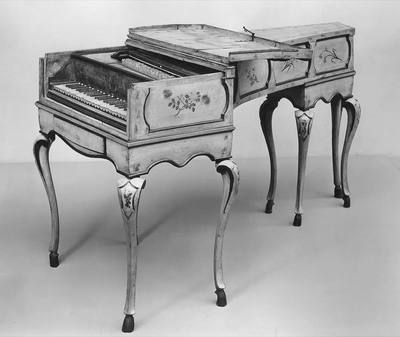
Harpsichord1773 · Italian (Italy) -
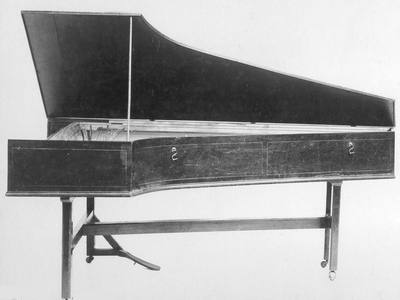
Harpsichord1781 · British (United Kingdom)
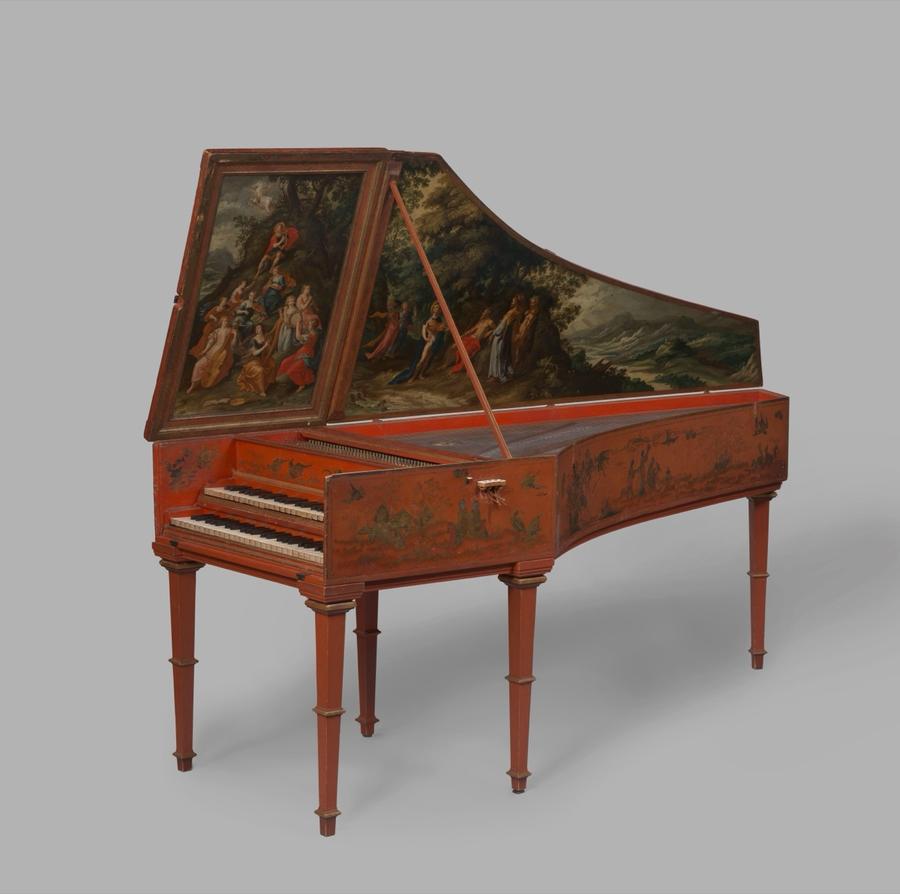
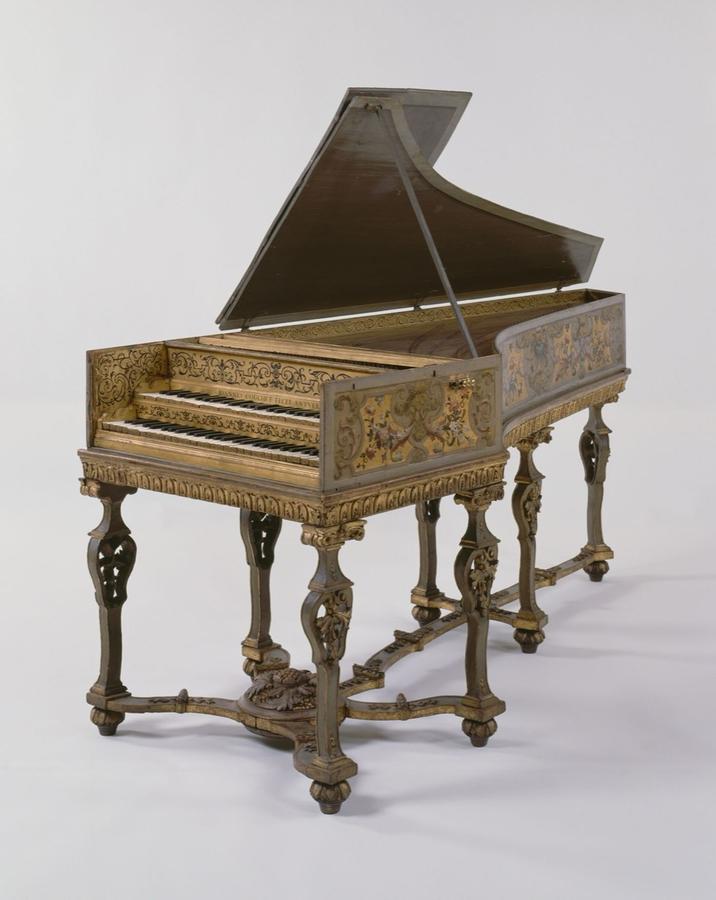
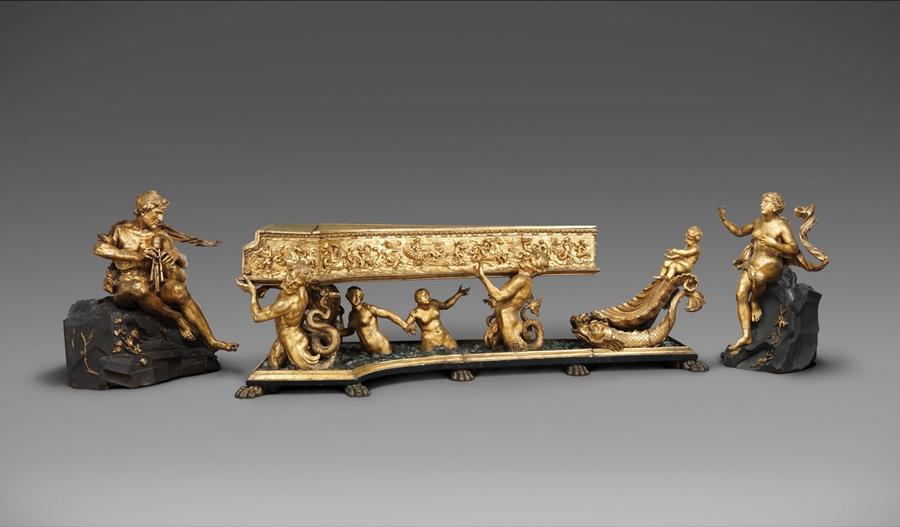
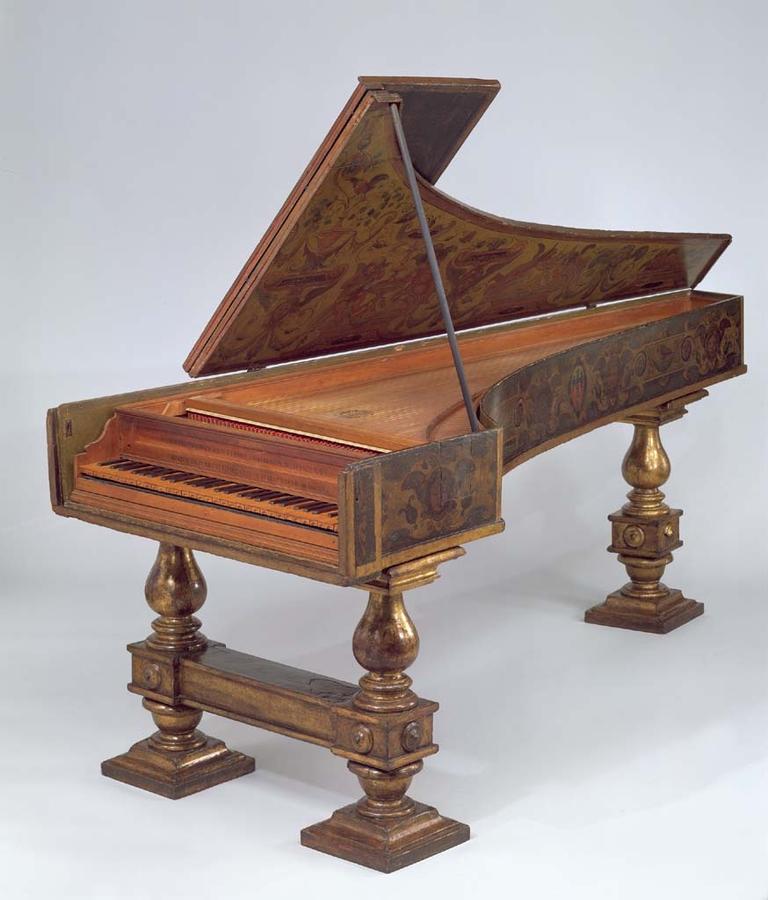
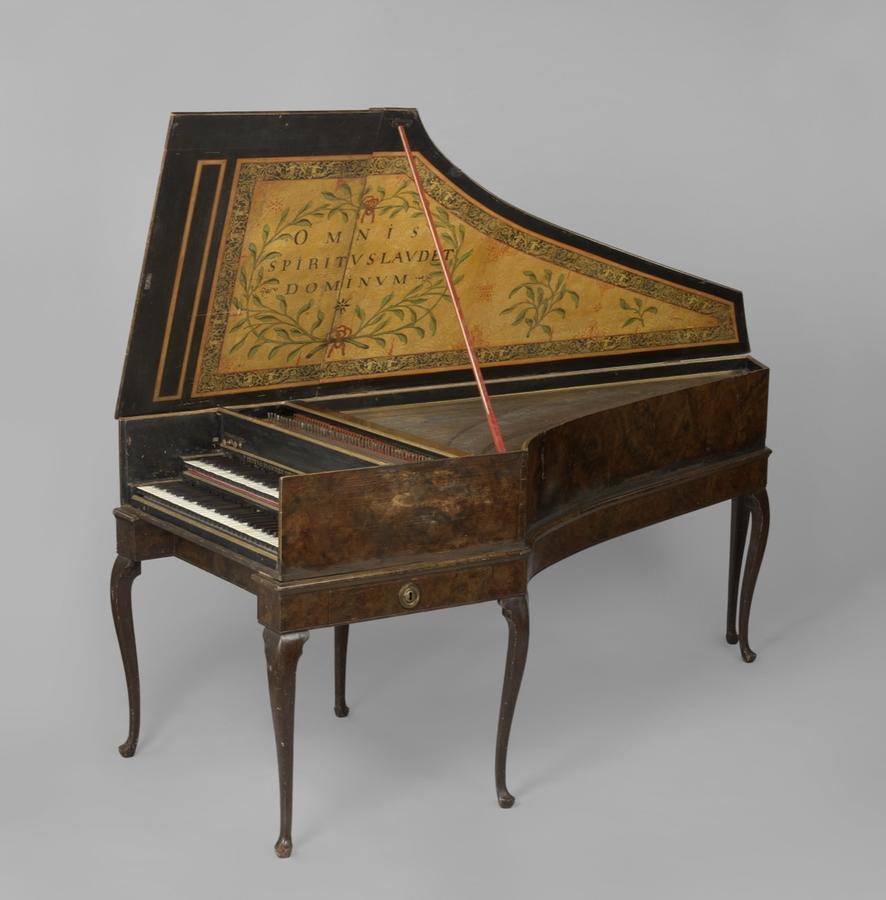
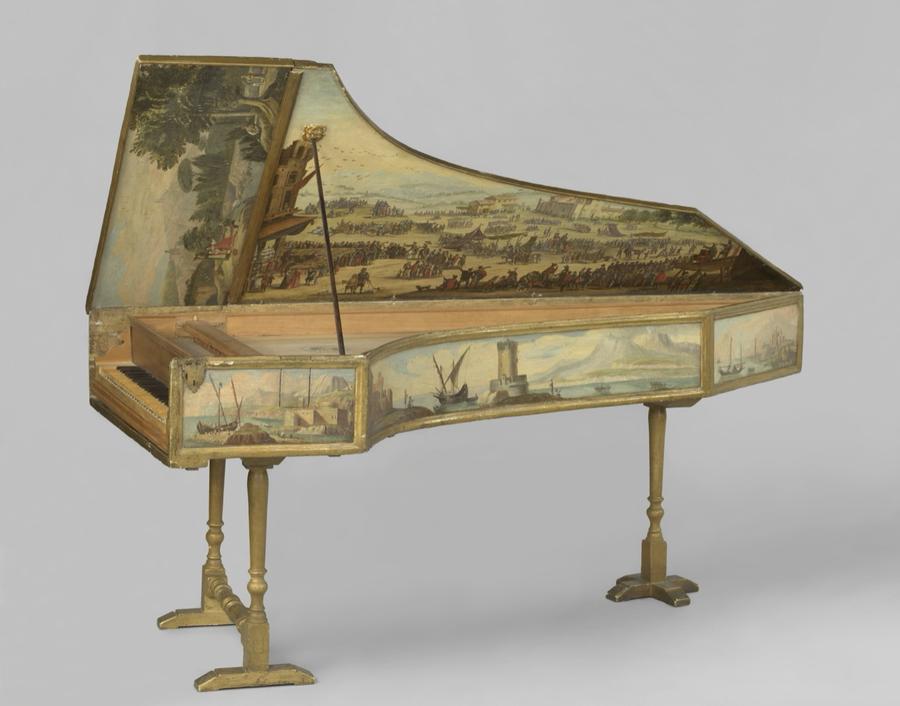
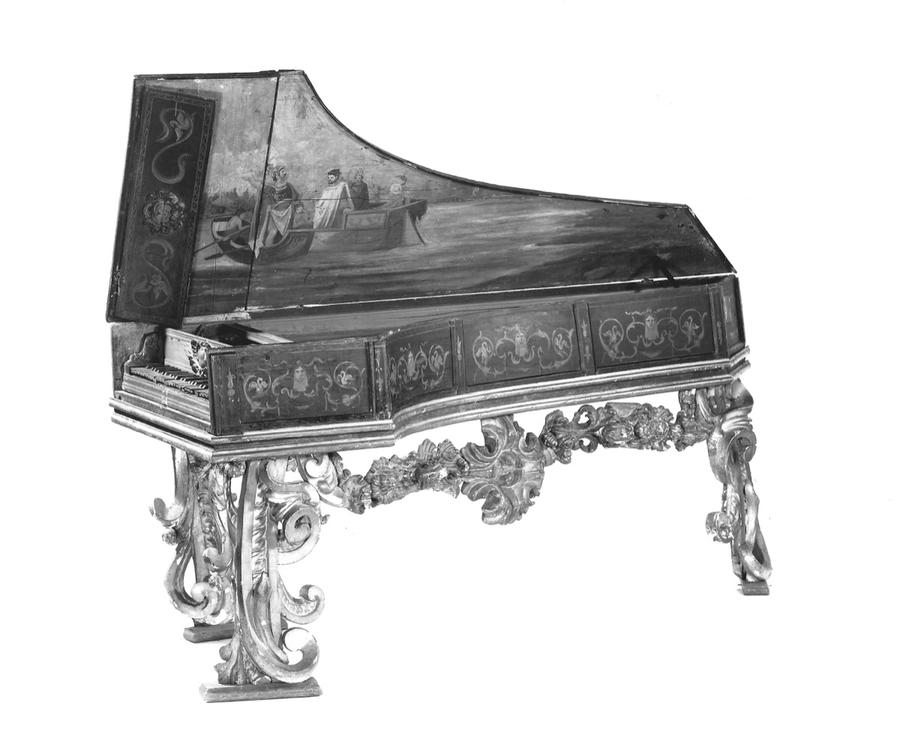
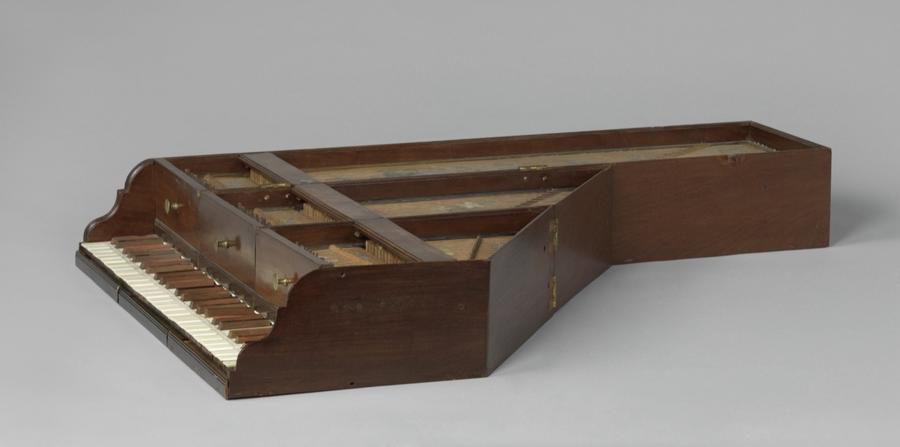
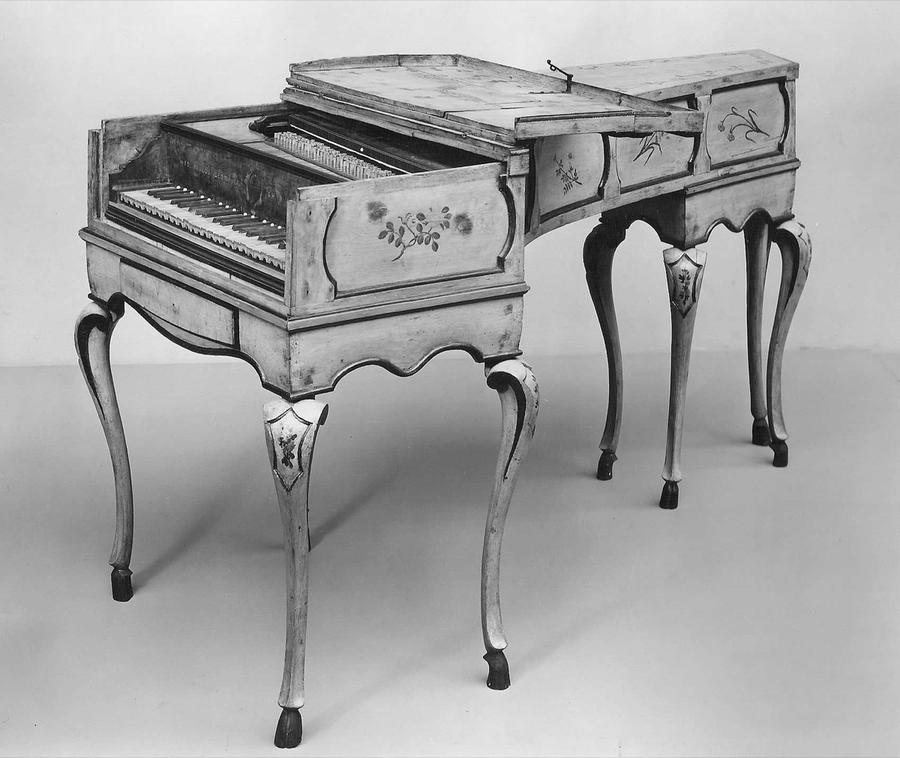
Facts at a glance
| Hornbostel–Sachs number | 314.122-6-8 |
|---|---|
| Hornbostel–Sachs group | Chordophones › Simple chordophones or zithers › Board zithers |
| Also known as | cembalo, clavicembalo, clavecin |
| Wikidata labels | 99 languages |
| Wikipedia article | Harpsichord |
| Wikidata item | Q81982 |
| Wikimedia Commons category | Harpsichords |
| MusicBrainz instrument | bfe379dc-1d65-4862-acd8-60d53bb963a2 |
| Encyclopaedia Britannica | art/harpsichord |
| Audio sample (Wikimedia Commons) | Bach C Major Prelude Equal.ogg |
Sources: Wikidata (CC0 1.0) — classification number, aliases, identifiers (dump of 2026-07-22); Wikipedia (CC BY-SA 4.0) — infobox fields (description of the classification number, development, inventors) and the names of the Hornbostel–Sachs groups (article “Hornbostel–Sachs”, revision of 2026-01-04).
The name in other languages
| Language | Name | Also written |
|---|---|---|
| English | harpsichord | cembalo, clavicembalo, clavecin |
| French | clavecin | grand clavecin baroque, clavessin, clavecins |
| German | Cembalo | Gravicembalo, Kielflügel, Clavicimbalum |
| Spanish | clavecín | arpicordio, clave, clavichémbalo |
| Italian | clavicembalo | cembalo |
| Portuguese | cravo | Cembalo, Clavecino, Harpsichord |
| Dutch | klavecimbel | clavecimbel, harpsichord |
| Russian | клавесин | чембало, харпсихорд, клавицимбал |
| Japanese | チェンバロ | クラヴサン, クラブサン, ハープシコード |
| Chinese | 大鍵琴 | 羽管键琴, 撥弦古鋼琴, 羽管鍵琴 |
| Korean | 하프시코드 | 쳄발로 |
| Arabic | هاربسكورد | الهاربسيكورد |
Sources: Wikidata (CC0 1.0) — labels and aliases; MusicBrainz (CC0 1.0) — instrument aliases (names only).
About the harpsichord: history, construction and playing
A harpsichord is a keyboard instrument that makes its sound by plucking a set of strings. In a harpsichord, depressing a key raises its back end within the instrument, which in turn lifts one or more jacks, each a thin strip of wood holding a small plectrum made from quill or plastic; each plectrum plucks a single string. The strings are under tension on a soundboard, which is mounted in a wooden case; the soundboard amplifies the vibrations from the strings so that the listeners can hear them. Harpsichord often include more than one choir of strings. Various devices are used to select which choir will sound when playing; these can include simple levers, or in more elaborate instruments the deployment of more than one keyboard.
The term denotes the whole family of similar plucked-keyboard instruments, including the smaller virginals, muselar, and spinet. The harpsichord was widely used in Renaissance and Baroque music, both for purposes of accompaniment and as a solo instrument. During the Baroque era, the harpsichord was a standard part of the continuo group. During the late 18th century, with the spread of the piano, the harpsichord gradually disappeared from the musical scene (except in opera, where it continued to be used to accompany recitative). In the 20th century, it made a resurgence, being used in historically informed performance of older music, in new compositions, and in certain styles of popular music.
History
The harpsichord was most likely invented in the late 14th century. The earliest instruments were quite small and sounded at relatively high pitch. By the 16th century, harpsichord makers in Italy had evolved a design that survived well into later centuries: lightweight instruments with thin case walls and low tension brass strings arranged in two choirs with a single manual. A different approach was taken in the Southern Netherlands starting in the late 16th century, notably by the Ruckers family. Their harpsichords used a heavier construction and produced a more powerful and distinctive tone with higher tension steel treble stringing. These included the first harpsichords with two keyboards, used for transposition.
The Flemish instruments served as the model for 18th-century harpsichord construction in other nations. In France, the double keyboards were adapted to control different choirs of strings, making a more musically flexible instrument (so-called 'expressive doubles'). Instruments from the peak of the French tradition, by makers such as the Blanchet family and Pascal Taskin, are among the most widely admired of all harpsichords, and are frequently used as models for the construction of modern instruments. In England, the Kirkman and Shudi firms produced sophisticated harpsichords of great power and sonority. German builders such as Hieronymus Albrecht Hass extended the sound repertoire of the instrument by adding sixteen-foot and two-foot choirs; instruments by the German builder Michael Mietke have recently served as models for modern builders.
Around the year 1700 the first piano was built by Bartolomeo Cristofori. In the piano, the strings are not plucked but rather are struck with hammers, which makes it possible for the player to control the volume of each note (in a harpsichord, a note sounds equally loud no matter how hard the key is pressed). With time and changes in compositional style, the expressive nuances made possible by the piano came to be increasingly valued, and by the late 18th century the piano (often called the fortepiano at that time) had largely supplanted the harpsichord. The harpsichord, now considered obsolete, almost disappeared from view for most of the 19th century. An exception was its continued use in opera for accompanying recitative, but the piano sometimes displaced it even there.
Mechanism
Harpsichords vary in size and shape, but all have the same basic mechanism. The player depresses a key that rocks over a pivot in the middle of its length. The other end of the key lifts a jack (a long strip of wood) that holds a small plectrum (a wedge-shaped piece of quill, in modern times often made of plastic), which plucks the string. When the player releases the key, the far end returns to its rest position, and the jack falls back; the plectrum, mounted on a tongue mechanism that can swivel backwards away from the string, passes the string without plucking it again. As the key reaches its rest position, a felt damper atop the jack stops the string's vibrations. These basic principles are explained in detail below.
Strings, tuning, and soundboard
Each string is wound around a tuning pin (also known as a wrest pin) at the end nearest the player. When rotated with a wrench or tuning hammer, the tuning pin adjusts the tension so that the string sounds the correct pitch. Tuning pins are held tightly in holes drilled in the pinblock or wrestplank, an oblong hardwood plank. Proceeding from the tuning pin, a string next passes over the nut, a sharp edge that is made of hardwood and is normally attached to the wrestplank. The section of the string beyond the nut forms its vibrating length, which is plucked and creates sound.
At the other end of its vibrating length, the string passes over the bridge, another sharp edge made of hardwood. As with the nut, the horizontal position of the string along the bridge is determined by a vertical metal pin inserted into the bridge, against which the string rests. The bridge itself rests on a soundboard, a thin panel of wood usually made of spruce, fir or—in some Italian harpsichords—cypress. The soundboard efficiently transmits the vibrations of the strings into vibrations in the air; without a soundboard, the strings would produce only a very feeble sound. A string is attached at its far end by a loop to a hitchpin that secures it to the case.
Multiple manuals and choirs of strings
While many harpsichords have one string per note, more elaborate harpsichords can have two or more. When there are multiple strings for each note, these additional strings are called "choirs" of strings. Having multiple choirs provides two advantages: the ability to vary volume and the ability to vary tonal quality. Volume is increased when the mechanism of the instrument is set up by the player so that the press of a single key plucks more than one string. Tonal quality can be varied in two ways. First, different choirs of strings can be designed to have distinct tonal qualities, usually by having one set of strings plucked closer to the nut, which emphasizes the higher harmonics, and produces a "nasal" sound quality. The mechanism of the instrument, called "stops" (following the use of the term in pipe organs), permits the player to select one choir or the other. Second, having one key pluck two strings at once changes not just volume but also tonal quality; for instance, when two strings tuned to the same pitch are plucked simultaneously, the note is not just louder but also richer and more complex.
A particularly vivid effect is obtained when the strings plucked simultaneously are an octave apart. This is normally heard by the ear not as two pitches but as one: the sound of the higher string is blended with that of the lower one, and the ear hears the lower pitch, enriched in tonal quality by the additional strength in the upper harmonics of the note sounded by the higher string.
Case
The wooden case holds in position all of the important structural members: pinblock, soundboard, hitchpins, keyboard, and the jack action. It usually includes a solid bottom, and also internal bracing to maintain its form without warping under the tension of the strings. Cases vary greatly in weight and sturdiness: Italian harpsichords are often of light construction; heavier construction is found in the later Flemish instruments and those derived from them.
Clavicytherium
A clavicytherium is a harpsichord with the soundboard and strings mounted vertically facing the player, the same space-saving principle as an upright piano. In a clavicytherium, the jacks move horizontally without the assistance of gravity, so that clavicytherium actions are more complex than those of other harpsichords.
Compass and pitch range
On the whole, earlier harpsichords have smaller ranges than later ones, although there are many exceptions. The largest harpsichords have a range of just over five octaves, and the smallest have under four. Usually, the shortest keyboards were given extended range in the bass with a "short octave". The traditional pitch range for a 5-octave instrument is F1–F6 (FF–f‴).
Tuning pitch is often taken to be A4 = 415 Hz, roughly a semitone lower than the modern standard concert pitch of A4 = 440 Hz. An accepted exception is for French baroque repertoire, which is often performed with a = 392 Hz, approximately a semitone lower again. See Jean-Philippe Rameau's Treatise on Harmony (1722) [Dover Publications], Book One, chapter five, for insight into French baroque tuning; "Since most of these semitones are absolutely necessary in the tuning of organs and other similar instruments, the following chromatic system has been drawn up." Tuning an instrument nowadays usually starts with setting an A; historically it would commence from a C or an F. The harpsichord uses the bass clef (F clef).
Some modern instruments are built with keyboards that can shift sideways, allowing the player to align the mechanism with strings at either A = 415 Hz or A = 440 Hz. If a tuning other than equal temperament is used, the instrument requires retuning once the keyboard is shifted.
Renaissance
The first music written specifically for solo harpsichord was published around the early 16th century. Composers who wrote solo harpsichord music were numerous during the whole Baroque era in European countries including Italy, Germany, England and France. Solo harpsichord compositions included dance suites, fantasias, and fugues. Among the most famous composers who wrote for the harpsichord were the members of English virginal school of the late Renaissance, notably William Byrd (c. 1540–1623).
Baroque era
In France, a great number of highly characteristic solo works were created and compiled into four books of ordres by François Couperin (1668–1733). Domenico Scarlatti (1685–1757) began his career in Italy but wrote most of his solo harpsichord works in Spain; his most famous work is his series of 555 harpsichord sonatas. Perhaps the most celebrated composers who wrote for the harpsichord were Georg Friedrich Händel (1685–1759), who composed numerous suites for harpsichord, and especially J. S. Bach (1685–1750), whose solo works (for instance, The Well-Tempered Clavier and the Goldberg Variations), continue to be performed very widely, often on the piano. Bach was also a pioneer of the harpsichord concerto, both in works designated as such, and in the harpsichord part of his Fifth Brandenburg Concerto.
Source: Wikipedia, “Harpsichord” — CC BY-SA 4.0 — text excerpted as published (references, images and tables removed); see the article for the full text and the list of authors. Revision of 2026-05-08.
From Grove’s Dictionary (1900)
Of this family there were four members living and working between 1579 and 1651 or later, who achieved great reputation. Their instruments are known by their signatures; and by the monograms forming the ornamental rosette or soundhole in the soundboard—a survival from the psaltery. The great improvement of the harpsichord is attributed to Hans, the eldest, who, by adding to the two unison strings of each note a third of shorter length and finer wire tuned an octave higher, increased the power and brilliancy of the tone. To employ this addition at will, alone, or with one or both the unison strings, he contrived, after the example of the organ, a second keyboard, and stops to be moved by the hand, for the control of the registers or slides of jacks acting upon the strings. By these expedients all the legitimate variety ever given to the instrument was secured. The Ruckers harpsichord given by Messrs. Broadwood to South Kensington Museum, signed and dated 'Andreas Ruckers me fecit Antverpiæ 1651', said to have been left by Handel to Christopher Smith, shows these additions to the construction, and was, in the writer's remembrance, before the soundboard gave way, of deliciously soft and delicately reedy timbre. The tension being comparatively small, these harpsichords lasted much longer than our modern pianofortes, even of the best construction. James Shudi Broadwood ('Notes,' 1838) states that many Ruckers harpsichords were in existence and good condition until nearly the end of the last century, and fetched high prices; one having sold in 1770 for 3000 francs (£120).
Source: Wikisource, A Dictionary of Music and Musicians (Grove, 1900) — “Harpsichord” (entry by A. J. Hipkins) — Public domain (published 1879–1910; authors died before 1929) — the first paragraphs of the entry, as transcribed; see the page for the full entry.
Composers who played it
91 composers on this site list the harpsichord as an instrument they played. A selection:
- Henry Purcell 1659–1695
- Antonio Vivaldi 1678–1741
- Domenico Scarlatti 1685–1757
- George Frideric Handel 1685–1759
- Johann Sebastian Bach 1685–1750
- Wolfgang Amadeus Mozart 1756–1791
- Jacopo Corsi 1561–1602
- Giles Farnaby 1563–1640
- Giovanni Picchi 1571–1643
- Girolamo Frescobaldi 1583–1643
- Jacques Champion de Chambonnières 1602–1672
- Albertus Bryne 1621–1668
Composers with a page on this site whose Wikidata record lists this instrument; featured and best-dated first. Data: Wikidata (property “instrument”, P1303), CC0 1.0.
Sources and licences
- Harpsichord, Louis Bellot, 1742, French (France). Wood and various materials. The Crosby Brown Collection of Musical Instruments, 1889 (89.4.1218). Museum record · CC0 1.0 (public domain dedication)
- Harpsichord, Johannes Ruckers, 1640, Antwerp. paint (coating), bone (material), metal, wood (plant material). Bailment from the Descendants and Heirs of Count Alexander II von Velen and his wife Countess Alexandrine von Velen nee Countess Huyn von Amstenrade and Geleen (Province Limburg). Museum record · Public Domain Mark 1.0
- Harpsichord, Jan Couchet the Elder, ca. 1650, Flemish. Wood and various materials. The Crosby Brown Collection of Musical Instruments, 1889 (89.4.2363). Museum record · CC0 1.0 (public domain dedication)
- Harpsichord, Michele Todini; Basilio Onofri; Jacob Reiff, ca. 1670, Italian (Roman) (Italy). Wood, gilt, ebony, ivory, parchment. The Crosby Brown Collection of Musical Instruments, 1889 (89.4.2929a–e). Museum record · CC0 1.0 (public domain dedication)
- Harpsichord, Girolamo Zenti, 1666, Italian (Italy). Cypress, boxwood, ebony, brass, leather. The Crosby Brown Collection of Musical Instruments, 1889 (89.4.1220a-b). Museum record · CC0 1.0 (public domain dedication)
- Harpsichord, Petrus Johannes Couchet, 1669, Amsterdam; Antwerp. spruce (wood), ivory, brass (alloy), poplar (wood), ebony (wood), iron (metal). Purchased with the support of the State of the Netherlands and the Vereeniging van Noord-Nederlandsche Muziekgeschiedenis. Museum record · Public Domain Mark 1.0
- Harpsichord, c. 1690, Naples. cypress (wood), poplar (wood), metal, parchment (animal material), boxwood (hardwood). On loan from the Gemeentemuseum Den Haag. Museum record · Public Domain Mark 1.0
- De Quoco Single Manual Harpsichord, De Quoco, Nicolas, 1694. metal (overall material); wood (overall material); paint (overall material). Smithsonian Institution (National Museum of American History). Museum record · CC0 1.0 (public domain dedication)
- Folding harpsichord, Rijk van Arkel, 1768, Gouda. iron (metal), tortoise shell, mahogany (wood), brass (alloy), ivory, softwood. Gift of A.J. Enschedé, Haarlem. Museum record · Public Domain Mark 1.0
- Harpsichord, Giovanni Paolo Leoni, 1773, Italian (Italy). Wood, various materials. The Crosby Brown Collection of Musical Instruments, 1889 (89.4.1226a-b). Museum record · CC0 1.0 (public domain dedication)
- Harpsichord, Abraham Kirkman; Jacob Kirkman, 1781, British (United Kingdom). Wood, various materials. The Crosby Brown Collection of Musical Instruments, 1889 (89.4.1678). Museum record · CC0 1.0 (public domain dedication)
Photographs: open-access collections of the museums named above; each is shown here reduced in size, otherwise unchanged. Text: Wikipedia (CC BY-SA 4.0), Grove’s Dictionary (public domain), Wikidata and MusicBrainz (CC0). The full list of sources and licences is on the credits page.