
Instruments · Chordophones
Guqin
The guqin literally "ancient stringed-instrument" is the modern name for a plucked seven-string Chinese musical instrument of the zither family. It has been played since ancient times, and has traditionally been favored by educated people as an instrument of great beauty and refinement.
Summary: Simple English Wikipedia, “Guqin” — CC BY-SA 4.0. Revision of 2026-05-08.
Museum photographs
These 5 photographs span 1584–1900, 1 place of origin and 2 museums. Every photograph is public domain or openly licensed, and links to the museum’s own record.
-
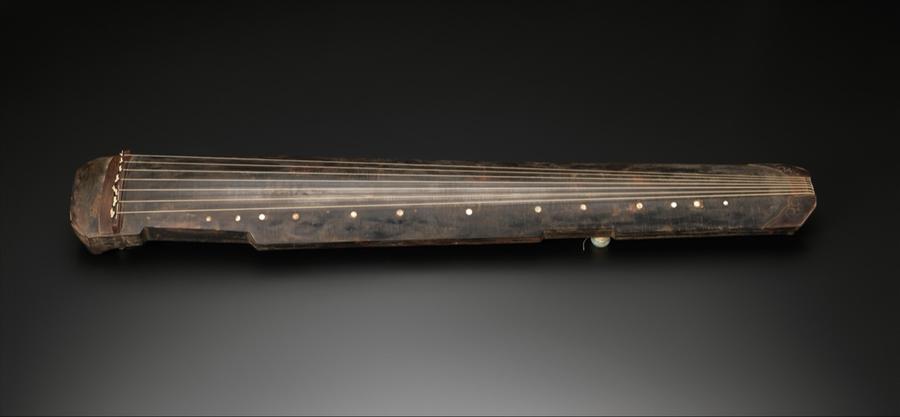
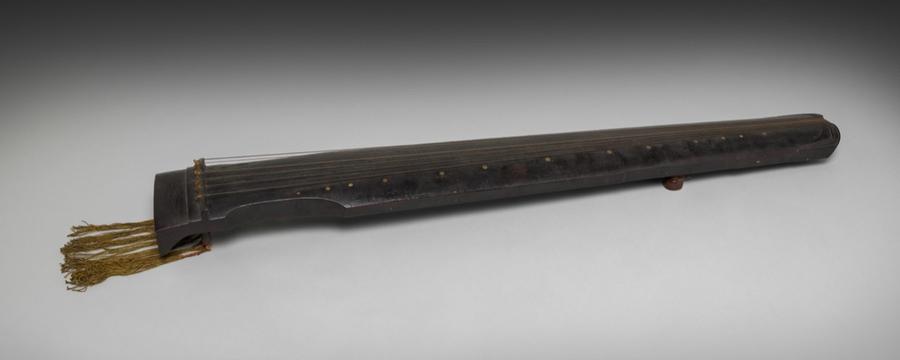
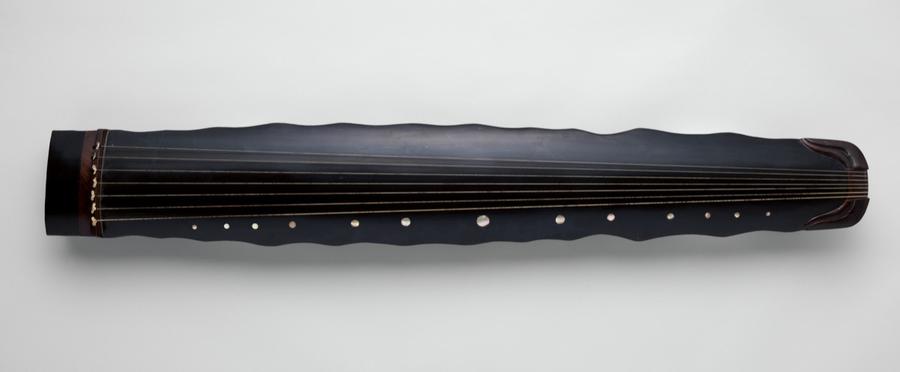
Guqin (古琴 )1634 · Chinese (China) -
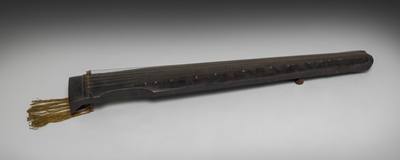
Guqin made by Zhang Ruixiu of Suzhou1584 · China, Ming dynasty (1368–1644) (China) -
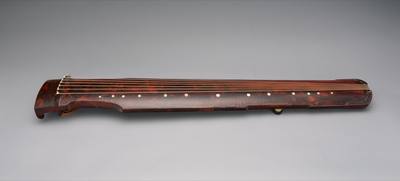
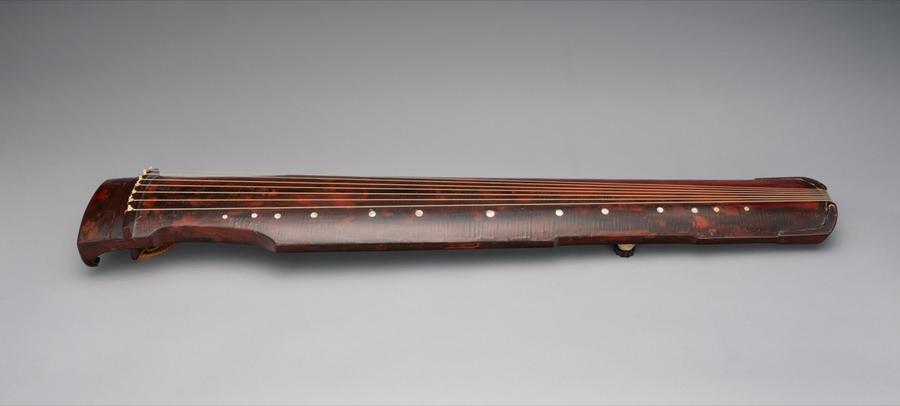
Guqin (古琴 )late 17th–mid 18th century · Chinese (China) -
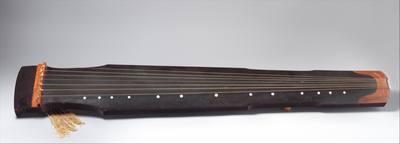
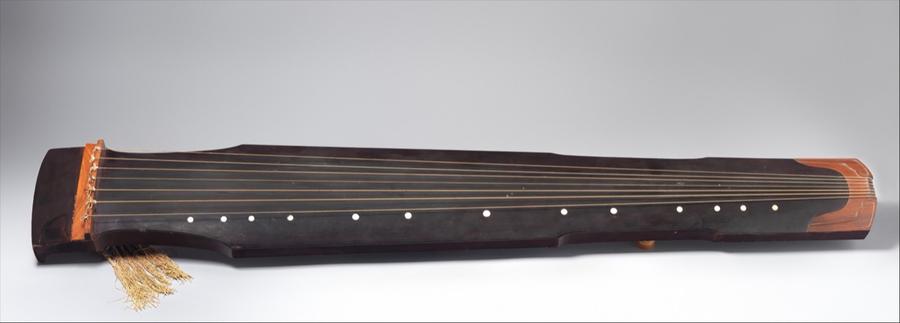
Guqin (古琴 )19th century · Chinese (China) -
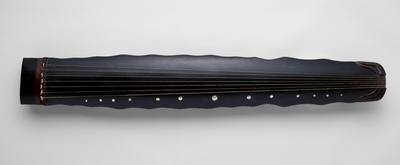
"Xiangpu’s Treasure" Guqin (古琴 )mid 19th century · Chinese (China)
Facts at a glance
| Hornbostel–Sachs number | 312.22 — heterochord half-tube zither |
|---|---|
| Hornbostel–Sachs group | Chordophones › Simple chordophones or zithers › Tube zithers |
| Also known as | qin, Chinese psaltery, Chinese zither, kin, kine, 5-string zither, 7-string zither, lyre, Chinese lyre, ancient qin |
| Classification (Wikipedia infobox) | String |
| Developed | 1st millennium BC or earlier |
| Wikidata labels | 42 languages |
| Wikipedia article | Guqin |
| Wikidata item | Q723720 |
| Wikimedia Commons category | Guqin |
| MusicBrainz instrument | 6e6329ed-27c0-4ace-a6fd-bfc03ae68a40 |
| Encyclopaedia Britannica | art/qin-musical-instrument |
| Audio sample (Wikimedia Commons) | Guqin-Zuiyu Changwan.ogg |
Sources: Wikidata (CC0 1.0) — classification number, aliases, identifiers (dump of 2026-07-22); Wikipedia (CC BY-SA 4.0) — infobox fields (description of the classification number, development, inventors) and the names of the Hornbostel–Sachs groups (article “Hornbostel–Sachs”, revision of 2026-01-04).
The name in other languages
| Language | Name | Also written |
|---|---|---|
| English | guqin | qin, Chinese psaltery, Chinese zither |
| French | guqin | qin, kin, kine |
| German | Qin | Guqin, Gu Qin |
| Spanish | guqin | qixianqin |
| Italian | guqin | |
| Portuguese | guqin | |
| Dutch | guqin | qin |
| Russian | цисяньцинь | гуцинь, цинь |
| Japanese | 古琴 | 琴, グーチン |
| Chinese | 古琴 | 瑶琴, 徽琴, 圣人之器 |
| Korean | 고금 | 구친, 금 |
| Arabic | قوتشين | قو تشين, تشين, القانون الصيني |
Sources: Wikidata (CC0 1.0) — labels and aliases; MusicBrainz (CC0 1.0) — instrument aliases (names only).
About the guqin: history, construction and playing
The guqin (Chinese: 古琴) is a plucked seven-string Chinese musical instrument. It has been played since ancient times, and has traditionally been favoured by scholars and literati as an instrument of great subtlety and refinement, as highlighted by the quote "a gentleman does not part with his qin or se without good reason," as well as being associated with the ancient Chinese philosopher Confucius. It is sometimes referred to by the Chinese as "the father of Chinese music" or "the instrument of the sages". The guqin is not to be confused with the guzheng, another Chinese long stringed instrument also without frets, but with moveable bridges under each string.
Traditionally, the instrument was simply referred to as the qin (琴) but by the twentieth century the term had come to be applied to many other musical instruments as well: the yangqin hammered dulcimer, the huqin family of bowed string instruments, and the Western piano (gangqin) and violin (小提琴, xiaotiqin) are examples of this usage. The prefix gu- (古) was later added for clarification. Thus, the instrument is called today. It can also be called qixian-qin (七絃琴, ‘seven-stringed qin’). Because Robert Hans van Gulik's book about the qin is called The Lore of the Chinese Lute, the guqin is sometimes inaccurately called a lute. Other incorrect classifications, mainly from music compact discs, include "harp" or "table-harp".
History
Legend has it that the qin, the most revered of all Chinese musical instruments, has a history of about 5,000 years, and that the legendary figures of China's pre-history – Fuxi; Shennong; and Huang Di, the "Yellow Emperor" – were involved in its creation. Nearly all qin books and tablature collections published prior to the twentieth century state this as the actual origins of the qin, although this is now viewed as mythology. It is mentioned in Chinese writings dating back nearly 3,000 years, and examples have been found in tombs from about 2,500 years ago. The exact origins of the qin is still a very much continuing subject of debate over the past few decades.
In 1977, a recording of "Flowing Water" (Liu Shui, as performed by Guan Pinghu, one of the best qin players of the 20th century) was chosen to be included in the Voyager Golden Record, a gold-plated LP recording containing music from around the world, which was sent into outer space by NASA on the Voyager 1 and Voyager 2 spacecraft. It is the second-longest excerpt included on the disc. The reason to select a work played on this specific instrument is because the tonal structure of the instrument, its musical scale, is derived from fundamental physical laws related to vibration and overtones, representing the intellectual capacity of human beings on this subject. In 2003, guqin music was proclaimed as one of the Masterpieces of the Oral and Intangible Heritage of Humanity by UNESCO.
Performance
During the performance of qin, musicians may use a variety of techniques to reach the full expressing potential of the instrument. There are many special tablatures that had developed over the centuries specifically dedicated to qin for their reference and a repertoire of popular and ancient tunes for their choice.
Playing technique
The tones of qin can be categorized as three characteristic "sounds". The first type is san yin (散音), which literally means "unfettered sound". It's the fundamental frequency produced by plucking a free string with the fingers of the right hand. The second type, made by plucking a string with the right hand and gently tapping specific note positions on the string with the left hand, will create a crisp sound named fan yin (泛音, ‘floating sound’) or overtone harmonics (the equivalent technique in Western music is the string harmonic or flageolet). Important scale notes, called hui (徽), are marked by 13 glossy white dots made of mica or seashell inset in the front surface of the qin, occur at integer divisions of the string length. The "crystal concordant" (perfectly harmonic) overtones can only be evoked by tapping the strings precisely at these hui. The third type is an yin (按音/案音, ‘pressed sound’), which is sometimes also called shi yin (實音, ‘full sound’) or zou yin (走音, ‘changing sound’). These comprise the major cadences of most qin pieces. To play an yin, the musician stops a string at a specific pitch on the board surface with the left thumb, middle or ring finger, strikes the string with the right hand, then they may slide the left hand up and down to vary the note. This technique is similar to playing a slide guitar across the player's lap. However, the manipulation of qin is much more multifarious than that of a guitar, which has only around 3 or 4 main techniques. (Listen to Pei Lan). According to the book Cunjian Guqin Zhifa Puzi Jilan, there are around 1,070 different finger techniques used for the qin. Thus the qin is possibly the instrument with the most playing techniques in both the Chinese and Western instrument families. Most of the qin's techniques are obsolete, but around 50 of them still appear in modern performance. Sometimes, guqin can be played with a violin bow. It has a tone similar to that of a cello, but raspier.
The above four figures are from an old handbook.
Construction
According to tradition, the qin originally had five strings, representing the five elements of metal, wood, water, fire and earth. Later, in the Zhou dynasty, Zhou Wen Wang added a sixth string to mourn his son, Boyikao. His successor, Zhou Wu Wang, added a seventh string to motivate his troops into battle with the Shang. The thirteen hui (徽) on the surface represent the 13 months of the year (the extra 13th is the 'leap month' in the lunar calendar). The surface board is round to represent Heaven and the bottom board flat to represent the earth. The entire length of the qin (in Chinese measurements) is 3 chi, 6 cun and 5 fen (三) representing the 365 days of the year. Each part of the qin has meaning, some more obvious, like "dragon pool" (龍) and "phoenix pond" (鳳).
Strings
Until recently, the guqin's strings were always made of various thicknesses of twisted silk, but since then most players use modern nylon-flatwound steel strings. This was partly due to the scarcity of high-quality silk strings and partly due to the newer strings' greater durability and louder tone.
Silk strings are made by gathering a prescribed number of strands of silk thread, then twisting them tightly together. The twisted cord of strings is then wrapped around a frame and immersed in a vat of liquid composed of a special mixture of natural glue that binds the strands together. The strings are taken out and left to dry, before being cut into the appropriate length. The top thicker strings (i.e, strings one to four) are further wrapped in a thin silk thread, coiled around the core to make it smoother. According to ancient manuals, there are three distinctive gauges of thickness that one can make the strings. The first is taigu (太古, ‘Great Antiquity’) which is the standard gauge, the zhongqing (中清, ‘Middle Clarity’) is thinner, whilst the jiazhong (加重, ‘Added Thickness’) is thicker. According to the Yugu Zhai Qinpu, zhongqing is the best. The currently used silk string gauge standard was defined by Suzhou silk string maker Pan Guohui (潘國輝).
Although most contemporary players use nylon-wrapped metal strings, some argue that nylon-wrapped metal strings cannot replace silk strings for their refinement of tone. Additionally, nylon-wrapped metal strings can cause damage to the wood of old qins. Many traditionalists feel that the sound of the fingers of the left hand sliding on the strings to be a distinctive feature of qin music. The modern nylon-wrapped metal strings were very smooth in the past, but are now slightly modified in order to capture these sliding sounds.
Around 2007, a new type of strings were produced made of mostly a nylon core coiled with nylon like the metal-nylon strings, possibly in imitation of Western catgut strings. The sound is similar to the metal-nylon strings but without the metallic tone to them (one of the main reasons why traditionalists do not like the metal-nylon strings). The nylon strings can be tuned to standard pitch without breaking and can sustain their tuning whatever the climate, unlike silk. The strings have various names in China, but they are advertised as sounding like silk strings prior to the 1950s, when silk string production stopped.
Tuning
To string a guqin, one traditionally had to tie a fly's head knot (蠅, yingtou jie) at one end of the string, and slip the string through the twisted cord (絨, rongkou) which goes into holes at the head of the qin and then out the bottom through the tuning pegs (軫, zhen). The string is dragged over the bridge (岳山, yueshan), across the surface board, over the nut (龍齦, longyin) to the back of the qin, where the end is wrapped around one of two legs (鳳足, fengzu or 雁足, yanzu). Afterwards, the strings are fine-tuned using the tuning pegs (sometimes, rosin is used on the part of the tuning peg that touches the qin body to stop it from slipping, especially if the qin is tuned to higher pitches). The most common tuning, zheng diao (正調), is pentatonic: 5 6 1 2 3 5 6 (which can be also played as 1 2 4 5 6 1 2) in the traditional Chinese number system or 簡譜, jianpu (i.e. 1=do, 2=re, etc.). Today this is generally interpreted to mean C D F G A c d, but this should be considered sol la do re mi sol la, since historically the qin was not tuned to absolute pitch. Other tunings are achieved by adjusting the tension of the strings using the tuning pegs at the head end. Thus manjiao diao (慢角調) gives 1 2 3 5 6 1 2 and ruibin diao (蕤賔調) gives 1 2 4 5 7 1 2, which is transposed to 2 3 5 6 1 2 3.
Source: Wikipedia, “Guqin” — CC BY-SA 4.0 — text excerpted as published (references, images and tables removed); see the article for the full text and the list of authors. Revision of 2026-06-19.
Sources and licences
- Guqin (古琴 ), Prince Lu, 1634, Chinese (China). Wood (wutong and zi), silk, jade, lacquer, mother-of-pearl. Purchase, Clara Mertens Bequest, in memory of André Mertens, Seymour Fund, The Boston Foundation Gift, Gift of Elizabeth M. Riley, by exchange, and funds from various donors, 1999 (1999.93a-b). Museum record · CC0 1.0 (public domain dedication)
- Guqin made by Zhang Ruixiu of Suzhou, 1584, China, Ming dynasty (1368–1644) (China). Seven-string Asian long zither, chordophone, made from wood, lacquer, mother of pearl, and silk strings. The Charles G. King Jr. collection; Gift of Ralph King in memory of Charles G. King Jr.. Museum record · CC0 1.0 (public domain dedication)
- Guqin (古琴 ), late 17th–mid 18th century, Chinese (China). Wood, silk, mother-of-pearl. Gift of J. C. Y. Watt, 2011 (2011.586). Museum record · CC0 1.0 (public domain dedication)
- Guqin (古琴 ), 19th century, Chinese (China). Wood, horn, silk, mother-of-pearl. The Crosby Brown Collection of Musical Instruments, 1889 (89.4.49). Museum record · CC0 1.0 (public domain dedication)
- "Xiangpu’s Treasure" Guqin (古琴 ), mid 19th century, Chinese (China). wutong wood, lacquer, mother-of-pearl, silk, jade. Gift of Florence and Herbert Irving, 2016 (2016.179.1). Museum record · CC0 1.0 (public domain dedication)
Photographs: open-access collections of the museums named above; each is shown here reduced in size, otherwise unchanged. Text: Wikipedia (CC BY-SA 4.0), Wikidata and MusicBrainz (CC0). The full list of sources and licences is on the credits page.