
Instruments · Chordophones
Viola d'amore
The viola d'amore is a string instrument which was popular in the 17th and 18th century. It is a kind of viola. The name is Italian and means “viola of love”. It can have 6 or 7 strings. It is held under the chin and bowed like a violin. Sometimes it is used today to play music from the 17th and 18th centuries. Occasionally some modern composers have also written music for it.
Summary: Simple English Wikipedia, “Viola d'amore” — CC BY-SA 4.0. Revision of 2013-04-20.
Museum photographs
These 7 photographs span 1700–1910, 3 places of origin and 2 museums. Every photograph is public domain or openly licensed, and links to the museum’s own record.
-
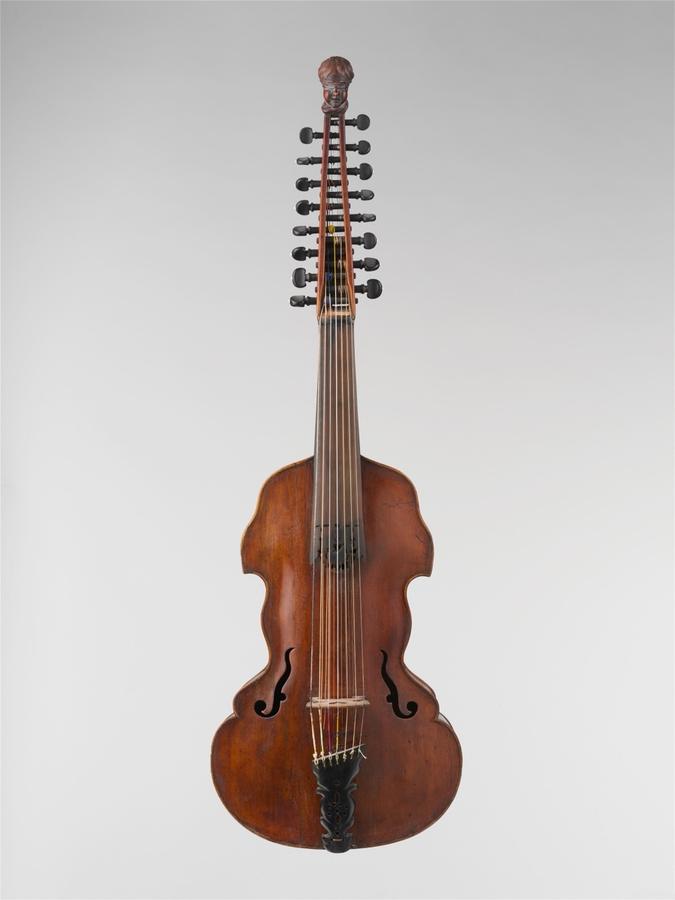
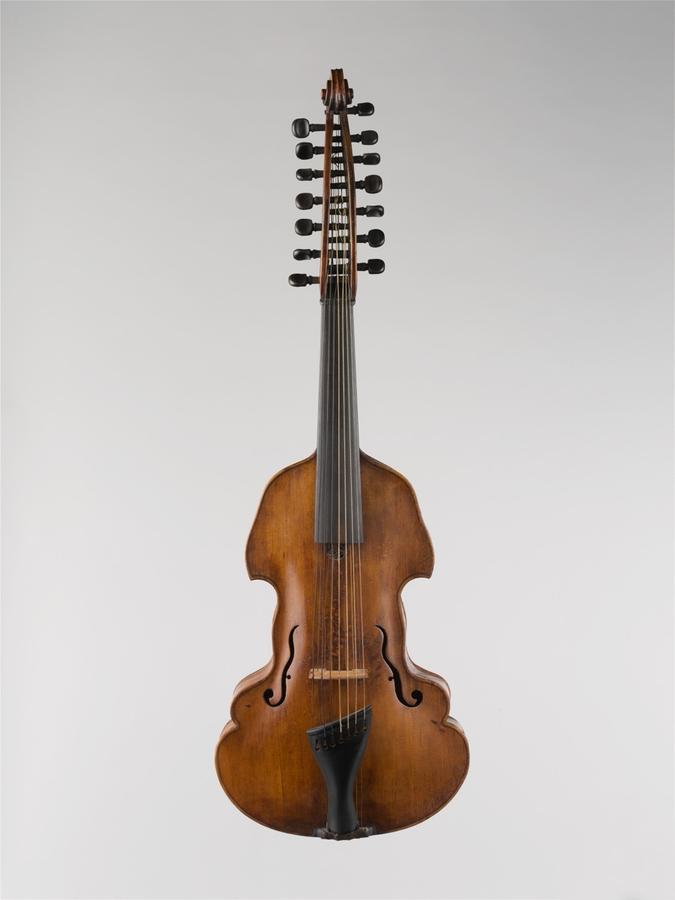
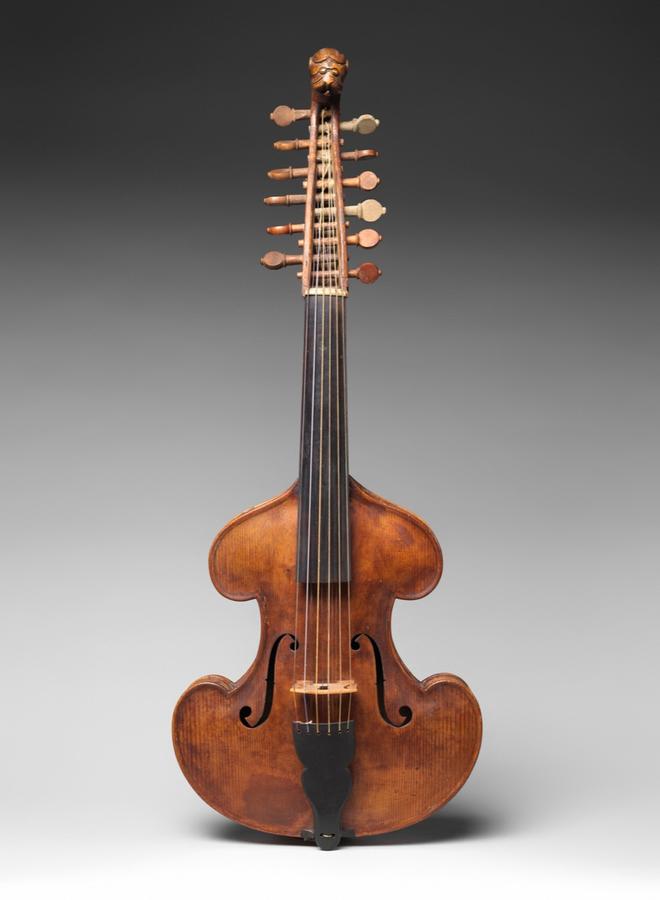
English violet (Viola d'Amore)1726 · Germany -
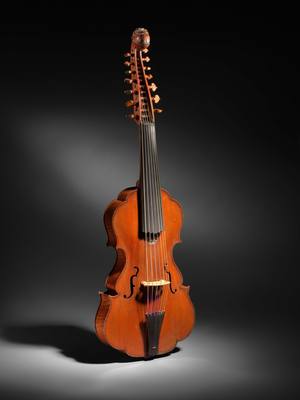
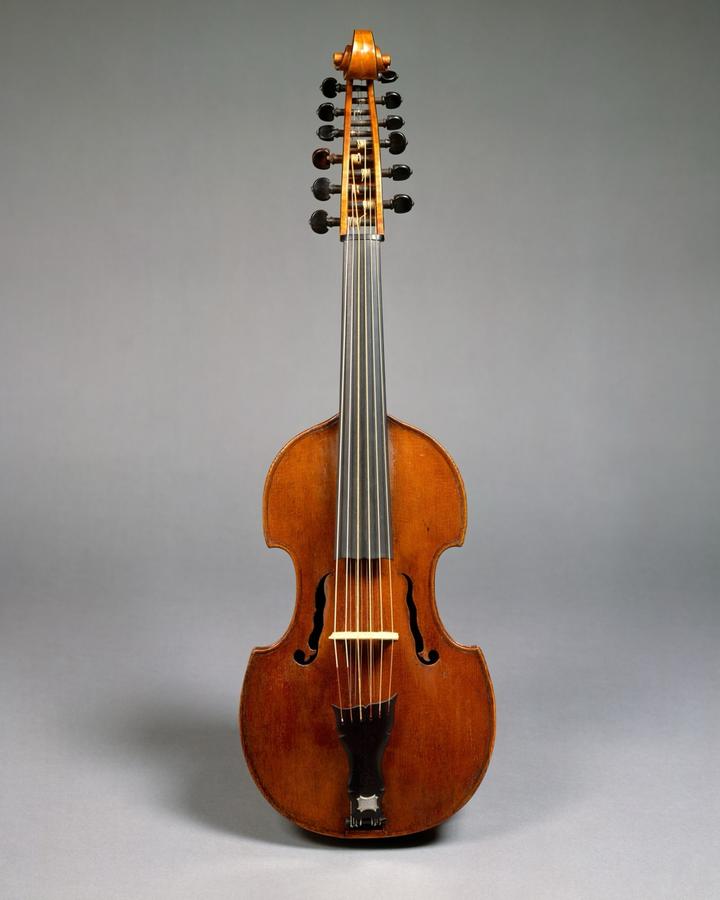
Viola d'Amore18th century · Italian (Italy) -
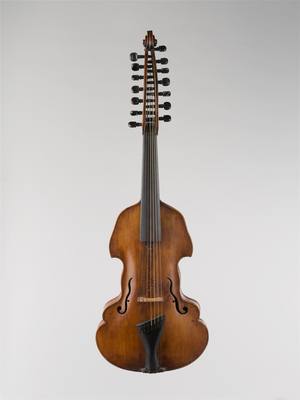
Viola d'Amore1739 · Germany -
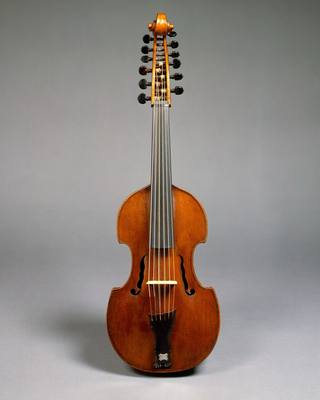
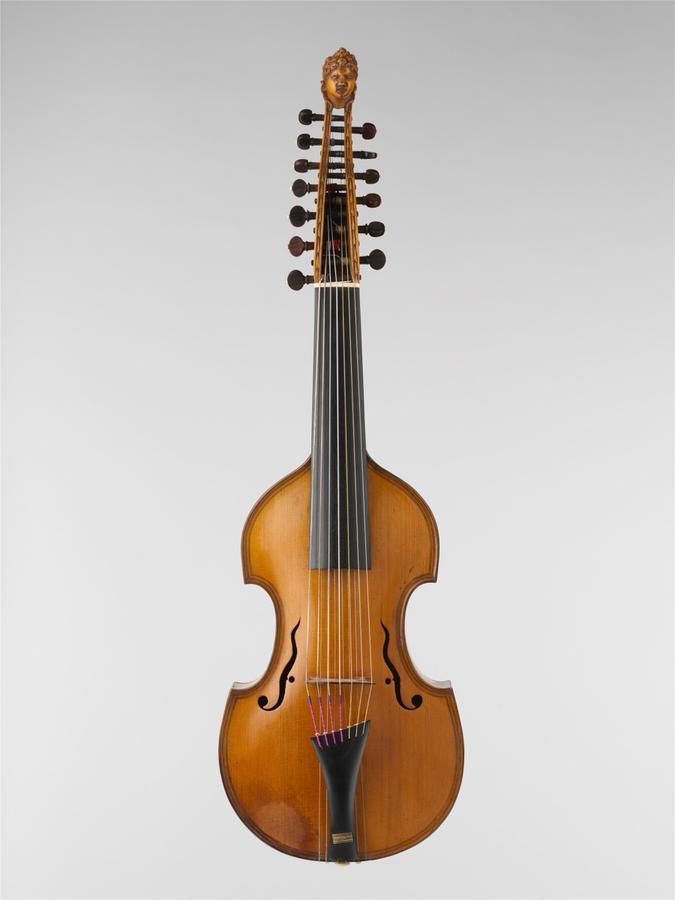
Viola d'Amoreca. 1780 · Italian (Italy) -
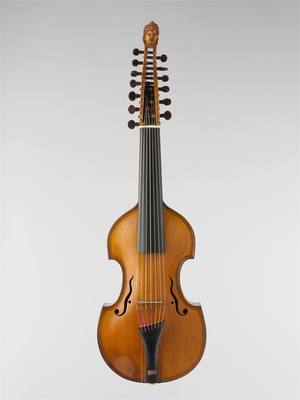
Viola d'Amoresecond half 18th century · French (France) -
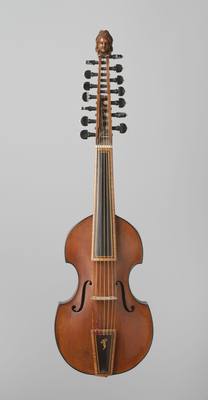
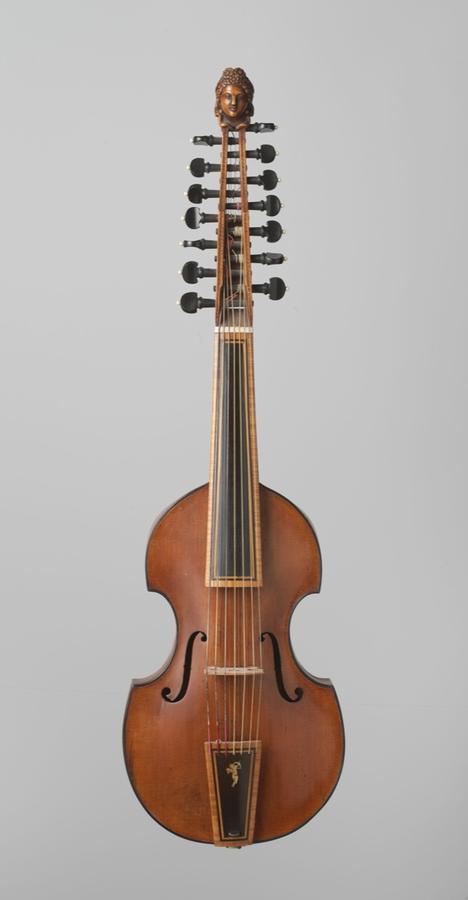
Viola d’Amorec. 1750 · France -
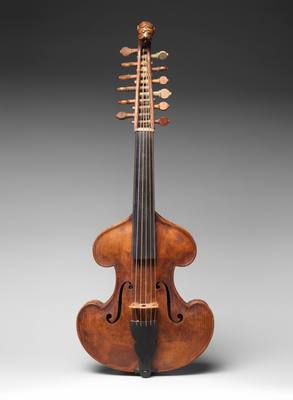
Viola d'Amoreca. 1900 · German
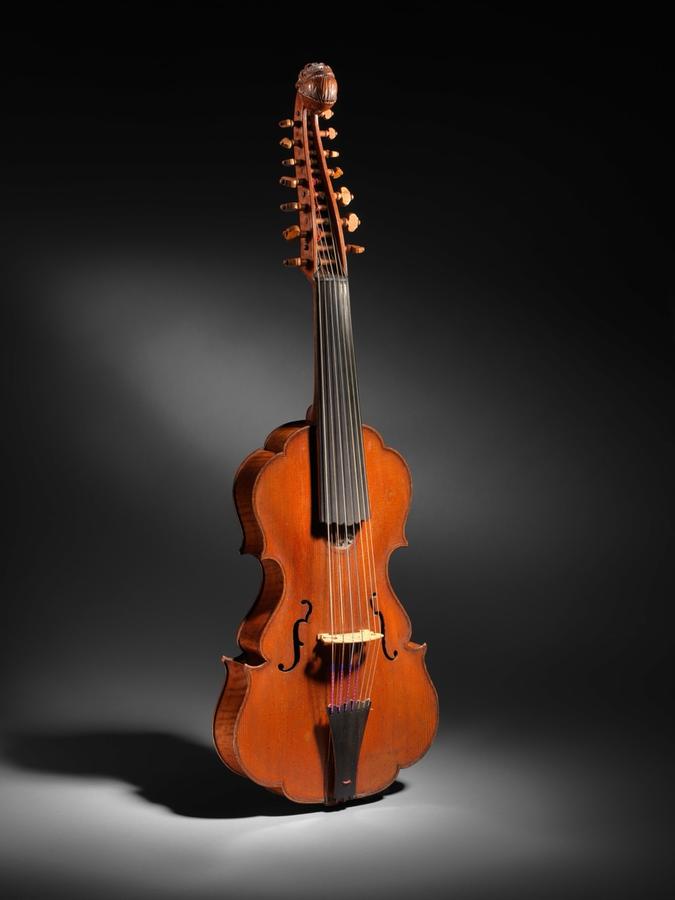
Facts at a glance
| Hornbostel–Sachs number | 321.322-71 — Composite chordophone sounded by a bow |
|---|---|
| Hornbostel–Sachs group | Chordophones › Composite chordophones › Lutes |
| Also known as | viole d'amour |
| Classification (Wikipedia infobox) | Bowed string instrument |
| Wikidata labels | 43 languages |
| Wikipedia article | Viola d'amore |
| Wikidata item | Q742180 |
| Wikimedia Commons category | Viola d'amore |
| MusicBrainz instrument | b47bdb4e-59ee-42d3-96ef-a1f0fdd61148 |
| Encyclopaedia Britannica | art/viola-damore |
Sources: Wikidata (CC0 1.0) — classification number, aliases, identifiers (dump of 2026-07-22); Wikipedia (CC BY-SA 4.0) — infobox fields (description of the classification number, development, inventors) and the names of the Hornbostel–Sachs groups (article “Hornbostel–Sachs”, revision of 2026-01-04).
The name in other languages
| Language | Name | Also written |
|---|---|---|
| English | viola d'amore | viole d'amour |
| French | viole d'amour | Sînekeman, Viole d’amour, Violes d'amour |
| German | Viola d’amore | Viola d'amore, Violino d'amore, Liebesgeige |
| Spanish | viola de amor | Viola d'amour, Viola d'amore |
| Italian | viola d'amore | |
| Portuguese | viola de amor | |
| Dutch | viola d'amore | Viola-dAmore |
| Russian | виоль д’амур | виольдамур, виола д’аморе, виола д'амур |
| Japanese | ヴィオラ・ダモーレ | ヴィオラダモーレ |
| Chinese | 柔音中提琴 | 古中提琴, 柔音维奥尔琴 |
| Korean | 비올라 다모레 | 비올라다모레 |
Sources: Wikidata (CC0 1.0) — labels and aliases; MusicBrainz (CC0 1.0) — instrument aliases (names only).
About the viola d'amore: history, construction and playing
The viola d'amore is a 6- or 7-stringed musical instrument with additional sympathetic strings, which is often associated with music of the Baroque period. It is played under the chin in the same manner as the violin. A player of the instrument may be called a violist d'amore, or simply referred to as a viola d'amore player.
Structure and sound
The viola d'amore shares many features of the viol family. It looks like a thinner treble viol without frets and usually with sympathetic strings added. The six-string viola d'amore and the treble viol also have approximately the same range of playable notes, though the viola d'amore's repertoire generally makes greater use of the higher register. Like all instruments in the viol family, it has a flat back. An intricately carved head at the top of the peg box is common on both viols and viola d'amore, although some instruments lack one. Unlike the carved heads on viols, the viola d'amore's head appears most often in the shape of Cupid blindfolded, representing the blindness of love. This was one of the three usual sound hole shapes for viols as well. It is unfretted, and played much like a violin, being held horizontally under the chin. It is about the same size as the modern viola, though its construction has never been entirely standardized and instruments tend to vary slightly in size.
The viola d'amore usually has six or seven playing strings, which are sounded by drawing a bow across them, just as with a violin or viol. In addition, it has an equal number of sympathetic strings located below the main strings and the fingerboard which are not played directly but vibrate in sympathy with the notes played. A common variation is six playing strings, and instruments exist with as many as fourteen sympathetic strings alone, though these are quite rare. Despite the fact that the sympathetic strings are now thought of as the most characteristic element of the instrument, early forms of the instrument almost uniformly lacked them. The first unambiguous reference to a viola d'amore with sympathetic strings does not occur until the 1730s. Both types continued to be built and played through the 18th century.
Range
As on the treble viol, the register above the octave (d) on the top string is seldom used in music of the 17th and 18th centuries. The viola d'amore was normally tuned specifically for the piece it was to play - cf. scordatura. Most commonly, the instrument would be tuned in D major, and by the end of the 18th century this became the standard: A, d, a, d', f♯', a', d". However, other tunings used include a D minor tuning (achieved by simply lowering the third string to F-natural) and an A minor tuning, both used in the viola d'amore concerti written by Antonio Vivaldi.
The overall range of the modern version of the instrument generally stretches from A2 to A6, though many instruments with longer fingerboards are capable of playing higher than this. Due to the enormous range covered by the open tuning itself, a three-octave A major scale can be played on a seven-string instrument without shifting past first position.
Use
The instrument was especially popular in the late 17th century, although a specialized viola d'amore player would have been highly unusual, since it was customary for professional musicians to play a number of instruments, especially within the family of the musician's main instrument. Towards the end of the 18th century, the instrument largely fell from use, as the volume and power of the violin family became preferred over the more introverted tone of the viol family. However, there has been significant renewed interest in the viola d'amore in the last century. The viola players and composers Henri Casadesus and Paul Hindemith both played the viola d'amore in the early 20th century, and the film composer Bernard Herrmann made use of it in several scores. It may be noted that, like instruments of the violin family, the modern viola d'amore was altered slightly in its construction from the Baroque version, mainly to support the extra tension of steel wound strings.
Leoš Janáček originally planned to use the viola d'amore in his second string quartet, "Intimate Letters". The use of the instrument was symbolic of the nature of his relationship with Kamila Stösslová, a relationship that inspired the work. However, the version with viola d'amore was found in rehearsal to be impracticable, and Janáček re-cast the part for a conventional viola. Sergei Prokofiev's ballet Romeo and Juliet features a viola d'amore as well.
The viola d'amore can be heard today on occasion in musical ensembles that specialise in historically informed performances of Baroque music on authentic instruments, and is heard most often in this style of music as a solo instrument rather than an integrated member of the ensemble. There also exist several viola d'amore players in the modern day that have brought the instrument to genres such as jazz, contemporary, folk, and electronic music.
Scordatura notation
Scordatura notation was first used in the late seventeenth century as a way for violinists to quickly read music for violin with altered tunings. Because the intervals are not uniform across the viola d'amore's range (i.e. the strings are not all tuned in one interval), many violinists began notating viola d'amore music as though the top four strings were tuned in fifths. Heinrich Ignaz Franz Biber, Antonio Vivaldi and Johann Joseph Vilsmayr (a student of Biber), among others, wrote pieces for violin with one or more strings retuned to notes other than the usual fifths. Given that the viola d’amore was usually played by violinists and that many different tunings were used, scordatura notation often made it easier for a violinist to read the music, though it is generally considered archaic by many players today.
Scordatura notation exists in a number of different types. Treble clef, alto clef, and soprano clefs are all used by different composers. Bass clef has often been used for notes on the lower two or three strings (on instruments with more than five strings), and usually sounds an octave higher than written. In scordatura, one imagines that one is playing a violin (or in some cases a viola, where alto clef is used) tuned in the normal fifths. Scordatura notation informs the player not about what note will sound but rather about where they should place their fingers; therefore, it may be referred to as a tablature or "finger" notation. In a more modern convention, alto clef is often used for the lower register (with treble clef having been standardized for the higher register), for ease of notation and transposition. This system was not overall unheard of in the Baroque era, but it became much more popular in music for the instrument from the late 19th century on (such as in works by Loeffler, Hindemith, and Casadesus), and is still used today, alongside the bass clef system.
Source: Wikipedia, “Viola d'amore” — CC BY-SA 4.0 — text excerpted as published (references, images and tables removed); see the article for the full text and the list of authors. Revision of 2026-07-04.
Composers who played it
6 composers on this site list the viola d'amore as an instrument they played. A selection:
- Antonio Vivaldi 1678–1741
- Attilio Ariosti 1666–1729
- Chrétien Urhan 1790–1845
- Duncan Druce 1939–2015
- Tan Dun 1957–
- Louis-Toussaint Milandre
Composers with a page on this site whose Wikidata record lists this instrument; featured and best-dated first. Data: Wikidata (property “instrument”, P1303), CC0 1.0.
Sources and licences
- English violet (Viola d'Amore), Paulus Alletsee, 1726, Germany. Spruce, maple. Funds from various donors, 1981 (1981.7). Museum record · CC0 1.0 (public domain dedication)
- Viola d'Amore, Johannes Florenus Guidantus, 18th century, Italian (Italy). Spruce, maple, ebony. Purchase, Amati Gifts, 2009 (2009.41). Museum record · CC0 1.0 (public domain dedication)
- Viola d'Amore, 1739, Germany. Spruce, maple. The Crosby Brown Collection of Musical Instruments, 1889 (89.4.1470). Museum record · CC0 1.0 (public domain dedication)
- Viola d'Amore, Joseph Gagliano (1742–1820), ca. 1780, Italian (Italy). Spruce, maple, ebony. Gift of H. H. Schambach, 1981 (1981.480). Museum record · CC0 1.0 (public domain dedication)
- Viola d'Amore, Jean-Nicolas Lambert, second half 18th century, French (France). Wood. Purchase, Roth Family Gift, in memory of Norman H. Roth, 1986 (1986.118.2). Museum record · CC0 1.0 (public domain dedication)
- Viola d’Amore, Anonymous, c. 1750, France. wood (plant material). Gift of Elly Lammers and Gerrit van der Veer, Lelystad. Museum record · Public Domain Mark 1.0
- Viola d'Amore, ca. 1900, German. Wood. The Crosby Brown Collection of Musical Instruments, by exchange, 1976 (1976.8.39). Museum record · CC0 1.0 (public domain dedication)
Photographs: open-access collections of the museums named above; each is shown here reduced in size, otherwise unchanged. Text: Wikipedia (CC BY-SA 4.0), Wikidata and MusicBrainz (CC0). The full list of sources and licences is on the credits page.