
Instruments · Chordophones
Double bass
The double bass is a big stringed instrument. It is also called the contrabass or upright bass. It is used in orchestras, jazz bands, rockabilly bands, bluegrass music, and some country music bands. It plays low-pitched musical notes in musical ensembles and bands. In jazz bands, these low-pitched musical lines are called the "bass note." The double bass looks like smaller instruments like the violin, viola, and cello.
Summary: Simple English Wikipedia, “Double bass” — CC BY-SA 4.0. Revision of 2025-07-15.
Hear the real instrument
These are recordings of a real double bass (contrabass), not a synthesiser. Click or tap a key to hear that note, or press Play the range to hear every note the instrument was recorded on, from lowest to highest.
| Recorded instrument | Double bass (contrabass) |
|---|---|
| Sounding range | E1 to C5 — the pitches you hear |
| Written range | E2 to C6 — the notes the player reads on the page |
| Transposition | The double bass is written an octave higher than it sounds. |
| Notes | 45 recorded notes, one for every semitone from lowest to highest. Middle C is C4. |
Without JavaScript: play the lowest note (E1) or the highest note (C5) as MP3 files.
Recordings: IRCAM SOL (TinySOL), CC BY 4.0, Cella et al. Each note is cut from the original recording, levelled in loudness and converted to a short MP3; the playing technique is ordinary (ordinario), mostly at mezzo-forte.
Museum photographs
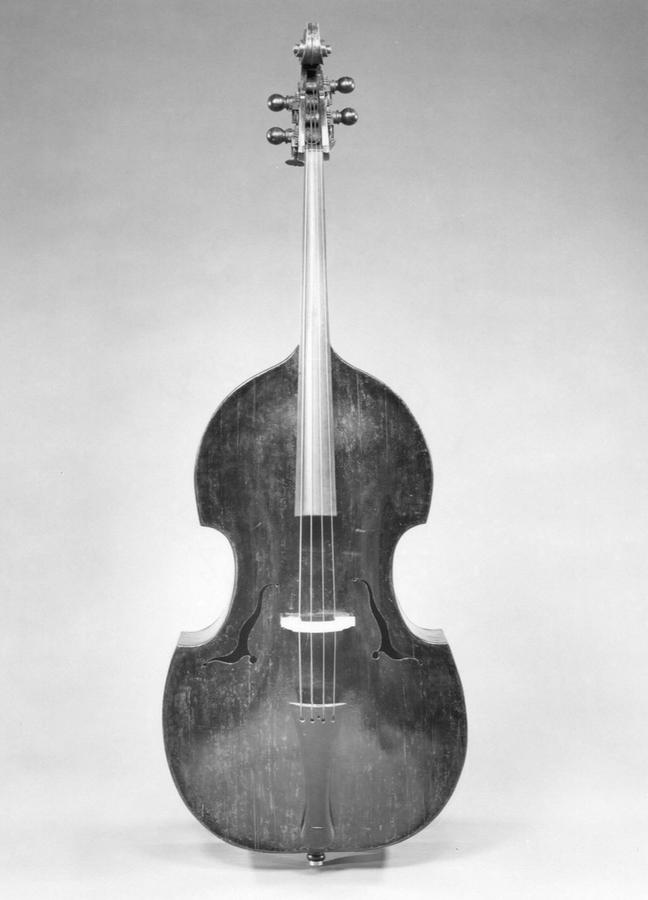
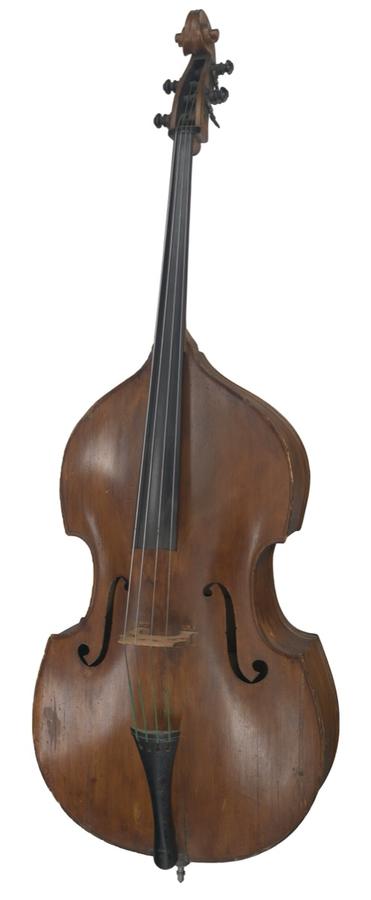
These 3 photographs span 1700–1799, 2 places of origin and 2 museums. 1 of them carry no date in the museum record. Every photograph is public domain or openly licensed, and links to the museum’s own record.
-
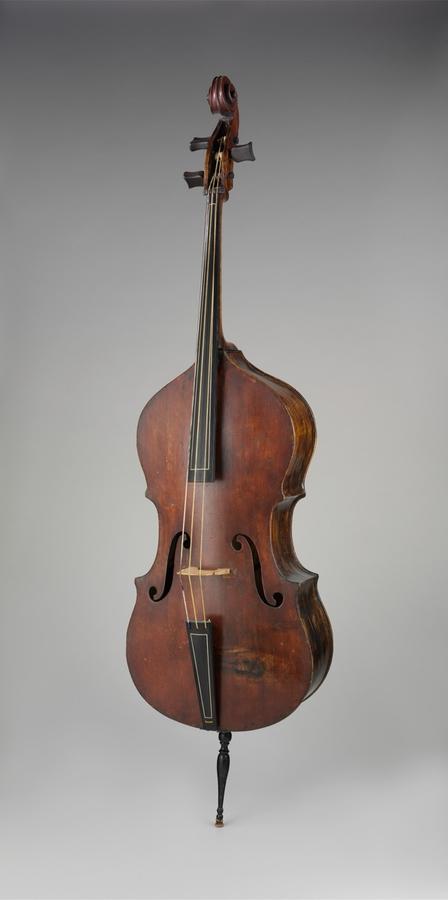
Double Bass18th century · Italian (Italy) -
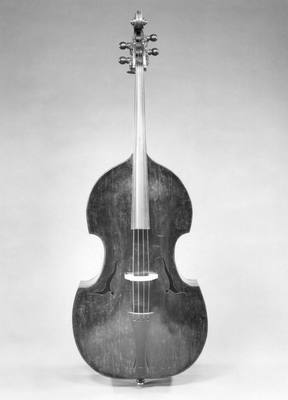
Double Bass1734 · Czech Republic -
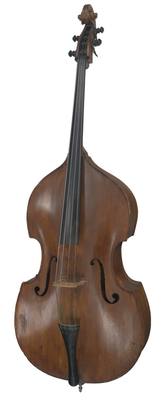
Upright acoustic double bass owned by Stanley Clarkelate 20th century · African Americans
Facts at a glance
| Hornbostel–Sachs number | 321.322-71 — Composite chordophone sounded by a bow |
|---|---|
| Hornbostel–Sachs group | Chordophones › Composite chordophones › Lutes |
| Also known as | string bass, upright bass, doghouse bass, contrabass, stand-up bass, bull fiddle, jazz bass, bass viol, bass (stringed instrument) |
| Classification (Wikipedia infobox) | String instrument (bowed or plucked) |
| Developed | 15th–19th century |
| Wikidata labels | 88 languages |
| Wikipedia article | Double bass |
| Wikidata item | Q80019 |
| Wikimedia Commons category | Double basses |
| MusicBrainz instrument | 7bd32b95-416f-4244-a98b-1311ec69c7db |
| Encyclopaedia Britannica | art/viola-da-gamba |
Sources: Wikidata (CC0 1.0) — classification number, aliases, identifiers (dump of 2026-07-22); Wikipedia (CC BY-SA 4.0) — infobox fields (description of the classification number, development, inventors) and the names of the Hornbostel–Sachs groups (article “Hornbostel–Sachs”, revision of 2026-01-04).
The name in other languages
| Language | Name | Also written |
|---|---|---|
| English | double bass | string bass, upright bass, doghouse bass |
| French | contrebasse | |
| German | Kontrabass | Stehbass, Kontrabaß, Contrabass |
| Spanish | contrabajo | doble bajo, contrabajos |
| Italian | contrabbasso | |
| Portuguese | contrabaixo | Contra-baixos, Contra-Baixo, Contrabaixos |
| Dutch | contrabas | bas, doublebass, staande bas |
| Russian | контрабас | |
| Japanese | コントラバス | アップライト・ベース, アコースティックベース, アップライトベース |
| Chinese | 低音提琴 | 木贝司, 低音大提琴, 弦贝司 |
| Korean | 콘트라베이스 | 더블베이스, 더블 베이스 |
| Arabic | كمان أجهر | دبلبس, كونترباص, كونتراباس |
Sources: Wikidata (CC0 1.0) — labels and aliases; MusicBrainz (CC0 1.0) — instrument aliases (names only).
About the double bass: history, construction and playing
The double bass, also known as the upright bass, the acoustic bass, the bull fiddle, the bass fiddle, the string bass, the contrabass, or simply the bass, is the largest and lowest-pitched chordophone in the modern symphony orchestra (excluding rare additions such as the octobass). It has four or five strings, and its construction is in between that of the gamba (viol) and the violin family.
The bass is a standard member of the orchestra's string section, along with violins, violas, and cellos, as well as the concert band, and is featured in concertos, solo, and chamber music in Western classical music. The bass is used in a range of other genres, such as jazz, blues, rock and roll, rockabilly, country music, bluegrass, tango, folk music and certain types of film and video game soundtracks.
The instrument's exact lineage is still a matter of some debate, with scholars divided on whether the bass is derived from the viol or the violin family.
Being a transposing instrument, the bass is typically notated one octave higher than tuned to avoid excessive ledger lines below the staff. The double bass is the only modern bowed string instrument that is tuned in fourths (like a bass guitar, viol, or the lowest-sounding four strings of a standard guitar), rather than fifths, with strings usually tuned to E1, A1, D2 and G2.
History
The double bass is generally regarded as a modern descendant of the violone (It. “large viol”), a member of the chordophone family that originated in Europe in the 15th century. Before the 20th century many double basses had only three strings, in contrast to the five to six strings typical of instruments in the viol family or the four strings of instruments in the violin family. The double bass's proportions are dissimilar to those of the violin and cello; for example, it is deeper (the distance from front to back is proportionally much greater than the violin). In addition, while the violin has bulging shoulders, most double basses have shoulders carved with a more acute slope, like members of the viol family. Many very old double basses have had their shoulders cut or sloped to aid playing with modern techniques. Before these modifications, the design of their shoulders was closer to instruments of the violin family.
The double bass is the only modern bowed string instrument that is tuned in fourths (like a viol), rather than fifths. The instrument's exact lineage is still a matter of some debate, and the supposition that the double bass is a direct descendant of the viol family is one that has not been entirely resolved.
In his A New History of the Double Bass, Paul Brun asserts that the double bass has origins as the true bass of the violin family. He states that, while the exterior of the double bass may resemble the viola da gamba, the internal construction of the double bass is nearly identical to instruments in the violin family, and very different from the internal structure of viols.
Double bass professor Larry Hurst argues that the "modern double bass is not a true member of either the violin or viol families". He says that "most likely its first general shape was that of a violone, the largest member of the viol family. Some of the earliest basses extant are violones, (including C-shaped sound holes) that have been fitted with modern trappings." Some existing instruments, such as those by Gasparo da Salò, were converted from 16th-century six-string contrabass violoni.
Design
There are two major approaches to the design outline shape of the double bass: the violin form (shown in the labelled picture in the construction section); and the viola da gamba form (shown in the header picture of this article). A third less common design, called the busetto shape, can also be found, as can the even more rare guitar or pear shape. The back of the instrument can vary from being a round, carved back similar to that of the violin, to a flat and angled back similar to the viol family.
The double bass features many parts that are similar to members of the violin family, including a wooden, carved bridge to support the strings, two f-holes, a tailpiece into which the ball ends of the strings are inserted (with the tailpiece anchored around the endpin mount), an ornamental scroll near the pegbox, a nut with grooves for each string at the junction of the fingerboard and the pegbox and a sturdy, thick sound post, which transmits the vibrations from the top of the instrument to the hollow body and supports the pressure of the string tension. Unlike the rest of the violin family, the double bass still reflects influences, and can be considered partly derived, from the viol family of instruments, in particular the violone, the lowest-pitched and largest bass member of the viol family. For example, the bass is tuned in fourths, like a viol, rather than in fifths, which is the standard in the violin group. Also, notice that the 'shoulders' meet the neck in a curve, rather than the sharp angle seen among violins. As with the other violin and viol family instruments that are played with a bow (and unlike mainly plucked or picked instruments like guitar), the double bass's bridge has an arc-like, curved shape. This is done because with bowed instruments, the player must be able to play individual strings. If the double bass were to have a flat bridge, it would be impossible to bow the A and D strings individually.
Construction
The double bass is closest in construction to violins, but has some notable similarities to the violone, the largest and lowest-pitched member of the viol family. Unlike the violone, however, the fingerboard of the double bass is unfretted, and the double bass has fewer strings (the violone, like most viols, generally had six strings, although some specimens had five or four). The fingerboard is made of ebony on high-quality instruments; on less expensive student instruments, other woods may be used and then painted or stained black (a process called "ebonizing"). The fingerboard is radiused using a curve, for the same reason that the bridge is curved: if the fingerboard and bridge were to be flat, then a bassist would not be able to bow the inner two strings individually. By using a curved bridge and a curved fingerboard, the bassist can align the bow with any of the four strings and play them individually. Unlike the violin and viola, but like the cello, the bass fingerboard is somewhat flattened out underneath the E string (the C string on cello), this is commonly known as a Romberg bevel. The vast majority of fingerboards cannot be adjusted by the performer; any adjustments must be made by a luthier. A very small number of expensive basses for professionals have adjustable fingerboards, in which a screw mechanism can be used to raise or lower the fingerboard height.
Strings
The history of the double bass is tightly coupled to the development of string technology, as it was the advent of overwound gut strings, which first rendered the instrument more generally practicable, as wound or overwound strings attain low notes within a smaller overall string diameter than non-wound strings. Professor Larry Hurst argues that had "it not been for the appearance of the overwound gut string in the 1650s, the double bass would surely have become extinct", because thicknesses needed for regular gut strings made the lower-pitched strings almost unplayable and hindered the development of fluid, rapid playing in the lower register.
Prior to the 20th century, double bass strings were usually made of catgut; however, steel has largely replaced it, because steel strings hold their pitch better and yield more volume when played with the bow. Gut strings are also more vulnerable to changes of humidity and temperature, and break more easily than steel strings.
Gut strings are nowadays mostly used by bassists who perform in baroque ensembles, rockabilly bands, traditional blues bands, and bluegrass bands. In some cases, the low E and A are wound in silver, to give them added mass. Gut strings provide the dark, "thumpy" sound heard on 1940s and 1950s recordings. The late Jeff Sarli, a blues upright bassist, said that "Starting in the 1950s, they began to reset the necks on basses for steel strings." Rockabilly and bluegrass bassists also prefer gut because it is much easier to perform the "slapping" upright bass style (in which the strings are percussively slapped and clicked against the fingerboard) with gut strings than with steel strings, because gut does not hurt the plucking fingers as much. A less expensive alternative to gut strings is nylon strings; the higher strings are pure nylon, and the lower strings are nylon wrapped in wire, to add more mass to the string, slowing the vibration, and thus facilitating lower pitches.
Bows
The double bass bow comes in two distinct forms (shown below). The "French" or "overhand" bow is similar in shape and implementation to the bow used on the other members of the orchestral string instrument family, while the "German" or "Butler" bow is typically broader and shorter, and is held in a "hand shake" (or "hacksaw") position.
These two bows provide different ways of moving the arm and distributing force and weight on the strings. Proponents of the French bow argue that it is more maneuverable, due to the angle at which the player holds the bow. Advocates of the German bow claim that it allows the player to apply more arm weight on the strings. The differences between the two, however, are minute for a proficient player, and modern players in major orchestras use both bows.
German bow
The German bow (sometimes called the Butler bow) is the older of the two designs. The design of the bow and the manner of holding it descend from the older viol instrument family. With older viols, before frogs had screw threads to tighten the bow, players held the bow with two fingers between the stick and the hair to maintain tension of the hair. Proponents of the use of German bow claim that the German bow is easier to use for heavy strokes that require a lot of power.
Source: Wikipedia, “Double bass” — CC BY-SA 4.0 — text excerpted as published (references, images and tables removed); see the article for the full text and the list of authors. Revision of 2026-06-07.
From Grove’s Dictionary (1900)
DOUBLE BASS (Ital. Contrabasso or Violone) is the largest of the stringed instruments played with a bow. Whether it was invented before or after the violin is still an unsettled question. In its forms it has some of the characteristics of the older gamba tribe, viz. the flat instead of the arched back, and the slanting shoulder; while, on the other hand, it has the four corners, the f-holes, and in every respect the belly of the violin, thus appearing to be a combination of the gamba and the violin, and therefore probably of a date posterior to both.
This and other similar musical barbarities were committed, until at the Crystal Palace the sensible plan was adopted of having half the number of the basses with four, and the other half with three stringc, thus avoiding the mutilation of phrases like the above, without sacrificing the greater richness of tone which is claimed for the three-stringed instrument.
If the violin is the leader of the orchestra, the double bass is its foundation. To it is given the lowest part, on which both harmony and melody rest. The English term 'double bass' has probably been applied to the instrument because it often doubles in the lower octave the bass of the harmony, given to the bass voice, the violoncello, the bassoon, or some other instrument. In a similar way the 32-feet stop of the organ is termed double diapason because it doubles a 16-feet diapason in the lower octave.
Source: Wikisource, A Dictionary of Music and Musicians (Grove, 1900) — “Double Bass” (entry by Paul David) — Public domain (published 1879–1910; authors died before 1929) — the first paragraphs of the entry, as transcribed; see the page for the full entry.
Composers who played it
34 composers on this site list the double bass as an instrument they played. A selection:
- Jan Dismas Zelenka 1679–1745
- Joseph Dall'Abaco 1710–1805
- Antonio Rosetti 1746–1792
- Johannes Matthias Sperger 1750–1812
- Domenico Dragonetti 1763–1846
- Pierre-Louis Dietsch 1808–1865
- Giovanni Bottesini 1821–1889
- Victor Frédéric Verrimst 1825–1893
- Johann Joseph Abert 1832–1915
- Marian Arkwright 1863–1922
- František Hertl 1906–1973
- André Amellér 1912–1990
Composers with a page on this site whose Wikidata record lists this instrument; featured and best-dated first. Data: Wikidata (property “instrument”, P1303), CC0 1.0.
Sources and licences
- Double Bass, Bartolomeo Cristofori, 18th century, Italian (Italy). Wood. Purchase, The Crosby Brown Collection of Musical Instruments, Gifts of Dr. and Mrs. Guido S. Corriero and Andrea Manley, by exchange, Rogers Fund, and funds from various donors, 1980 (1980.112). Museum record · CC0 1.0 (public domain dedication)
- Double Bass, Johann Ulrich Eberle, 1734, Czech Republic. Wood. Purchase, The Crosby Brown Collection of Musical Instruments, by exchange; Gifts of Mr. and Mrs. Garnett Day, Fred Miller, Mrs. G. C. Glynn and Mr. and Mrs. Jason Berger, in honor of Angna Enters, by exchange; Gifts in memory of June Reid; and Deborah Autorino Gift, 1983 (1983.130). Museum record · CC0 1.0 (public domain dedication)
- Upright acoustic double bass owned by Stanley Clarke, late 20th century, African Americans. wood, metal and steel. Collection of the Smithsonian National Museum of African American History and Culture, Gift of Stanley Clarke. Museum record · CC0 1.0 (public domain dedication)
Photographs: open-access collections of the museums named above; each is shown here reduced in size, otherwise unchanged. Text: Wikipedia (CC BY-SA 4.0), Grove’s Dictionary (public domain), Wikidata and MusicBrainz (CC0). The full list of sources and licences is on the credits page.