
Instruments · Idiophones
Gong
A gong is an East and Southeast Asian musical percussion instrument. It is a bowl-shaped, circular metal disc which a person hits with a mallet or thick padded stick.
Gongs produce two distinct types of sound. A gong with a flat surface gives a "crash" rather than a tuned note. In Indonesian gamelan ensembles, some gongs are made to give a beat note in the range from about 1 to 5 Hz. The use of the term "gong" for both these types of instrument is common.
Summary: Simple English Wikipedia, “Gong” — CC BY-SA 4.0. Revision of 2025-02-23.
Museum photographs
These 7 photographs span 1801–1900, 4 places of origin and 2 museums. 2 of them carry no date in the museum record. Every photograph is public domain or openly licensed, and links to the museum’s own record.
-
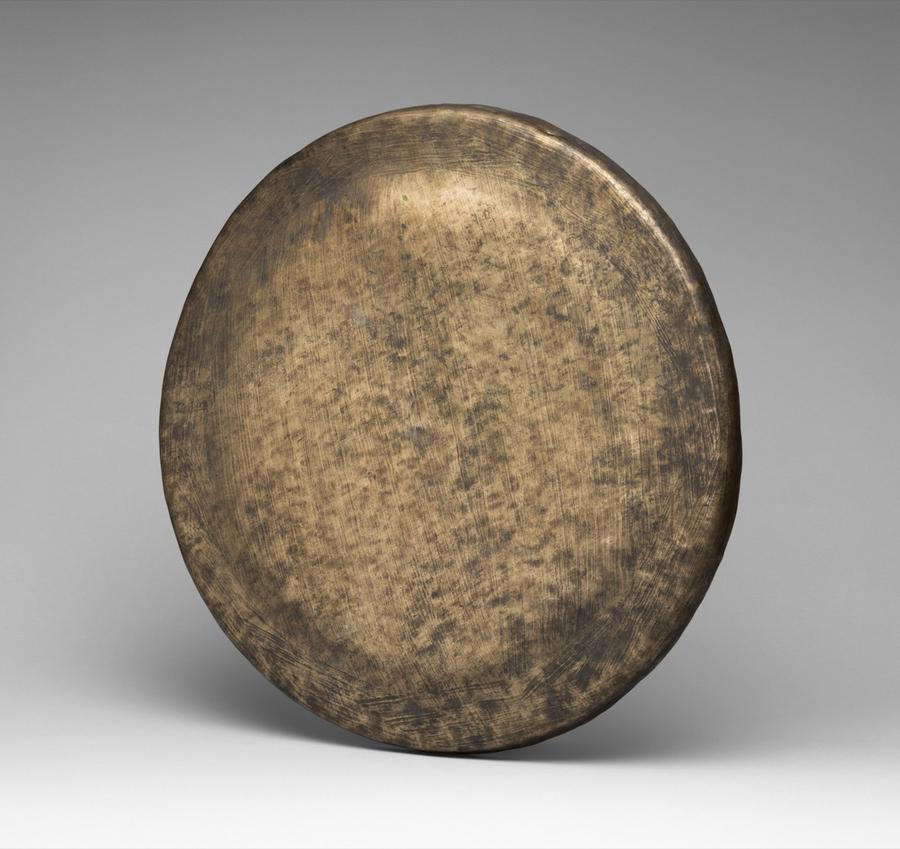
Luo (锣 or 鑼 )19th century · Chinese (China) -
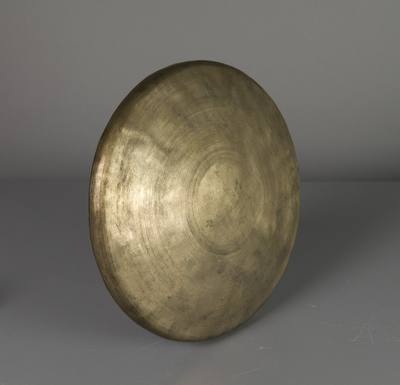
Xiao Luo (小锣)19th century · Chinese (China) -
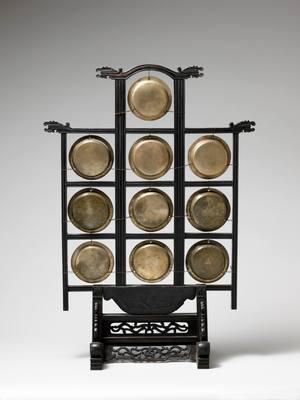
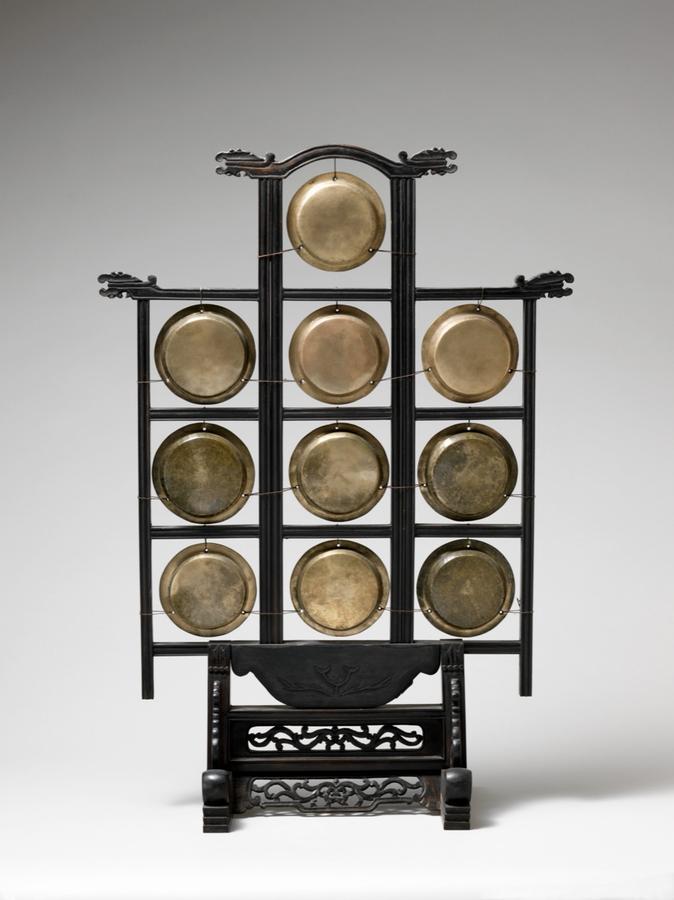
Yunluo (雲鑼 )"Cloud Gong"19th century · Chinese (China) -
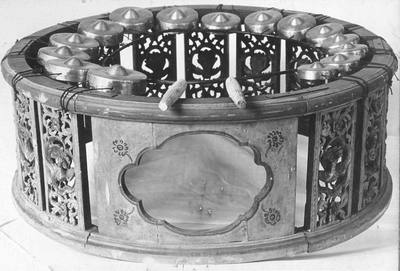
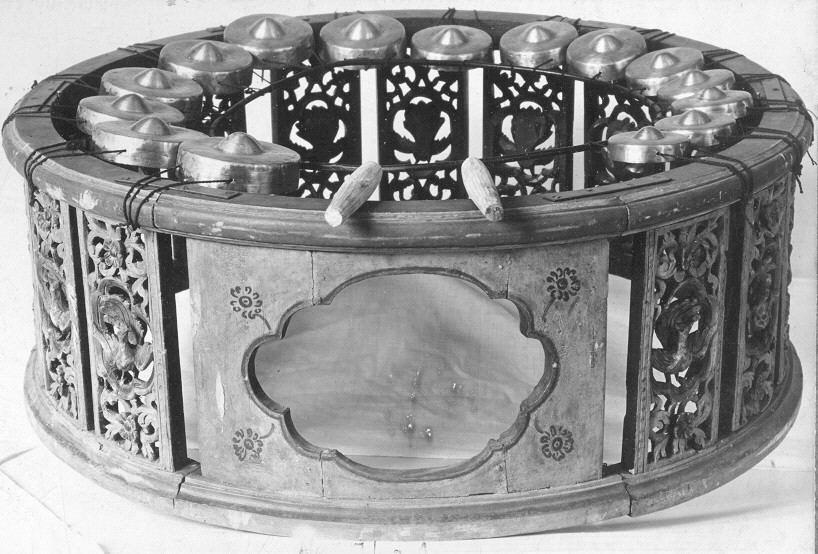
Kyì-waìnglate 19th century · Burmese (Myanmar (formerly Burma)) -
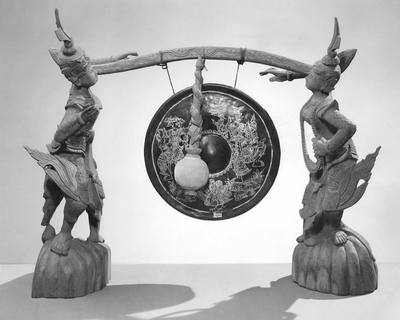
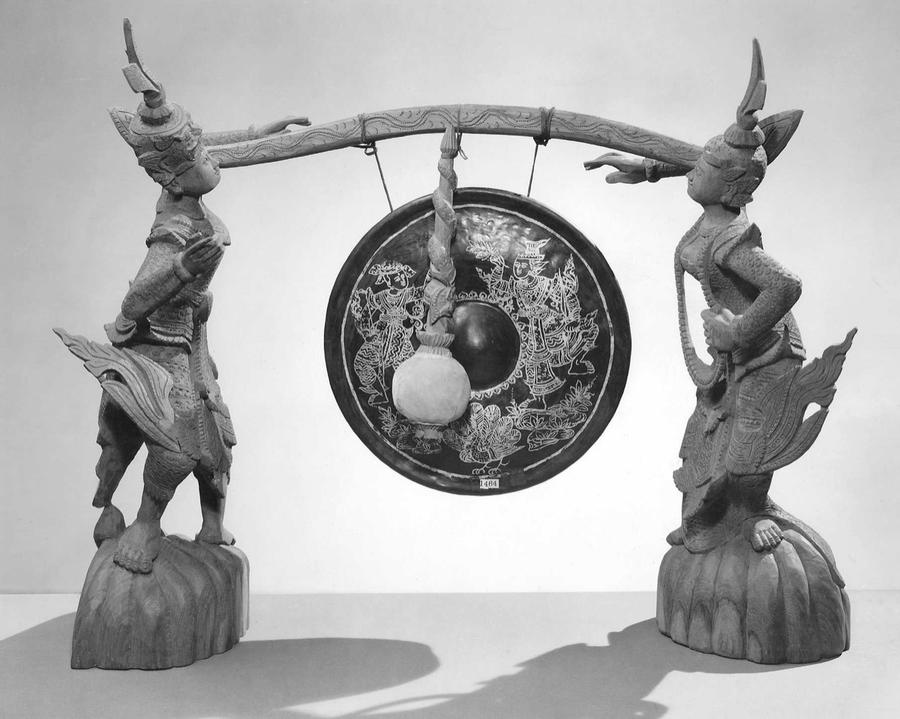
Gonglate 19th century · Burmese (Myanmar (formerly Burma)) -
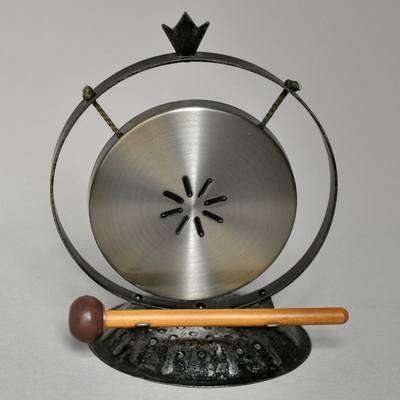
GongUndated · Estonia -
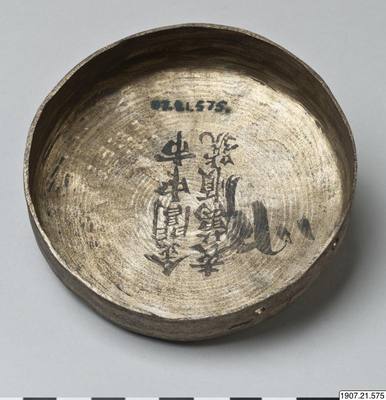
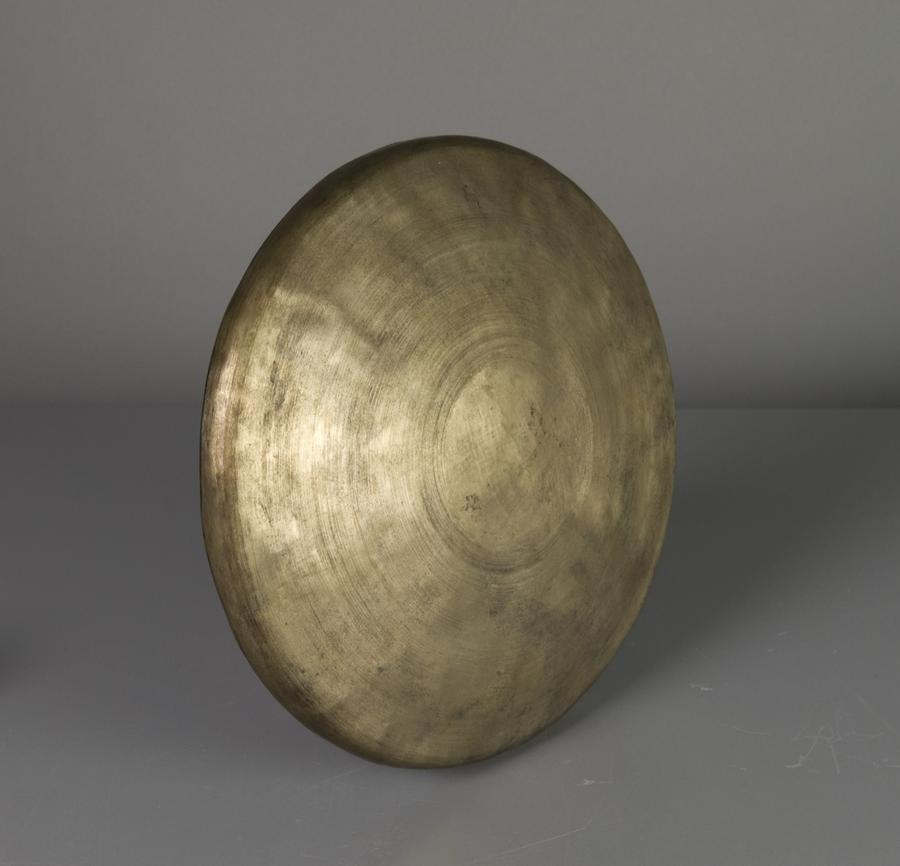
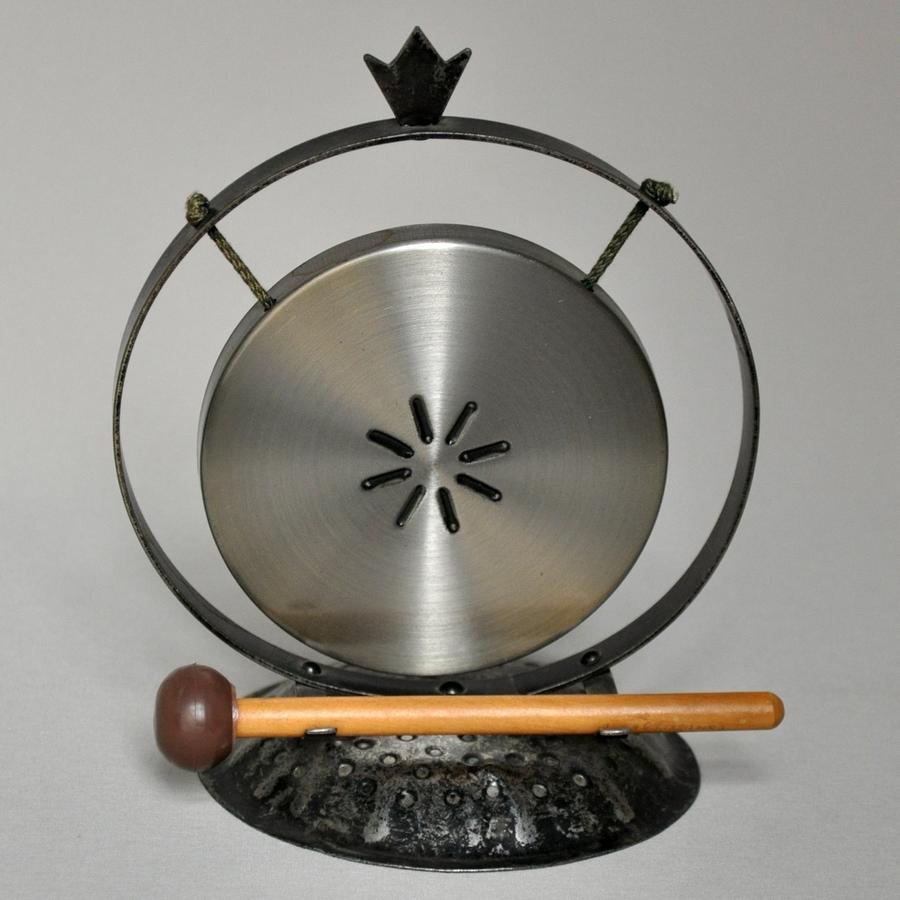
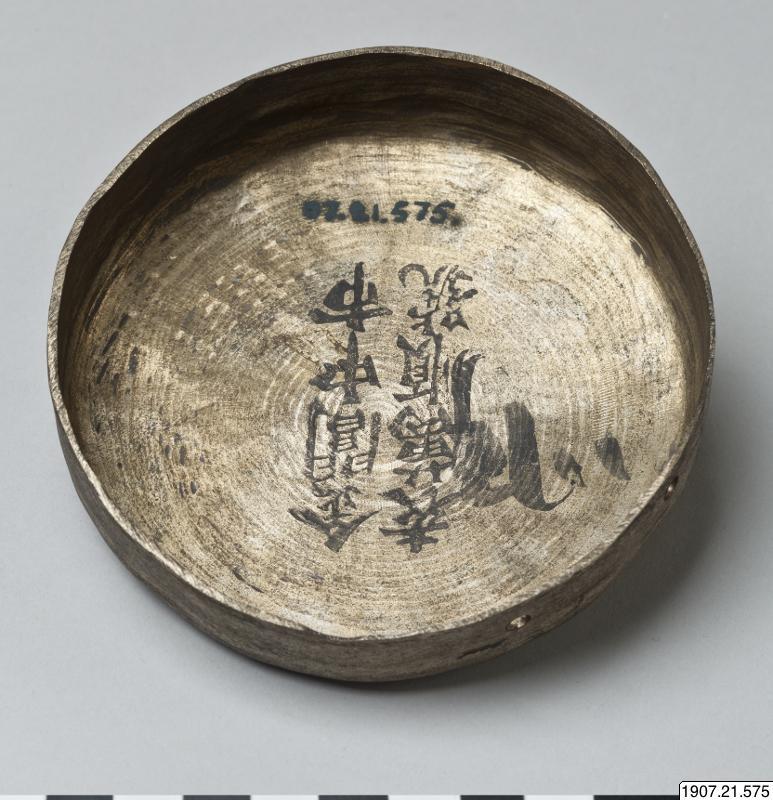
Gong, pang-loUndated · Sweden
Facts at a glance
| Hornbostel–Sachs number | 111.241 |
|---|---|
| Hornbostel–Sachs group | Idiophones › Struck idiophones › Directly struck idiophones |
| Also known as | nipple gongs, bossed, bowl gongs, suspended gongs, gongs, metal gongs |
| Classification (Wikipedia infobox) | Metallophone |
| Wikidata labels | 80 languages |
| Wikipedia article | Gong |
| Wikidata item | Q208320 |
| Wikimedia Commons category | Gongs |
| MusicBrainz instrument | 21e8f13c-aca2-4a34-83a3-951cc347c14a |
| Encyclopaedia Britannica | art/gong-musical-instrument |
| Audio sample (Wikimedia Commons) | Gong or bell vibrant.ogg |
Sources: Wikidata (CC0 1.0) — classification number, aliases, identifiers (dump of 2026-07-22); Wikipedia (CC BY-SA 4.0) — infobox fields (description of the classification number, development, inventors) and the names of the Hornbostel–Sachs groups (article “Hornbostel–Sachs”, revision of 2026-01-04).
The name in other languages
| Language | Name | Also written |
|---|---|---|
| English | Gong | nipple gongs, bossed, bowl gongs |
| French | gong | gongs |
| German | Gong | Gongspiel, Gongs |
| Spanish | gong | tam-tam, batintín, batintin |
| Italian | gong | |
| Portuguese | gongo | Gongos, Tan tan |
| Dutch | gong | gongs |
| Russian | гонг | Тамтам, Там-там |
| Japanese | ゴング | 銅鑼 |
| Chinese | 锣 | 鑼 |
| Korean | 공 | |
| Arabic | جونج | لو, صنجة |
Sources: Wikidata (CC0 1.0) — labels and aliases; MusicBrainz (CC0 1.0) — instrument aliases (names only).
About the gong: history, construction and playing
A gong is a percussion instrument originating from Southeast Asia, and used widely in Southeast Asian and East Asian musical traditions. Gongs are made of metal and are circular and flat or bowl-like in shape, and can come in various sizes. They are typically struck with a mallet. They can be played alone, giving a characteristic "crashing" sound, or played as part of a tuned set that produce bell-like sounds.
The earliest possible depictions of gongs is from the details on the surface of the Ngọc Lũ I bronze drum (c. 3rd to 2nd century BC) from the Dong Son culture of northern Vietnam. It depicts what looks like seven-gong ensembles along with other instruments (including cymbals/bells and the bronze drums themselves). The oldest undisputed historical mention of gongs can be found in sixth century AD Chinese records, which mentioned it as a foreign instrument that came from a country between Tibet and Burma. The term gong (ꦒꦺꦴꦁ) originated in the Indonesian island of Java. Scientific and archaeological research has established that Annam, Java, Burma, and Southern China were the four main gong manufacturing centres of the ancient world. The gong found its way into the Western World in the 18th century, when it was also used in the percussion section of a Western-style symphony orchestra. A form of bronze cauldron gong known as a resting bell was widely used in ancient Greece and Rome: for instance in the famous Oracle of Dodona, where disc gongs were also used.
Types
Suspended gongs are played with hammers and are of two main types: flat faced discs, either with or without a turned edge and gongs with a raised centre boss. In general, the larger the gong, the larger and softer the hammer. In Western symphonic music, the flat faced gongs are generally referred to as tam-tams to distinguish them from their bossed counterparts. Here, the term "gong" is reserved for the bossed type only. The gong has been a Chinese instrument for millennia. Its first use may have been to signal peasant workers in from the fields, because some gongs are loud enough to be heard from up to 5 mi away.
Large flat gongs may be 'primed' by lightly hitting them before the main stroke, greatly enhancing the sound and causing the instrument to "speak" sooner, with a shorter delay for the sound to "bloom". Keeping this priming stroke inaudible calls for a great deal of skill. The smallest suspended gongs are played with bamboo sticks or even western-style drumsticks. Contemporary and avant-garde music, where different sounds are sought, will often use friction mallets (producing squeals and harmonics), bass bows (producing long tones and high overtones), and various striking implements (wood/plastic/metal) to produce the desired tones.
Rock gongs are large stones struck with smaller stones to create a metallic resonating sound.
Chau gong (tam-tam)
By far the most familiar to most Westerners is the chau gong or bullseye gong. Large chau gongs, called tam-tams have become part of the symphony orchestra. Sometimes a chau gong is referred to as a Chinese gong, but in fact, it is only one of many types of suspended gongs that are associated with China. A chau gong is made of copper-based alloy, bronze, or brass. It is almost flat except for the rim, which is turned up to make a shallow cylinder. On a 10 in gong, for example, the rim extends about 1/2 in perpendicular to the surface. The main surface is slightly concave when viewed from the direction to which the rim is turned. The centre spot and rim of a chau gong are left coated on both sides with the black copper oxide that forms during manufacture; the rest is polished to remove this coating. Chau gongs range in size from 7 to 80 in in diameter.
History
The earliest Chau gong is from a tomb discovered at the Guixian site in the Guangxi Zhuang Autonomous Region of China. It dates from the early Western Han dynasty. Gongs are depicted in Chinese visual art as of the 6th century CE, and were known for their very intense and spiritual drumming in rituals and tribal meetings. Traditionally, chau gongs were used to clear the way for important officials and processions, much like a police siren today. Sometimes the number of strokes was used to indicate the seniority of the official. In this way, two officials meeting unexpectedly on the road would know before the meeting which of them should bow down before the other.
Nipple gong
A nipple gong has a central raised boss or nipple, often made of different metals than other gongs with varying degrees of quality and resonance. They have a tone with less shimmer than other gongs, and two distinct sounds depending on whether they are struck on the boss or next to it. They are most often but not always tuned to various pitches.
Nipple gongs range in size from 6 to 20 in or larger. Sets of smaller, tuned nipple gongs can be used to play a melody.
Nipple gongs are used in Chinese temples for worship and Buddhist temples in Southeast Asia.
These are the primary gong in the traditional Philippine music of kulintang.
In Indonesian gamelan ensembles, instruments that are organologically gongs come in various sizes with different functions and different names. For example, in the central Javanese gamelan, the largest gong is called gong ageng, ranges in size up to 1 meter in diameter, has the deepest pitch and is played least often; the next smaller gong is the gong suwukan or siyem, has a slightly higher pitch and replaces the gong ageng in pieces where gong strokes are close together; the kempul is smaller still, has a higher pitch, and is played more frequently. The gong ageng and some gong suwukan have a beat note.
Opera gongs
An essential part of the orchestra for Chinese opera is a pair of gongs, the larger with a descending tone, the smaller with a rising tone. The larger gong is used to announce the entrance of major players or men and to identify points of drama and consequence. The smaller gong is used to announce the entry of lesser players or women and to identify points of humour.
Opera gongs range in size from 7 to 12 in, with the larger of a pair 1 or 2 in larger than the smaller.
Pasi gongs
A Pasi gong is a medium-size gong 12 to 15 in in size, with a loud crashing sound. It is used traditionally to announce the start of a performance, play or magic. Construction varies, some having nipples and some not, so this type is named more for its function than for its structure or even its sound.
Pasi gongs without nipples have found favour with adventurous middle-of-the-road kit drummers.
Wind gong
Wind gongs (also known as Feng or Lion Gongs) are flat bronze discs, with little fundamental pitch, heavy tuned overtones, and long sustain. They are most commonly made of B20 bronze, but can also be made of M63 brass or NS12 nickel-silver. Traditionally, a wind gong is played with a large soft mallet, which gives it a roaring crash to match their namesake. They are lathed on both sides and are medium to large in size, typically 15 to 22 in but sizes from 7 to 60 in are available. The 22 in size is most popular due to its portability and large sound.
They are commonly used by drummers in rock music. Played with a nylon tip drumstick they sound rather like the coil chimes in a mantle clock. Some have holes in the centre, but they are mounted like all suspended gongs by other holes near the rim. The smaller sizes, 7 to 12 in, have a more bell-like tone due to their thickness and small diameter.
Sculptural gongs
Sculptural gongs (also known as Gong Sculptures) are gongs which serve the dual purpose of being a musical instrument and a work of visual art. They are generally not disc shaped, but instead take more complex, even abstract forms. Sculptural gongs were pioneered in the early 1990s by Welsh percussionist and metal crafter, Steve Hubback, who was partially inspired by the work of the French Sound Sculptors, Francois and Bernard Baschet.
Hubback's works have been used by many musicians including solo percussionist Dame Evelyn Glennie and rock drummer Carl Palmer.
English gong and cymbal maker, Matt Nolan, partially inspired by the work of Hubback, also creates sculptural gongs of his own design or to private commission.
UK based sculptor Barry Mason makes gongs in titanium and other elemental metals.
Materials and size
Gongs vary in diameter from about 20 to 60 in. They are made of a bronze alloy composed of a maximum of 22 parts tin to 78 parts copper, but in many cases the proportion of tin is considerably less. This alloy is excessively brittle when cast and allowed to cool slowly, but it can be tempered and annealed in a peculiar manner to alleviate this. When suddenly cooled from red heat, the alloy becomes so soft that it can be hammered and worked on the lathe then hardened by reheating. Afterwards, the gong has all of the qualities and timbre of the Chinese instruments. The composition of the alloy of bronze used for making gongs is stated to be as follows: 76.52% Cu, 22.43% Sn, 0.26% Pb, 0.23% Zn, 0.81% Fe. In Turkish Cymbal making there is also sulfur and silicon in the alloy.
Turkish Cymbals and Gamelan Gongs share beta phase bronze as a metallurgical roots. Tin and copper mix phase transition graphs show a very narrow up-down triangle at 21–24% tin content and 780 C symbolized by β. This is the secret of all past bronze instrument making. When bronze is mixed and heated, it glows orange-red which indicates it has been heated to the beta phase borders where the metal needs to be submerged in cold water to lock the alloy in the beta phase for cymbal making. The gong is then beaten with a round, hard, leather-covered pad that is fitted on a short stick or handle. It emits a peculiarly sonorous sound which can be varied by particular ways of striking the disk. Its complex vibrations burst into a wave-like succession of tones that can be either shrill or deep. In China and Japan gongs are used in religious ceremonies, state processions, marriages and other festivals.
Rail crossing
A railroad crossing with a flashing traffic signal or wigwag will also typically have a warning bell. Mechanical bells, known in some places as a gong, are struck by an electric-powered hammer to audibly warn motorists and pedestrians of an oncoming train. Many railroad crossing gongs are now being replaced by electronic devices with no moving parts.
Source: Wikipedia, “Gong” — CC BY-SA 4.0 — text excerpted as published (references, images and tables removed); see the article for the full text and the list of authors. Revision of 2026-05-16.
Sources and licences
- Luo (锣 or 鑼 ), 19th century, Chinese (China). Metal, wood, leather. The Crosby Brown Collection of Musical Instruments, 1889 (89.4.6). Museum record · CC0 1.0 (public domain dedication)
- Xiao Luo (小锣), 19th century, Chinese (China). Metal. The Crosby Brown Collection of Musical Instruments, 1889 (89.4.7). Museum record · CC0 1.0 (public domain dedication)
- Yunluo (雲鑼 )"Cloud Gong", 19th century, Chinese (China). Bronze, wood. The Crosby Brown Collection of Musical Instruments, 1889 (89.4.15a). Museum record · CC0 1.0 (public domain dedication)
- Kyì-waìng, late 19th century, Burmese (Myanmar (formerly Burma)). Wood, metal. The Crosby Brown Collection of Musical Instruments, 1889 (89.4.1239). Museum record · CC0 1.0 (public domain dedication)
- Gong, late 19th century, Burmese (Myanmar (formerly Burma)). Metal, wood, skin. The Crosby Brown Collection of Musical Instruments, 1889 (89.4.1464). Museum record · CC0 1.0 (public domain dedication)
- Gong, Undated, Estonia. Estonian Sports and Olympic Museum / Estonian e-Repository and Conservation of Collections (via Europeana). Museum record · CC0 1.0 (public domain dedication)
- Gong, pang-lo, Undated, Sweden. Museum of Ethnography / Swedish Open Cultural Heritage (via Europeana). Museum record · CC0 1.0 (public domain dedication)
Photographs: open-access collections of the museums named above; each is shown here reduced in size, otherwise unchanged. Text: Wikipedia (CC BY-SA 4.0), Wikidata and MusicBrainz (CC0). The full list of sources and licences is on the credits page.