
Instruments · Idiophones
Music box
A music box (American English) or musical box (British English) is an automatic musical instrument in a box that produces musical notes by using a set of pins placed on a revolving cylinder or disc to pluck the tuned teeth (or lamellae) of a steel comb. The popular device best known today as a "music box" developed from musical snuff boxes of the 18th century and were originally called carillons à musique (French for "chimes of music"). Some of the more complex boxes also contain a tiny drum and/or bells in addition to the metal comb.
Summary: Wikipedia, “Music box” — CC BY-SA 4.0. Revision of 2026-06-19.
Museum photographs
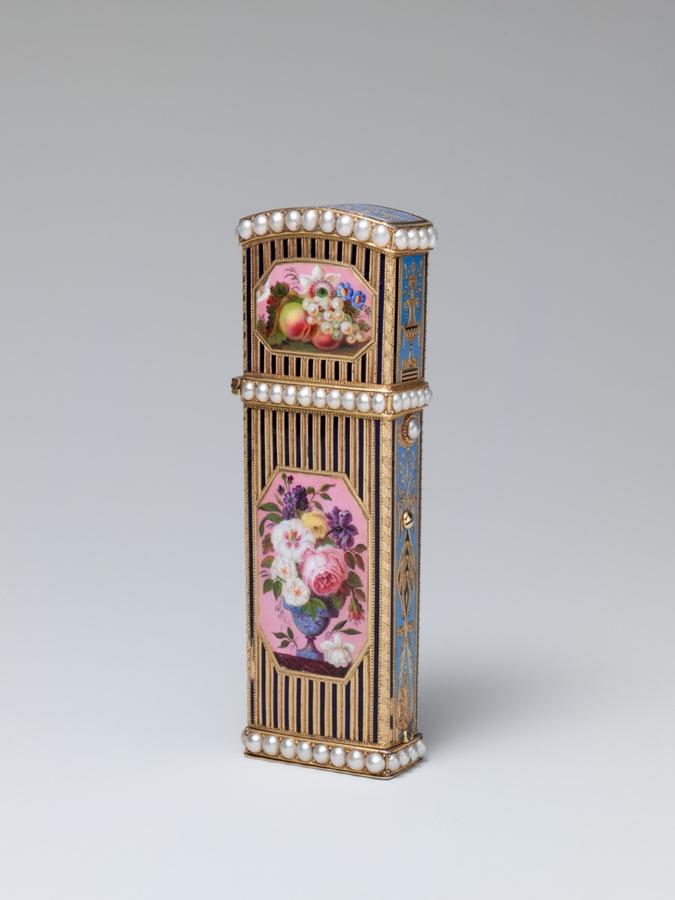
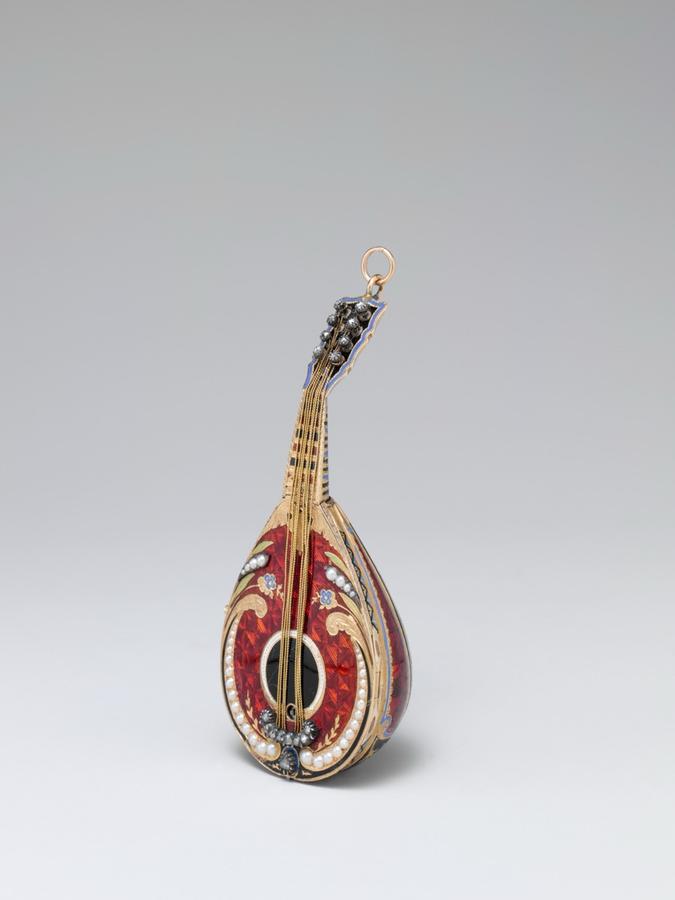
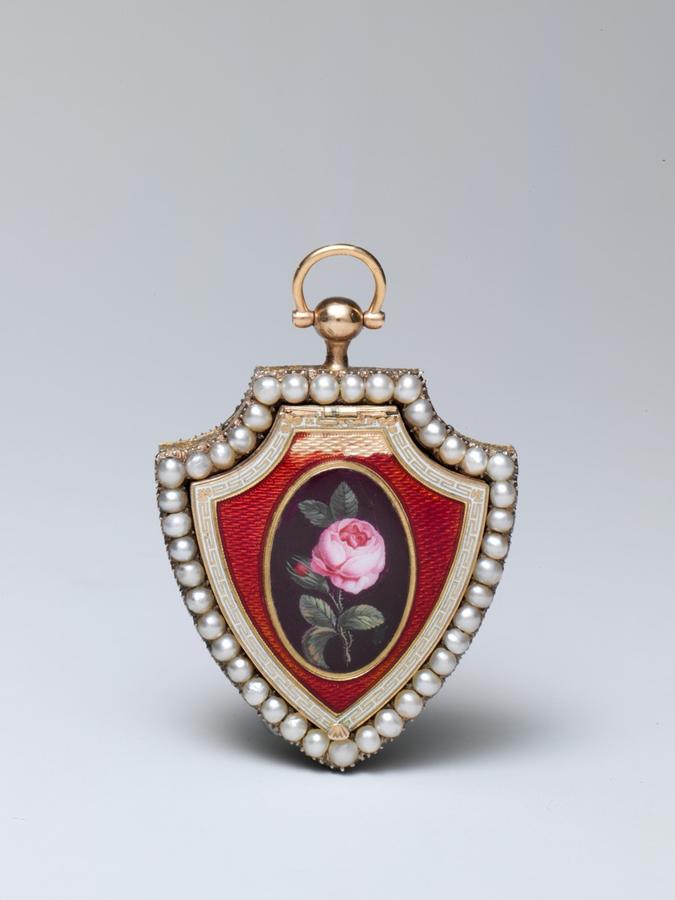
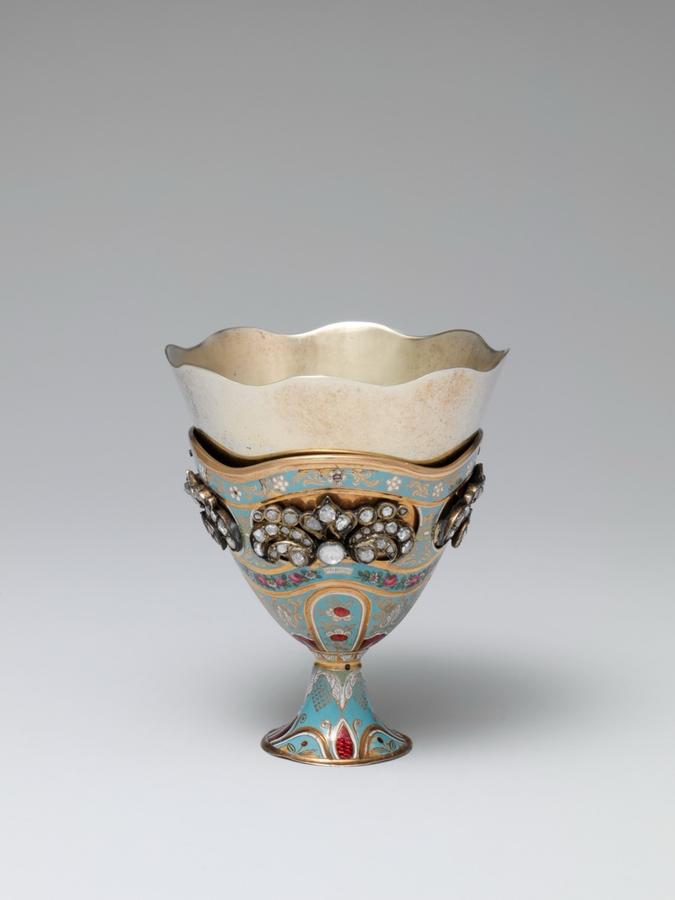
These 7 photographs span 1780–1879, 2 places of origin and 2 museums. Every photograph is public domain or openly licensed, and links to the museum’s own record.
-
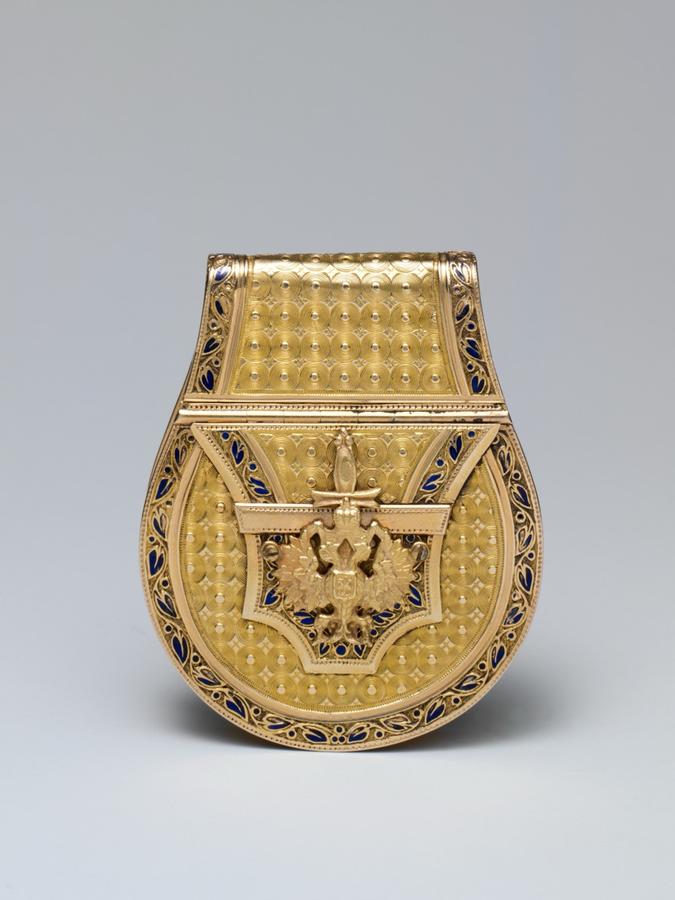
Music Boxca. 1810 · Swiss (Switzerland) -
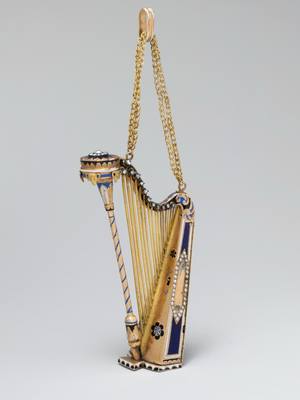
Music Boxca. 1800 · Swiss (Switzerland) -
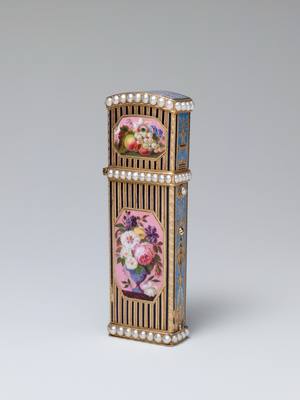
Music Boxearly 19th century · French or Swiss (Switzerland, France) -
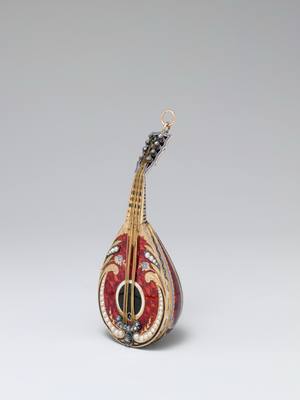
Music Boxca. 1820 · Swiss (Switzerland) -
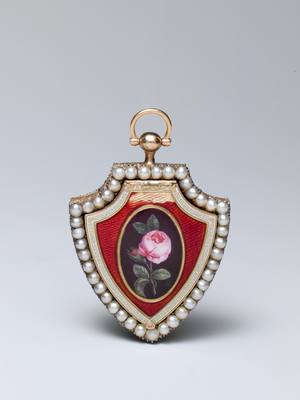
Music Boxca. 1815 · Swiss (Switzerland) -
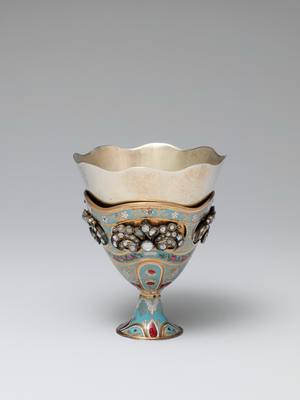
Music Boxca. 1840 · Swiss (Switzerland) -
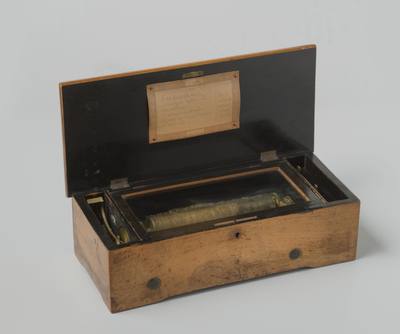
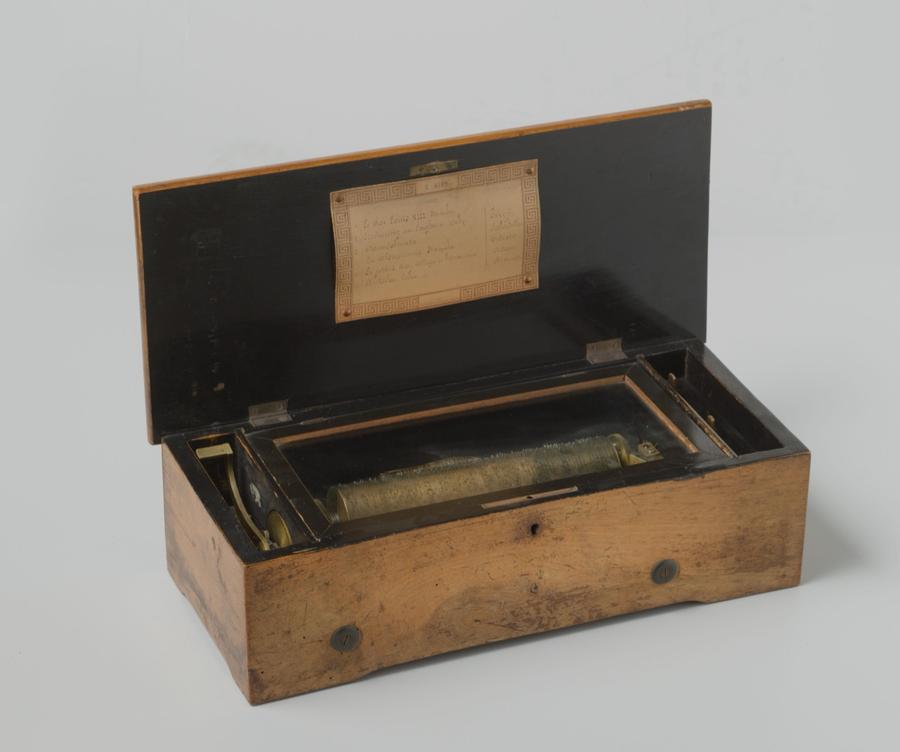
Musical box1874 - 1879 · Sainte-Croix
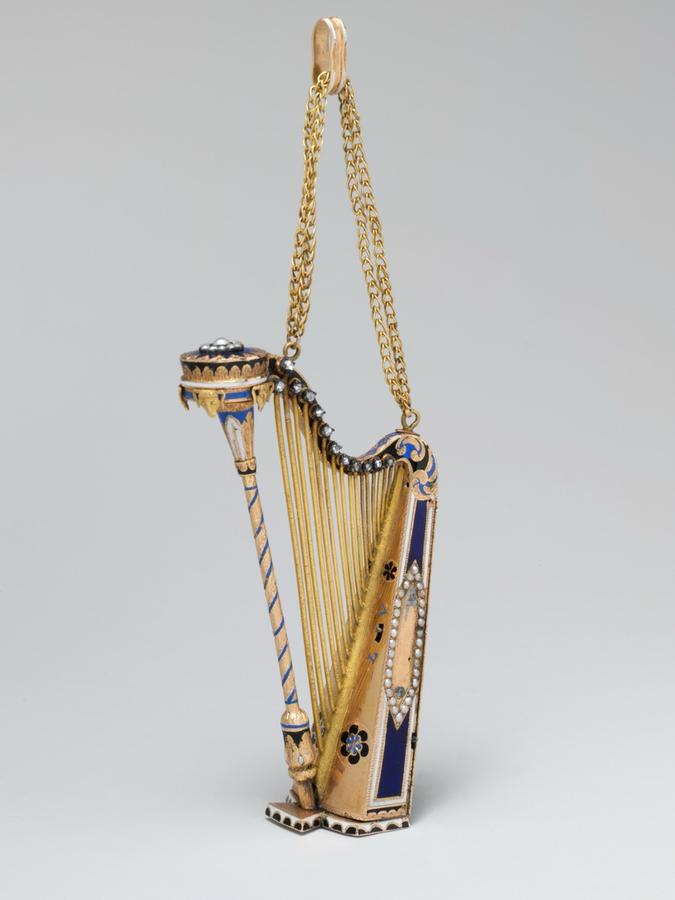
Facts at a glance
| Hornbostel–Sachs number | 112.1 |
|---|---|
| Hornbostel–Sachs group | Idiophones › Struck idiophones › Indirectly struck idiophones |
| Wikidata labels | 45 languages |
| Wikipedia article | Music box |
| Wikidata item | Q1365218 |
| Wikimedia Commons category | Musical boxes |
| MusicBrainz instrument | 2f5f6a67-2b2b-4857-92b0-5b25d485f632 |
| Encyclopaedia Britannica | art/music-box |
Sources: Wikidata (CC0 1.0) — classification number, aliases, identifiers (dump of 2026-07-22); Wikipedia (CC BY-SA 4.0) — infobox fields (description of the classification number, development, inventors) and the names of the Hornbostel–Sachs groups (article “Hornbostel–Sachs”, revision of 2026-01-04).
The name in other languages
| Language | Name | Also written |
|---|---|---|
| English | music box | musical box |
| French | boîte à musique | boîte-à-musique, boite à musique, boite a musique |
| German | Spieldose | Spieluhr |
| Spanish | caja de música | Cajon de musica, Cajita de música, Caja de musica |
| Italian | carillon | scatola musicale, scatole musicali, scatola sonora |
| Portuguese | caixa de música | |
| Dutch | speeldoos | muziekspeeldoos, muziekdoos |
| Russian | музыкальная шкатулка | музыкальная табакерка |
| Japanese | オルゴール | 自鳴琴 |
| Chinese | 八音盒 | 八音琴, 音樂盒, 自鸣琴 |
| Korean | 음악상자 | 自鳴琴, 音樂箱子, 뮤직박스 |
| Arabic | صندوق موسيقي | العلبة الموسيقية |
Sources: Wikidata (CC0 1.0) — labels and aliases; MusicBrainz (CC0 1.0) — instrument aliases (names only).
About the music box: history, construction and playing
A music box (American English) or musical box (British English) is an automatic musical instrument in a box that produces musical notes by using a set of pins placed on a revolving cylinder or disc to pluck the tuned teeth (or lamellae) of a steel comb. The popular device best known today as a "music box" developed from musical snuff boxes of the 18th century and were originally called carillons à musique (French for "chimes of music"). Some of the more complex boxes also contain a tiny drum and/or bells in addition to the metal comb.
History
The Symphonium company started business in 1885 as the first manufacturers of disc-playing music boxes. Two of the founders of the company, Gustave Brachhausen and Paul Riessner, left to set up a new firm, Polyphon, in direct competition with their original business and their third partner, Oscar Paul Lochmann. Following the establishment of the Original Musikwerke Paul Lochmann in 1900, the founding Symphonion business continued until 1909.
According to the Victoria Museums in Australia, "The Symphonion is notable for the enormous diversity of types, styles, and models produced... No other disc-playing musical box exists in so many varieties. The company also pioneered the use of electric motors... the first model fitted with an electric motor being advertised in 1900. The company moved into the piano-orchestrion business and made both disc-operated and barrel-playing models, player-pianos, and phonographs."
Meanwhile, Polyphon expanded to America, where Brachhausen established the Regina Company. Regina was a spectacular success. It eventually reinvented itself as a maker of vacuums and steam cleaners.
In the heyday of the music box, some variations were as tall as a grandfather clock and all used interchangeable large disks to play different sets of tunes. These were spring-wound and driven and both had a bell-like sound. The machines were often made in England, Italy, and the US, with additional disks made in Switzerland, Austria, and Prussia. Early "juke-box" pay versions of them existed in public places. Marsh's free Museum and curio shop in Long Beach, Washington (US) has several still-working versions of them on public display. The Musical Museum, Brentford, London has a number of machines. The Morris Museum in Morristown, New Jersey, USA has a notable collection, including interactive exhibits. In addition to video and audio footage of each piece, the actual instruments are demonstrated for the public daily on a rotational basis.
Timeline
9th century: In Baghdad, the Banū Mūsā brothers, a trio of Persian inventors, produced "the earliest known mechanical musical instrument", in this case a hydropowered organ which played interchangeable cylinders automatically, which they described in their Book of Ingenious Devices. According to Charles B. Fowler, this "cylinder with raised pins on the surface remained the basic device to produce and reproduce music mechanically until the second half of the nineteenth century."
Early 13th century: In Flanders, an ingenious bell ringer invented a cylinder with pins which operates cams, which then hit the bells.
1598: Flemish clockmaker Nicholas Vallin produced a wall-mounted clock which has a pinned barrel playing on multiple tuned bells mounted in the superstructure. The barrel can be programmed, as the pins can be separately placed in the holes provided on the surface of the barrel.
1665: Ahasuerus Fromanteel in London made a table clock which has quarter striking and musical work on multiple bells operated by a pinned barrel. These barrels could be changed for those playing different tunes.
1772: A watch was made by one Ransonet at Nancy, France which has a pinned drum, playing music not on bells but on tuned steel prongs arranged vertically.
1796: Antoine Favre-Salomon, a clockmaker from Geneva replaced the stack of bells by a comb with multiple pre-tuned metallic notes in order to reduce space. Together with a horizontally placed pinned barrel, this produced more varied and complex sounds. One of these first music boxes is now displayed at the Shanghai Gallery of Antique Music Boxes and Automata in Pudong's Oriental Art Center.
1877: Thomas Edison invents the phonograph, which has important consequences for the musical-box industry, especially around the end of the century.
In 2010 American jazz guitarist Pat Metheny released the album Orchestrion on which he performed alongside a variety of custom-designed and built acoustic and electromechanical orchestrions which comprised the rest of the "band", playing music in real-time through the MIDI file format.
Source: Wikipedia, “Music box” — CC BY-SA 4.0 — text excerpted as published (references, images and tables removed); see the article for the full text and the list of authors. Revision of 2026-06-19.
From Grove’s Dictionary (1900)
SNUFF-BOX, MUSICAL. A mechanical invention which has given pleasure to thousands from the peculiar—what for want of a better expression we may call Æolian—charm arising from the production of harmonics in the solid part of the steel comb which provides the necessary reinforcement to the sounds emitted by the teeth of the comb. The motive power is a pinned cylinder resembling the barrel of a mechanical organ, and made to shift on the same principle; the working power is a spring; the mechanism and rotation are closely allied to those of a watch or clock; and the teeth of the comb which produce the notes are measured to scale.
Musical boxes were invented about the beginning of the present century, probably in Switzerland, the chief seat of their production, where there are now some twenty principal manufactories. About 30,000 are said to be made annually, half of which are below the selling value of 50 francs each. The original musical boxes are small and not unlike a snuff-box in appearance. They are now made of all sizes, the cost ranging from 20s. to 50l.
Source: Wikisource, A Dictionary of Music and Musicians (Grove, 1900) — “Snuff-Box, Musical” (entry by Alfred James Hipkins) — Public domain (published 1879–1910; authors died before 1929) — the first paragraphs of the entry, as transcribed; see the page for the full entry.
Sources and licences
- Music Box, ca. 1810, Swiss (Switzerland). Various materials. Gift of Murtogh D. Guinness, 1976 (1976.285.1a, b). Museum record · CC0 1.0 (public domain dedication)
- Music Box, ca. 1800, Swiss (Switzerland). Various materials. Gift of Murtogh D. Guinness, 1976 (1976.285.6a, b). Museum record · CC0 1.0 (public domain dedication)
- Music Box, early 19th century, French or Swiss (Switzerland, France). Various materials. Gift of Murtogh D. Guinness, 1976 (1976.285.7). Museum record · CC0 1.0 (public domain dedication)
- Music Box, ca. 1820, Swiss (Switzerland). Various materials. Gift of Murtogh D. Guinness, 1976 (1976.285.3a–c). Museum record · CC0 1.0 (public domain dedication)
- Music Box, ca. 1815, Swiss (Switzerland). Gold, enamel. Gift of Murtogh D. Guinness, 1976 (1976.285.20). Museum record · CC0 1.0 (public domain dedication)
- Music Box, ca. 1840, Swiss (Switzerland). Various materials. Gift of Murtogh D. Guinness, 1976 (1976.285.14a, b). Museum record · CC0 1.0 (public domain dedication)
- Musical box, 1874 - 1879, Sainte-Croix. wood (plant material). Private gift. Museum record · Public Domain Mark 1.0
Photographs: open-access collections of the museums named above; each is shown here reduced in size, otherwise unchanged. Text: Wikipedia (CC BY-SA 4.0), Grove’s Dictionary (public domain), Wikidata and MusicBrainz (CC0). The full list of sources and licences is on the credits page.