
Instruments · Idiophones
Handbell
A handbell is a bell designed to be rung by hand. To ring a handbell, a ringer grasps the bell by its slightly flexible handle – traditionally made of leather, but often now made of plastic – and moves the arm to make the hinged clapper strike the inside of the bell. An individual handbell can be used simply as a signal to catch people's attention or summon them together, but handbells are also often heard in tuned sets.
Summary: Wikipedia, “Handbell” — CC BY-SA 4.0. Revision of 2026-06-16.
Museum photographs
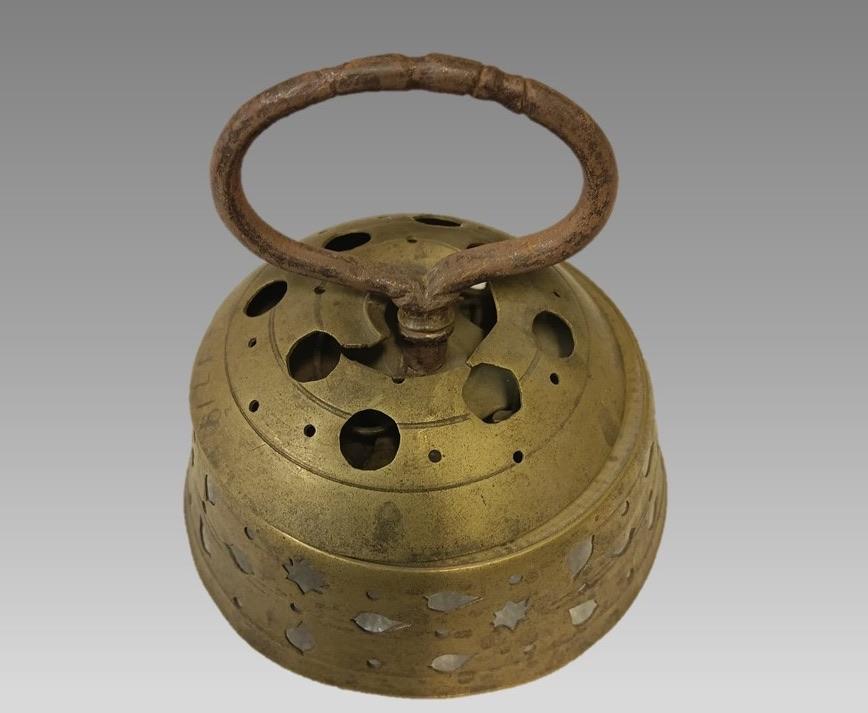
These 12 photographs span 800–1900, 10 places of origin and 2 museums. Every photograph is public domain or openly licensed, and links to the museum’s own record.
-
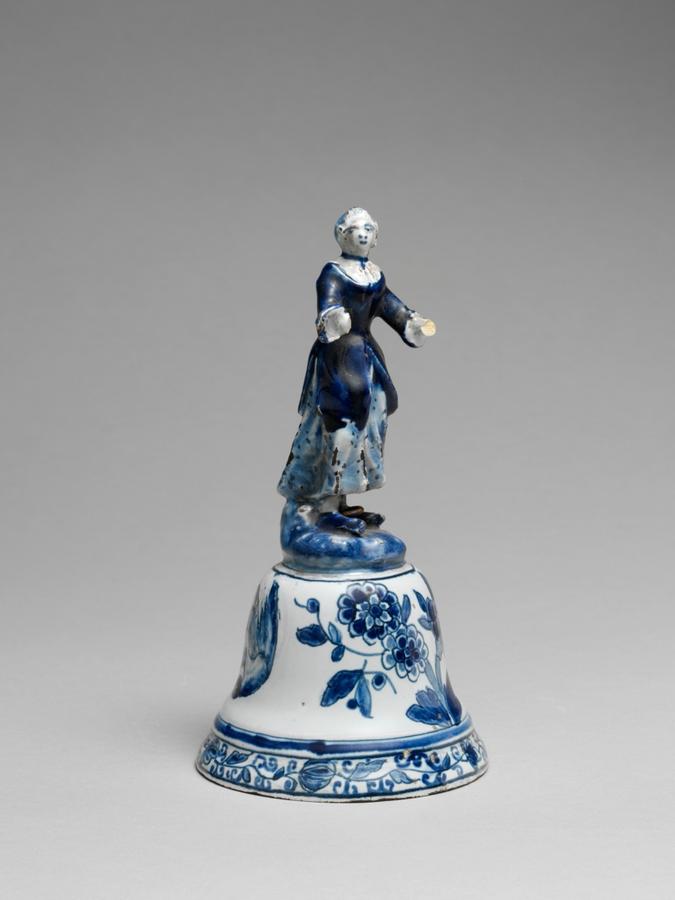
Handbellca. 1770 · Dutch (Netherlands) -

Handbellc. 800 - c. 900 · Midden-Java -

Ghanta900 - 1600 · Oost-Java -

Handbellc. 1200 - c. 1500 · Indonesia -

Handbell1300 - 1600 · Indonesia -

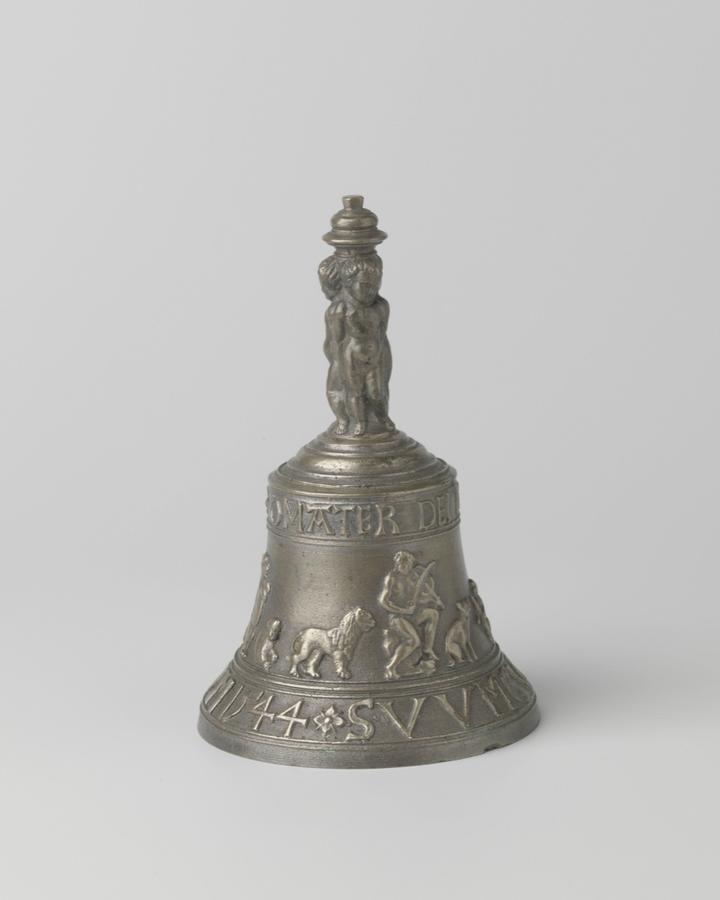
Handbell1544 · Mechelen -

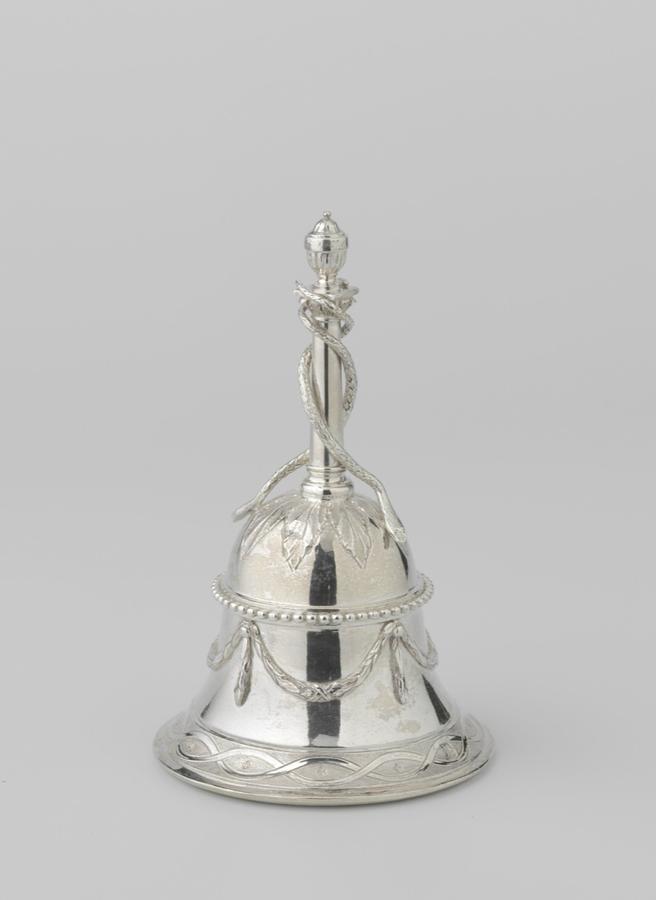
Handbell1791 · Middelburg -
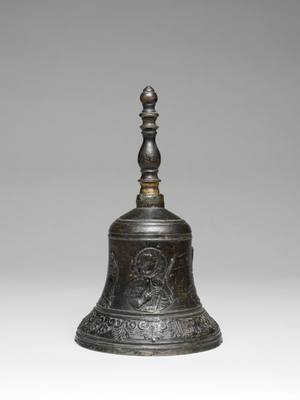
Handbell19th century · Possibly Italian (Italy?) -

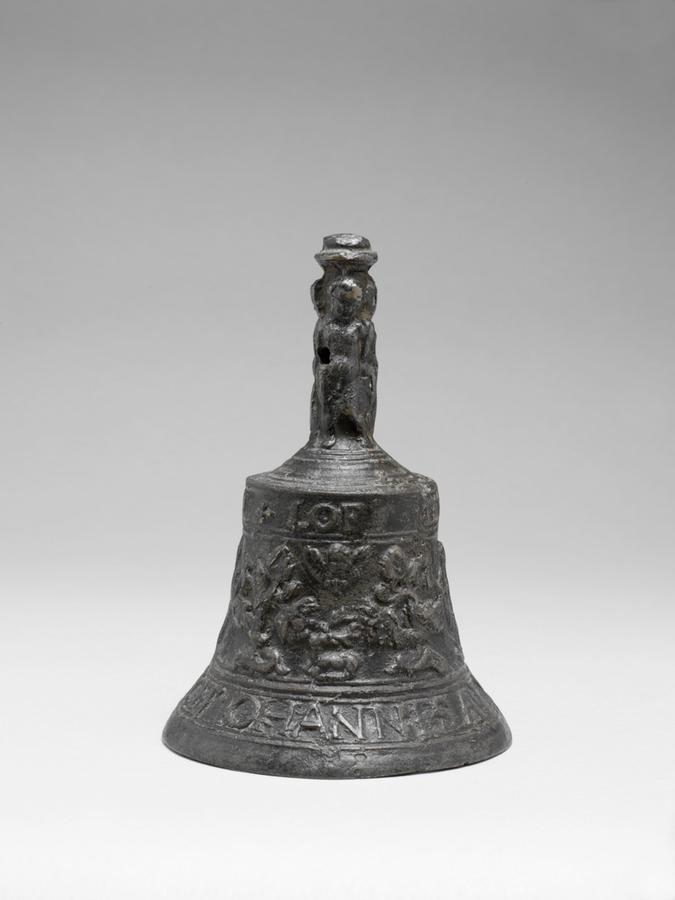
Hand Bell19th century · European -
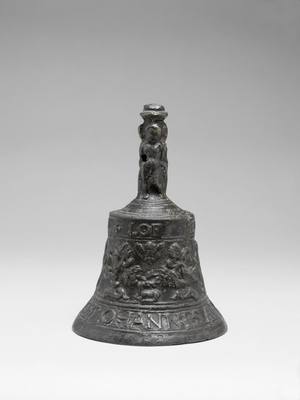
Handbell19th century · Dutch (Holland) -
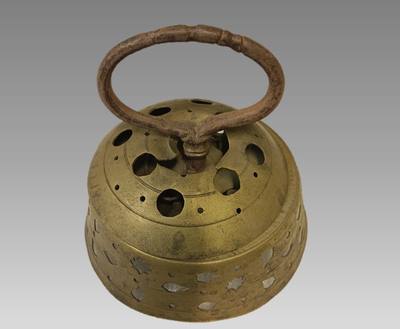
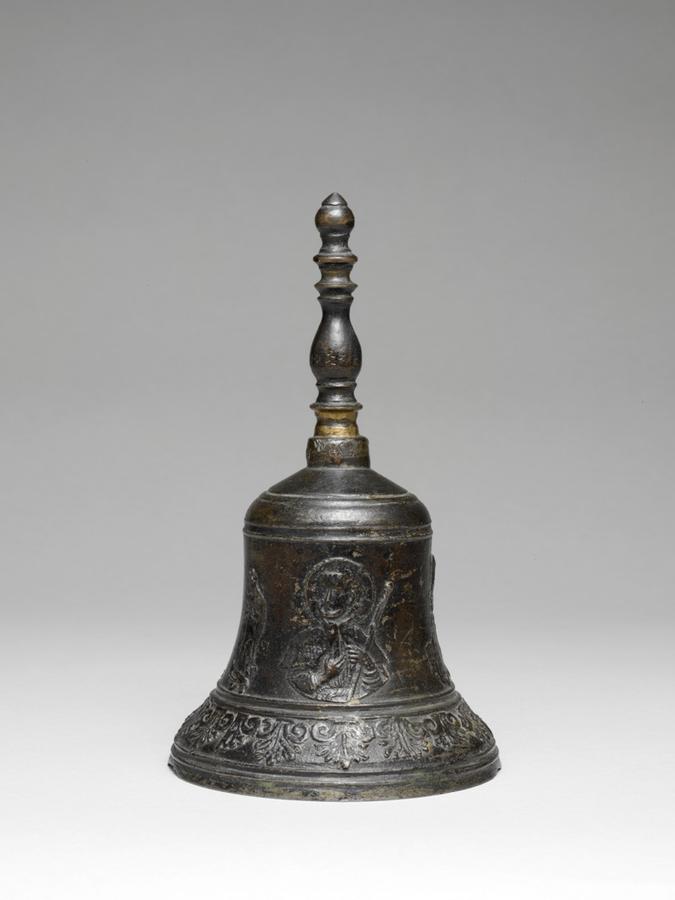
Mass Bell19th century (?) · possibly Belgian (Flemish) (Belgium?) -

Handbelllate 19th century · French (France)






Facts at a glance
| Hornbostel–Sachs number | 111.242.222 — Sets of clapper bells |
|---|---|
| Hornbostel–Sachs group | Idiophones › Struck idiophones › Directly struck idiophones |
| Classification (Wikipedia infobox) | Percussion |
| Developed | 1696–1724 |
| Inventors | Robert and William Cor |
| Wikidata labels | 29 languages |
| Wikipedia article | Handbell |
| Wikidata item | Q871633 |
| Wikimedia Commons category | Handbells |
| MusicBrainz instrument | ee376c6e-128d-45be-b060-35e9655a612f |
| Encyclopaedia Britannica | art/handbell |
Sources: Wikidata (CC0 1.0) — classification number, aliases, identifiers (dump of 2026-07-22); Wikipedia (CC BY-SA 4.0) — infobox fields (description of the classification number, development, inventors) and the names of the Hornbostel–Sachs groups (article “Hornbostel–Sachs”, revision of 2026-01-04).
The name in other languages
| Language | Name | Also written |
|---|---|---|
| English | handbell | handbells |
| French | clochette | cloche à main, cloches à main |
| German | Handglocke | |
| Spanish | campanilla | Campanilla (instrumento), campanillas |
| Italian | campanella | |
| Portuguese | handbells | |
| Dutch | handbel | handbellen |
| Russian | колокольчик | |
| Japanese | ハンドベル | イングリッシュハンドベル, ミュージックベル |
| Chinese | 手摇铃 | 手鈴, Handbell |
| Korean | 핸드벨 |
Sources: Wikidata (CC0 1.0) — labels and aliases; MusicBrainz (CC0 1.0) — instrument aliases (names only).
About the handbell: history, construction and playing
A handbell is a bell designed to be rung by hand. To ring a handbell, a ringer grasps the bell by its slightly flexible handle – traditionally made of leather, but often now made of plastic – and moves the arm to make the hinged clapper strike the inside of the bell. An individual handbell can be used simply as a signal to catch people's attention or summon them together, but handbells are also often heard in tuned sets.
History
Handheld bells have a long history. Credit for the development of the modern hand bell, or "handbell", is accorded to brothers Robert and William Cor in Aldbourne, Wiltshire, England, between 1696 and 1724. The Cor brothers originally made latten bells for hame boxes, but they began tuning their bells more finely to have an accurate fundamental tone and fitted them with hinged clappers that moved only in one plane.
Originally, tuned sets of handbells, such as the ones made by the Cor brothers, were used by change ringers to rehearse outside their towers. Tower bell ringers' enthusiasm for practising the complicated algorithms of change ringing can easily exceed the neighbours' patience, so in the days before modern sound control, handbells offered them a way to continue ringing without causing annoyance. It was also more pleasant for the ringers to learn and practise in the warmth of the local pub rather than in a cold tower in winter. The handbell sets used by change ringers had the same number of bells as in the towers – generally six to twelve, tuned to a diatonic scale.
During the nineteenth century, handbell ensembles became common in England, particularly in the north. Major competitions, such as an annual competition held at Belle Vue Zoological Gardens between 1855 and 1925, and the Yorkshire Hand-Bell Ringers Association's contests, which they sponsored most years between 1904 and 1932, were a central feature of this era of handbell performance. The competition at these events was intense and drew large crowds of up to 20,000 spectators.
Handbells were first taken to the United States by the Lancashire Bell-ringers, who contracted with P. T. Barnum to tour the United States from 1844 to 1847 as "Swiss Bell-ringers." Handbell ringing then became popular in Vaudeville and Chautauqua Circuit variety acts until these venues faded in importance during the early twentieth century.
Characteristics
The two major defining characteristics of English handbells are their clappers and the ability to produce overtones. The clapper on an English handbell is on a hinge and moves back and forth in a single direction, unlike a school bell, in which the clapper swings freely in any direction. It also has a spring that holds the clapper away from the casting after the strike to allow the bell to ring freely. Furthermore, the shaft of the clapper is rigid, such that the bell may be held with its mouth facing upward. The overtones on an English handbell are a 12th (an octave and a perfect fifth) above the fundamental, while Dutch handbells – such as Petit & Fritsen – focus on the overtone a minor 10th (an octave and a minor third) or a major 10th (an octave and a major third) above the fundamental.
Handbells can weigh as little as 7 oz or upwards of 18 lb.
Performance
A handbell choir or ensemble (in the United States) or handbell team (in England) is a group that rings recognizable music with melodies and harmony, as opposed to the mathematical permutations used in change ringing. The bells generally include all notes of the chromatic scale within the range of the set. While a smaller group uses only 25 bells (two octaves, G4–G6), the sets are often larger, ranging up to an eight-octave set (97 bells, C1–C9). The bells are typically arranged chromatically on foam-covered tables; these tables protect the bronze surface of the bell, as well as keep the bells from rolling when placed on their sides. Unlike an orchestra or choir in which each musician is responsible for one line of the texture, a handbell ensemble acts as one composite instrument, with each musician responsible for particular notes, sounding their assigned bells whenever those notes appear in the music.
Music
Several major publishers print handbell music, such as the Hope Publishing Company, The Lorenz Corporation, and Alfred Music, as well as free sites from individual composers and arrangers. Costs associated with handbell music typically result from shipping (many scores are only published in hard copy) and dissemination, as most scores do not permit duplication and must be purchased individually for each ringer.
The coordination of the ringers requires a different approach than other ensembles. All the ringers read from a score. This score is similar to a piano score, but with an additional convention: The C♯ above middle C and all notes below are always written in the bass clef, and the D♭ above middle C and all notes above are always written in the treble clef. (This formatting is not always the convention for solo and small-ensemble music.) Handbells are a transposing instrument, meaning that they "speak" an octave higher than written (this is to help keep the notes centered on the staff), so a middle C bell is actually a C5 or "tenor high C". (For simplicity, the bell would still always be referred to as middle C or C5). However, some newer handbell music published today specifies to play an octave lower than written (meaning middle C sounds as C4, like on the piano) if the composer wants a bit more of a vocal character out of the handbells, or if the handbells are being used to accompany vocal choirs to not overpower the singers.
Due to handbells' relative rarity outside of the confines of church services—although less so now than in the 1980s and early 1990s—the majority of pieces last approximately four minutes. A few composers and arrangers write longer and more intricate works; generally, these pieces use handbells in combination with other instruments.
Ringing techniques
To ring a handbell, the ringer moves it in such a way that the clapper strikes the inside surface of the bell, usually holding it against their shoulder, bell upwards, and then swinging the bell through an elliptical shape to cause the clapper to strike the casting. The tone of the bell will continue to resonate, decaying naturally until it stops completely or the ringer stops it by damping the bell with a hand or on the body or a padded surface.
Handbell techniques have changed very much over the years. Donald E. Allured, founding director of Westminster Concert Bell Choir, is credited with fully realizing an American off-the-table style of ringing that includes many non-ringing sound effects, including stopped techniques such as plucking the clapper with the bell on the table. He is also credited for promoting precise damping or stopping of the sound by touching the bell to a soft surface, in the service of more musical results.
Multiple-bell techniques
Normal ringing technique only allows a ringer to ring two bells at a time, one in each hand. Depending on the number of bells needed for a particular piece and the number of ringers, it may be necessary for each ringer to ring more than two bells at a time or in short succession (four-in-hand). Many techniques change the sound of the bell as it is rung.
Four bells
There are two main ways of ringing two handbells with one hand: four-in-hand and Shelley.
In the four-in-hand technique, the ringer holds two bells in one hand with the clappers at right angles to each other. This allows the ringer to either move the hand normally ("ring" – primary bell) or ring knuckles-first ("knock" – secondary bell) to ring two bells independently with the same hand (for a total of four bells when ringing with both hands). The two bells can also be played simultaneously by holding the wrist at a 45° angle. In large ensembles, four-in-hand is typically used to ring multiple positions or pick up accidentals.
Shelley ringing is similar, except that the clappers are each oriented in the same direction, so that the two bells normally ring simultaneously with one movement. Shelley is typically used to ring notes in octaves, but can also be used to ring two notes separately by striking the primary bell sideways and the secondary bell forward in an action like tapping the fingers.
As to the relative merits of the two techniques, some believe that Shelley ringing is rendered obsolete when four-in-hand is perfected, while others believe that the motion of the clappers in the same plane makes certain techniques more feasible, particularly shaking, martellato, and vibrato.
Six bells
There are several ways to play six bells at a time (i.e, to ring three bells in each hand). One way is to pick two bells up as if one were Shelley ringing, then pick the third up between one's little and ring fingers (a 'triple Shelley'). All three bells ring together when ringing in a knocking motion. A second way is to pick up the third bell sideways so the clapper swings outward. Ringers with good control can then ring the first bell without ringing the third, allowing them to play three notes in two hands. Another method, called interlocked six-in-hand, can be set up by interlocking the handles of two bells so that the clappers move in the same direction (similar to the Shelley technique), rotating a third bell, and inserting it between the other two.
Weaving
Weaving is the technique of playing a succession of bells by changing which bell is in each hand as required. This is used by bass and solo or small-ensemble ringers. The large size and weight of bass bells make four-in-hand ringing impractical and impossible, and often a solo or small-ensemble ringer will need to move up and down a range of bells, possibly sharing them with others. This technique means more than two bells can be rung in short succession, using the table to damp and free the hand to pick up the next bell. If the ringing sequence requires bells to be rung in tonal order, this technique often results in a weaving pattern as the ringer must often reach across their body for the next bell. Weaving can also be used in combination with the four-in-hand in a technique called "traveling four-in-hand". By combining the ability to hold two bells in each hand with the ability to quickly drop and pick up the secondary bell of a four-in-hand, a ringer has quick access to several bells.
Source: Wikipedia, “Handbell” — CC BY-SA 4.0 — text excerpted as published (references, images and tables removed); see the article for the full text and the list of authors. Revision of 2026-06-16.
From Grove’s Dictionary (1900)
HAND BELLS for purposes of tune-playing or practising Change-Ringing can be obtained of all bell founders, tuned either chromatically or simply in the diatonic scale.
Source: Wikisource, A Dictionary of Music and Musicians (Grove, 1900) — “Hand Bells” (entry by C. A. W. Troyte) — Public domain (published 1879–1910; authors died before 1929) — the first paragraphs of the entry, as transcribed; see the page for the full entry.
Sources and licences
- Handbell, Johannes Harlees, ca. 1770, Dutch (Netherlands). Ceramic, wood. The Crosby Brown Collection of Musical Instruments, 1889 (89.4.1584). Museum record · CC0 1.0 (public domain dedication)
- Handbell, Anonymous, c. 800 - c. 900, Midden-Java. bronze (metal). On loan from the Royal Asian Art Society in The Netherlands (purchase auction Mak van Waay (Loudon coll), 1953). Museum record · Public Domain Mark 1.0
- Ghanta, Anonymous, 900 - 1600, Oost-Java. bronze (metal). On loan from the Royal Asian Art Society in The Netherlands (purchase, 1949). Museum record · Public Domain Mark 1.0
- Handbell, Anonymous, c. 1200 - c. 1500, Indonesia. bronze (metal). Gift of Mr and Mrs Oorthuys-Lutjens, Baak. Museum record · Public Domain Mark 1.0
- Handbell, Anonymous, 1300 - 1600, Indonesia. bronze (metal). Gift of Mr and Mrs Oorthuys-Lutjens, Baak. Museum record · Public Domain Mark 1.0
- Handbell, Johan van den Eynde, 1544, Mechelen. iron (metal), bronze (metal). Rijksmuseum, Amsterdam. Museum record · Public Domain Mark 1.0
- Handbell, Leendert Jacobus Leendertsen, 1791, Middelburg. silver (metal). Rijksmuseum, Amsterdam. Museum record · Public Domain Mark 1.0
- Handbell, 19th century, Possibly Italian (Italy?). Metal. The Crosby Brown Collection of Musical Instruments, 1889 (89.4.1721). Museum record · CC0 1.0 (public domain dedication)
- Hand Bell, 19th century, European. metal. The Crosby Brown Collection of Musical Instruments, 1889 (89.4.1127). Museum record · CC0 1.0 (public domain dedication)
- Handbell, 19th century, Dutch (Holland). Bronze. The Crosby Brown Collection of Musical Instruments, 1889 (89.4.1602). Museum record · CC0 1.0 (public domain dedication)
- Mass Bell, 19th century (?), possibly Belgian (Flemish) (Belgium?). Metal. The Crosby Brown Collection of Musical Instruments, 1889 (89.4.1719). Museum record · CC0 1.0 (public domain dedication)
- Handbell, late 19th century, French (France). Ceramic, brass. The Crosby Brown Collection of Musical Instruments, 1889 (89.4.1596). Museum record · CC0 1.0 (public domain dedication)
Photographs: open-access collections of the museums named above; each is shown here reduced in size, otherwise unchanged. Text: Wikipedia (CC BY-SA 4.0), Grove’s Dictionary (public domain), Wikidata and MusicBrainz (CC0). The full list of sources and licences is on the credits page.