
Instruments · Chordophones
Guitar
The guitar is a string instrument which is played by plucking the strings. The main parts of a guitar are the body, the fretboard, the headstock and the strings. Guitars are usually made from wood or plastic. Their strings are made of steel or nylon.
Summary: Simple English Wikipedia, “Guitar” — CC BY-SA 4.0. Revision of 2025-08-02.
Museum photographs
These 12 photographs span 1695–1995, 10 places of origin and 5 museums. 1 of them carry no date in the museum record. Every photograph is public domain or openly licensed, and links to the museum’s own record.
-
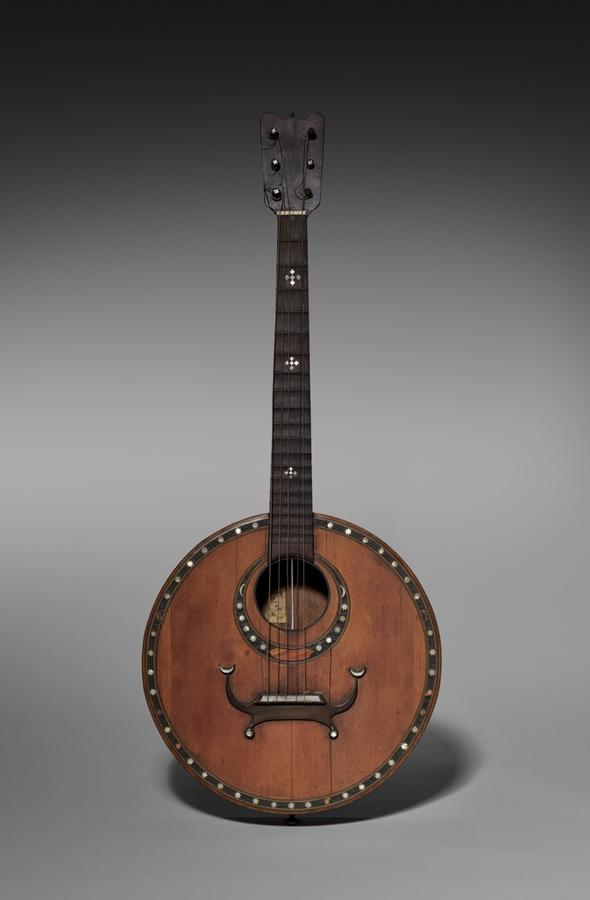
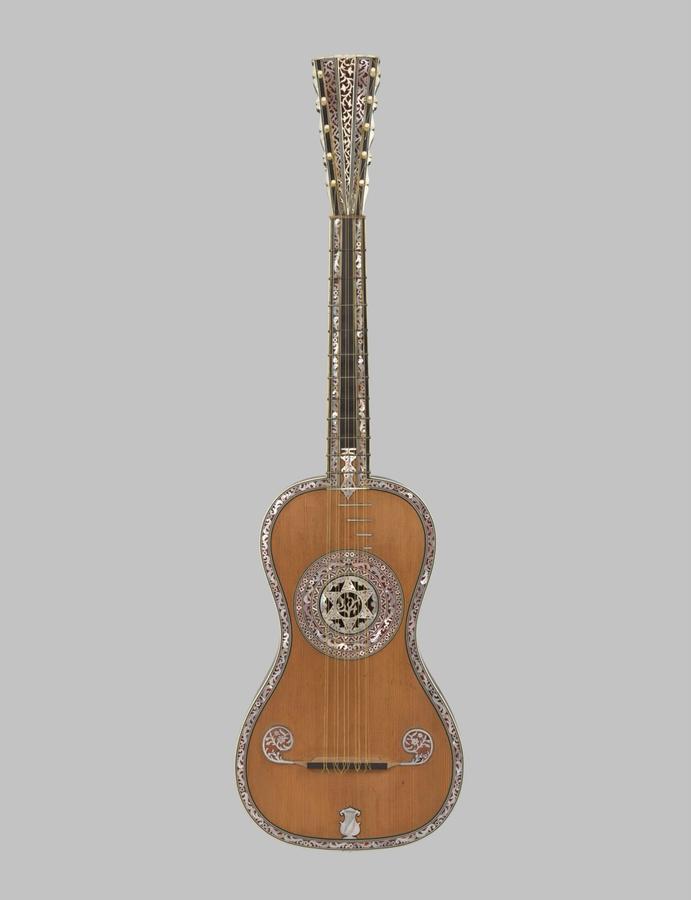
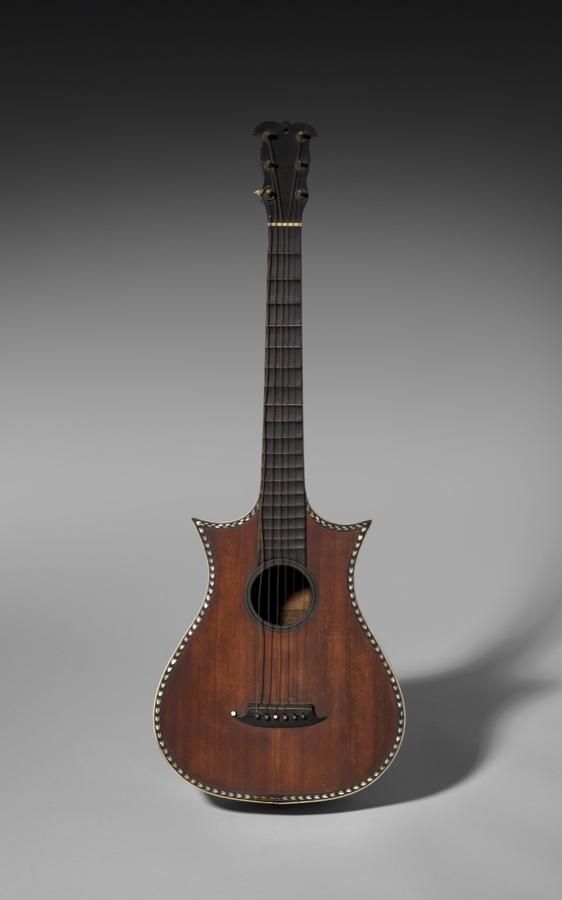
Guitarc. 1860 · Italy, 19th century (Italy) -
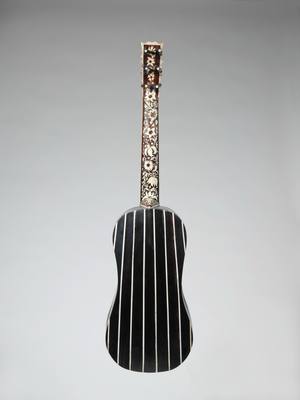
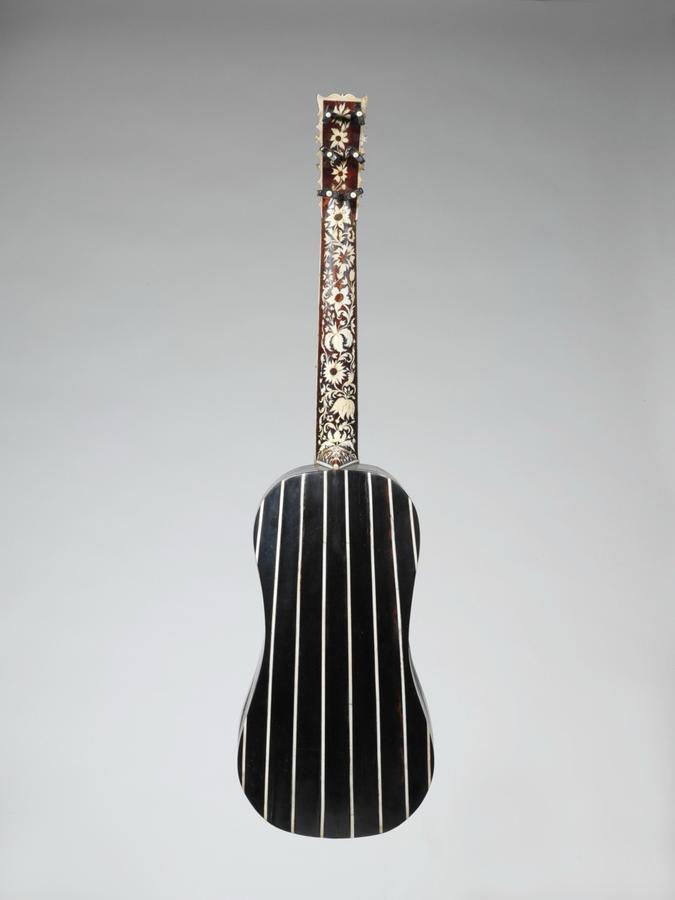
Guitarca. 1695–99 · Germany -
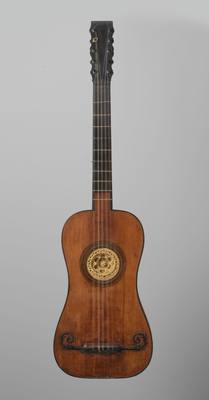
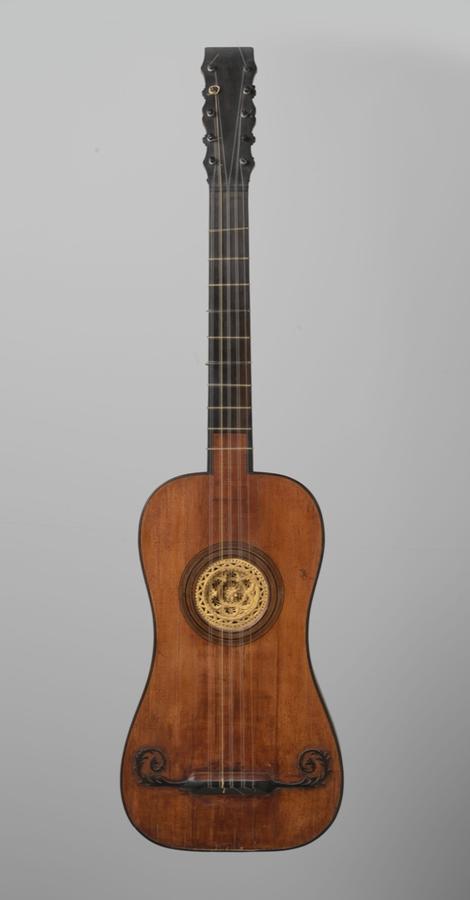
Guitar1763 · Paris -
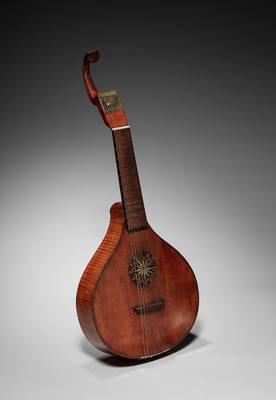
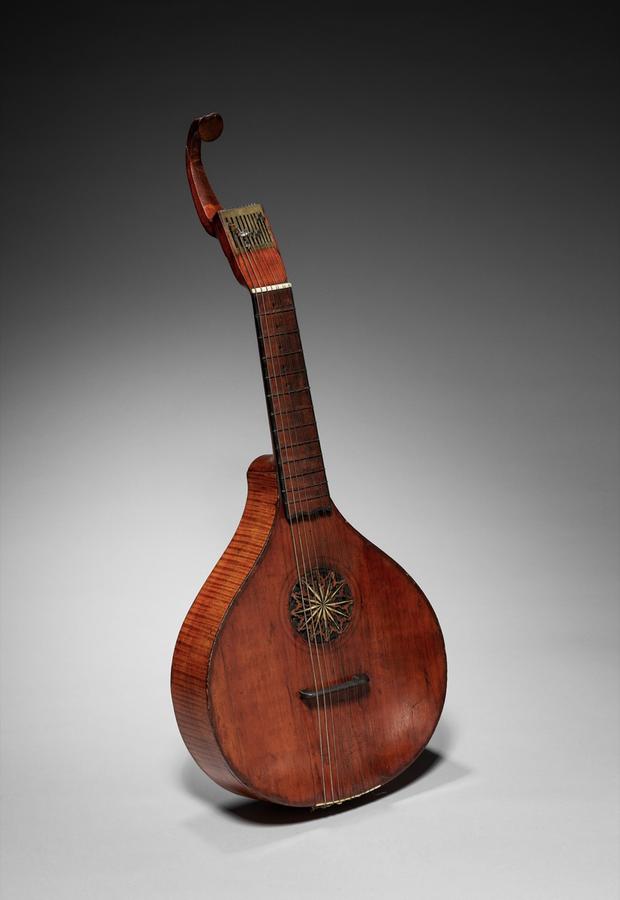
Guitarlate 1700s · England, London (England) -
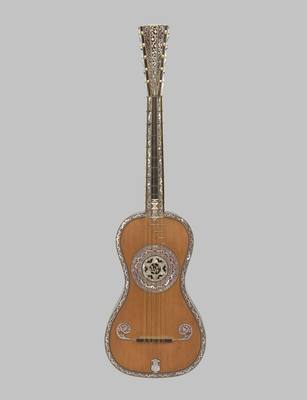
Guitar1793 · Lille -
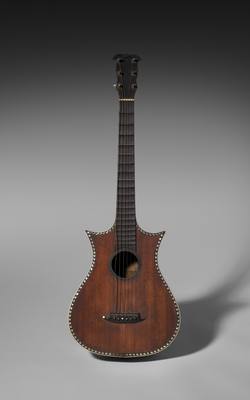
Guitar1800s · France, Lyon (France) -
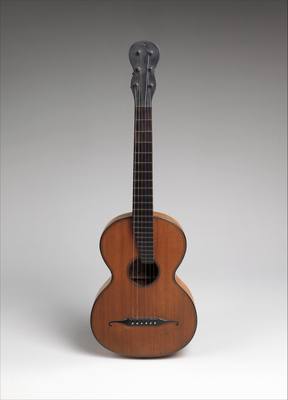
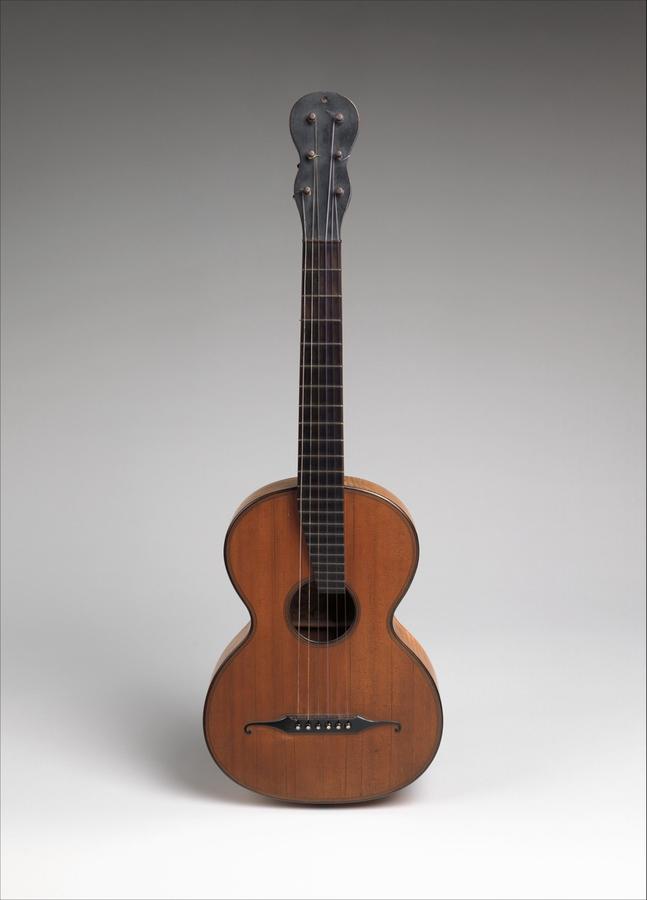
Guitarca. 1835–40 · Austrian (Austria) -
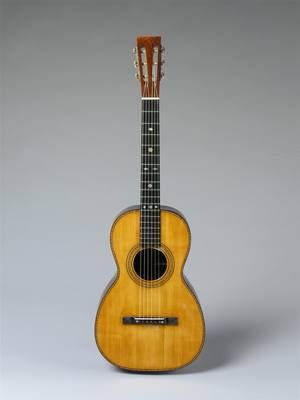
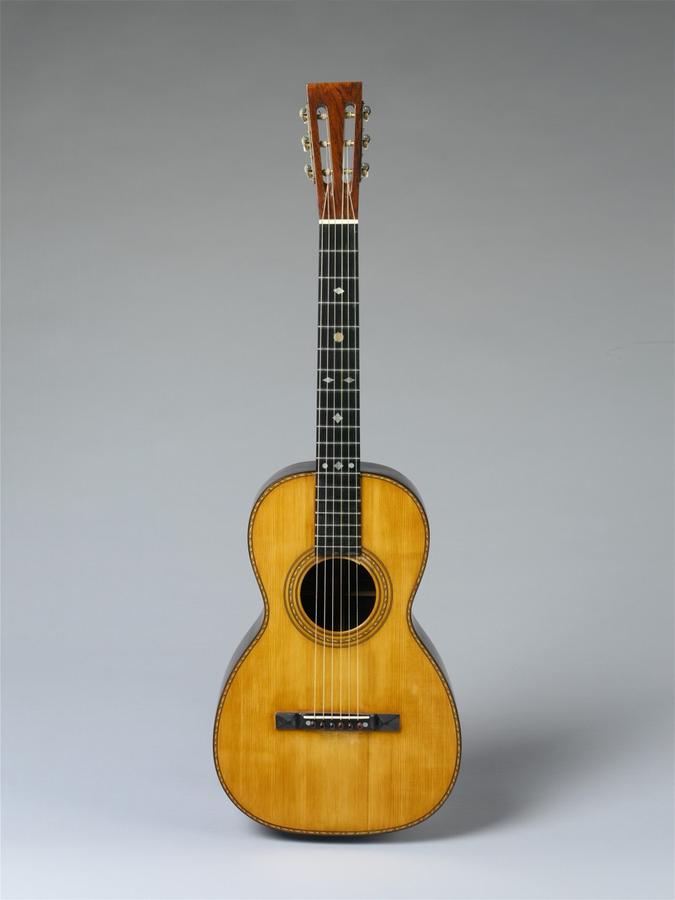
Guitarca. 1870 · American (United States) -
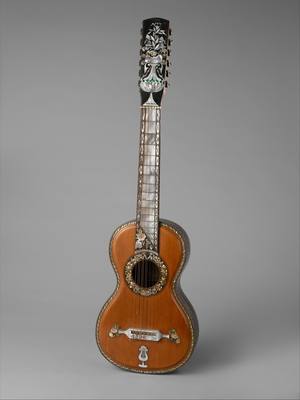
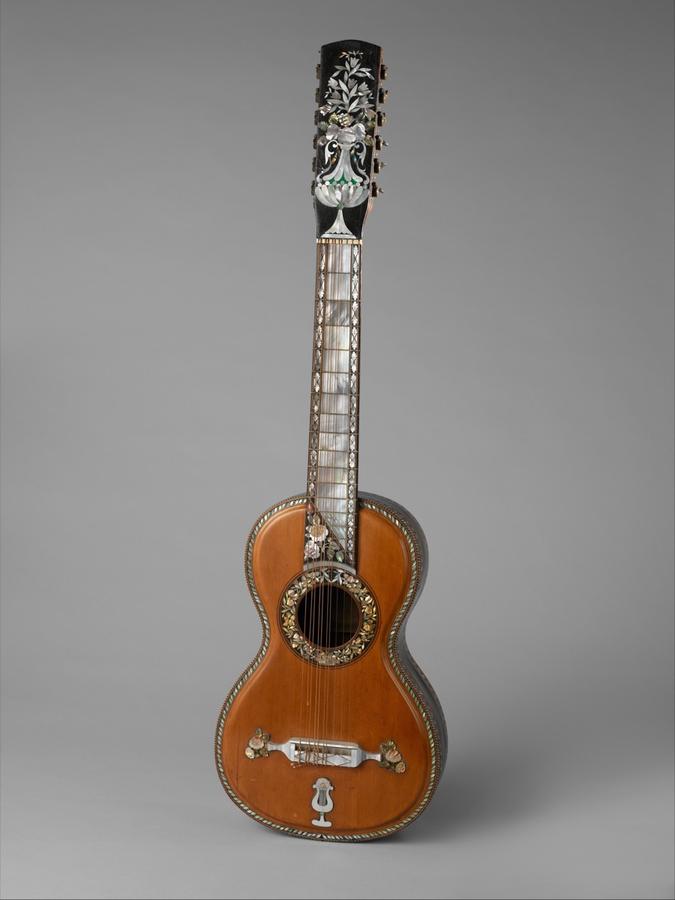
Guitarra Séptima (Seven-course guitar)ca. 1880 · Mexican (Mexico) -
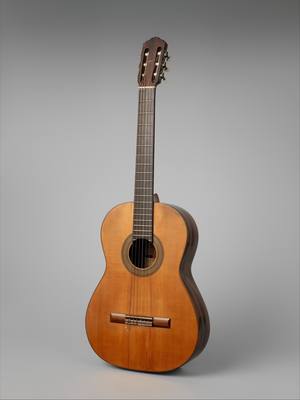
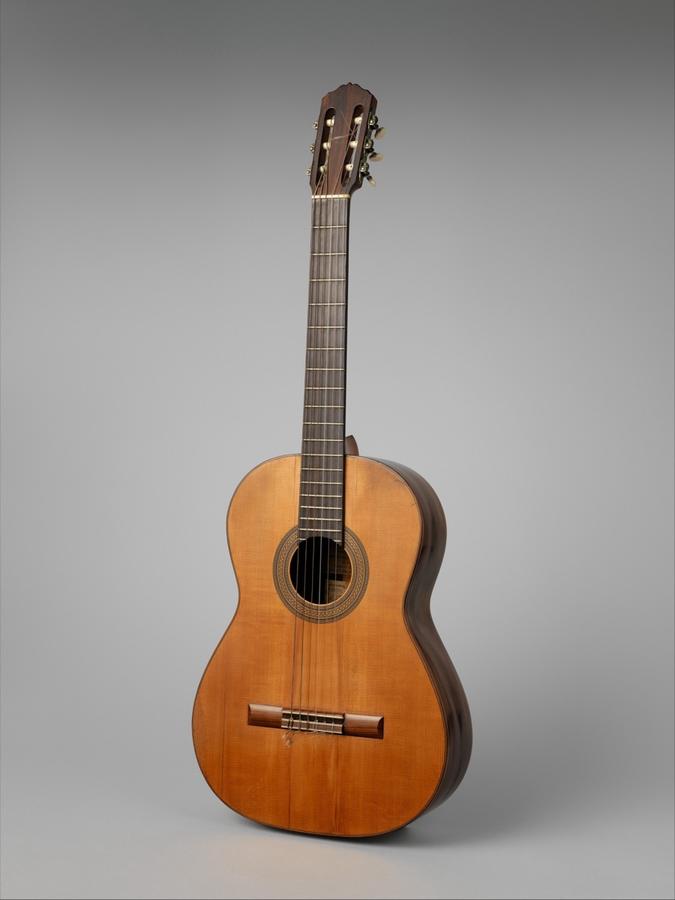
Guitar1912 · Spanish (Spain) -
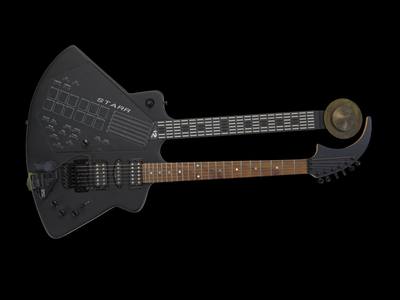
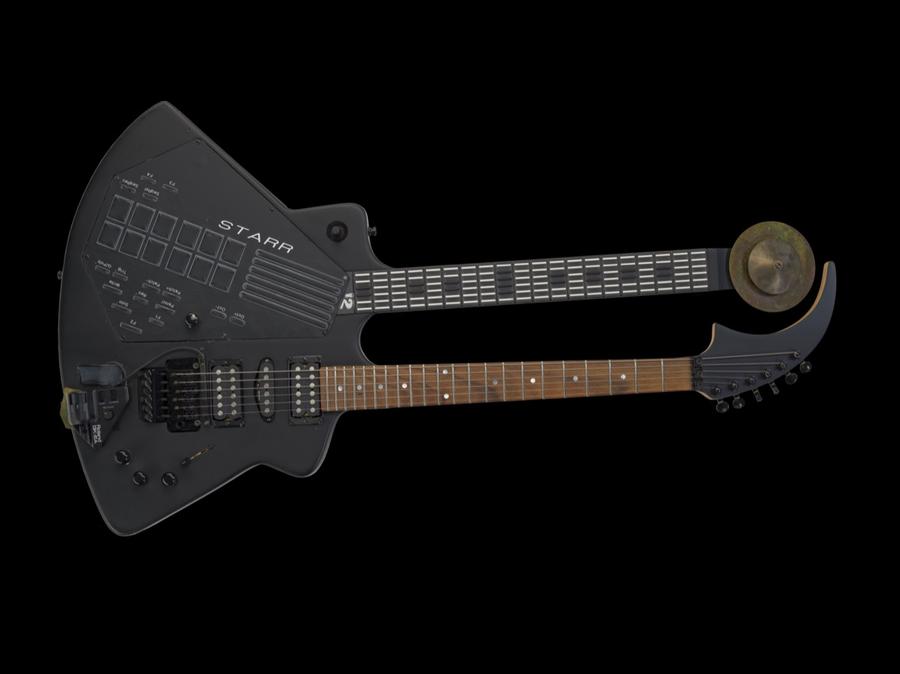
Double neck guitar/synthesizer owned by Vernon Reid1986-1995 · African Americans -
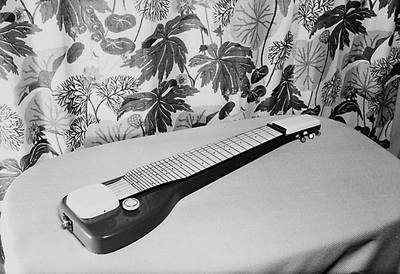
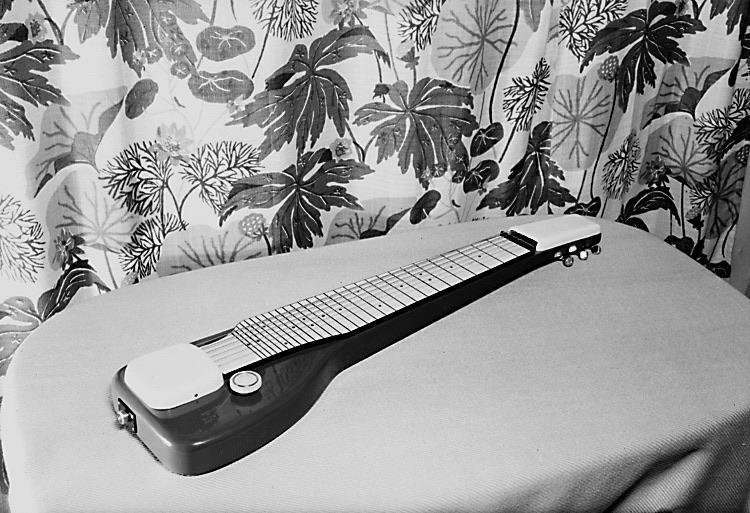
Hawaii guitar. Skandia Musik AB.Undated · Sweden
Facts at a glance
| Hornbostel–Sachs number | 321.322-5-6 — Composite chordophone |
|---|---|
| Hornbostel–Sachs group | Chordophones › Composite chordophones › Lutes |
| Classification (Wikipedia infobox) | String instrument (plucked or strummed) |
| Developed | 13th century |
| Wikidata labels | 210 languages |
| Wikipedia article | Guitar |
| Wikidata item | Q6607 |
| Wikimedia Commons category | Guitars |
| MusicBrainz instrument | 63021302-86cd-4aee-80df-2270d54f4978 |
| Encyclopaedia Britannica | art/guitar |
| Audio sample (Wikimedia Commons) | Romanza española.ogg |
Sources: Wikidata (CC0 1.0) — classification number, aliases, identifiers (dump of 2026-07-22); Wikipedia (CC BY-SA 4.0) — infobox fields (description of the classification number, development, inventors) and the names of the Hornbostel–Sachs groups (article “Hornbostel–Sachs”, revision of 2026-01-04).
The name in other languages
| Language | Name | Also written |
|---|---|---|
| English | guitar | |
| French | guitare | |
| German | Gitarre | |
| Spanish | guitarra | |
| Italian | chitarra | |
| Portuguese | guitarra | viola |
| Dutch | gitaar | |
| Russian | гитара | Шестиструнная гитара, Семиструнная гитара |
| Japanese | ギター | |
| Chinese | 吉他 | |
| Korean | 기타 | |
| Arabic | قيثارة | قيتار |
Sources: Wikidata (CC0 1.0) — labels and aliases; MusicBrainz (CC0 1.0) — instrument aliases (names only).
About the guitar: history, construction and playing
The guitar is a stringed musical instrument that is usually fretted (with some exceptions) and typically has six or twelve strings. It is usually held flat against the player's body and played by strumming or plucking the strings with the dominant hand, while simultaneously pressing selected strings against frets with the fingers of the opposite hand. A guitar pick may also be used to strike the strings. The sound of the guitar is projected either acoustically, by means of a resonant hollow chamber on the guitar, or amplified by an electronic pickup and an amplifier.
The guitar is classified as a chordophone, meaning the sound is produced by a vibrating string stretched between two fixed points. Historically, a guitar was constructed from wood, with its strings made of catgut. Steel guitar strings were introduced near the end of the nineteenth century in the United States, but nylon and steel strings became mainstream only following World War II. The guitar's ancestors include the gittern, the vihuela, the four-course Renaissance guitar, and the five-course baroque guitar, all of which contributed to the development of the modern six-string instrument.
History
The modern word guitar and its antecedents have been applied to a wide variety of chordophones since classical times, sometimes causing confusion. The English word guitar, the German Gitarre, and the French guitare were all adopted from the Spanish guitarra, which comes from the Andalusian Arabic قيثارة (qīthārah) and the Latin cithara, which in turn came from the Ancient Greek κιθάρα (kithára) which is of uncertain ultimate origin. Kithara appears in the Bible four times (1 Cor. 14:7, Rev. 5:8, 14:2, and 15:2), and is usually translated into English as harp.
The origins of the modern guitar are not known. Before the development of the electric guitar and the use of synthetic materials, a guitar was defined as being an instrument having "a long, fretted neck, flat wooden soundboard, ribs, and a flat back, most often with incurved sides." The term is used to refer to a number of chordophones that were developed and used across Europe, beginning in the 12th century and, later, in the Americas. A 3,300-year-old stone carving of a Hittite bard playing a stringed instrument is the oldest iconographic representation of a chordophone, and clay plaques from Babylonia show people playing a lute-like instrument which is similar to the guitar.
Several scholars cite varying influences as antecedents to the modern guitar. Although the development of the earliest "guitar" is lost to the history of medieval Spain, two instruments are commonly claimed as influential predecessors: the four-string oud and its precursor, the European lute; the former was brought to Iberia by the Moors in the 8th century. It has often been assumed that the guitar is a development of the lute, or of the ancient Greek kithara. However, many scholars consider the lute an offshoot or separate line of development which did not influence the evolution of the guitar in any significant way.
At least two instruments called "guitars" were in use in Spain by 1200: the guitarra latina (Latin guitar) and the so-called guitarra morisca (Moorish guitar). The guitarra morisca had a rounded back, a wide fingerboard, and several sound holes. The guitarra Latina had a single sound hole and a narrower neck. By the 14th century the qualifiers "moresca" or "morisca" and "latina" had been dropped, and these two chordophones were simply referred to as guitars.
Renaissance and Baroque
Renaissance and Baroque guitars are the ancestors of the modern classical and flamenco guitar. They are substantially smaller, more delicate in construction, and generate less volume. The strings are paired in courses as in a modern 12-string guitar, but they only have four or five courses of strings rather than six single strings normally used now. They were more often used as rhythm instruments in ensembles than as solo instruments, and can often be seen in that role in early music performances. (Gaspar Sanz's Instrucción de Música sobre la Guitarra Española of 1674 contains his whole output for the solo guitar.) Renaissance and Baroque guitars are easily distinguished, because the Renaissance guitar is very plain and the Baroque guitar is very ornate, with ivory or wood inlays all over the neck and body, and a paper-cutout inverted "wedding cake" inside the hole.
Twelve-string
The twelve-string guitar usually has steel strings, and it is widely used in folk music, blues, and rock and roll. Rather than having only six strings, the 12-string guitar has six courses made up of two strings each, like a mandolin or lute. The highest two courses are tuned in unison, while the others are tuned in octaves. The 12-string guitar is also made in electric forms. The chime-like sound of the 12-string electric guitar was the basis of jangle pop.
Seven-string and eight-string
Solid-body seven-string guitars were popularized in the 1980s and 1990s. Other artists go a step further, by using an eight-string guitar with two extra low strings. Although the most common seven-string has a low B string, Roger McGuinn (of The Byrds and Rickenbacker) uses an octave G string paired with the regular G string as on a 12-string guitar, allowing him to incorporate chiming 12-string elements in standard six-string playing. In 1982 Uli Jon Roth developed the "Sky Guitar", with a vastly extended number of frets, which was the first guitar to venture into the upper registers of the violin. Roth's seven-string and "Mighty Wing" guitar features a wider octave range.
Head
The headstock is located at the end of the guitar neck farthest from the body. It is fitted with machine heads that adjust the tension of the strings, which in turn affects the pitch. The traditional tuner layout is "3+3", in which each side of the headstock has three tuners (such as on Gibson Les Pauls). In this layout, the headstocks are commonly symmetrical. Many guitars feature other layouts, including six-in-line tuners (featured on Fender Stratocasters) or even "4+2" (e.g. Ernie Ball Music Man). Some guitars (such as Steinbergers) do not have headstocks at all, in which case the tuning machines are located elsewhere, either on the body or the bridge.
The nut is a small strip of bone, plastic, brass, corian, graphite, stainless steel, or other medium-hard material, at the joint where the headstock meets the fretboard. Its grooves guide the strings onto the fretboard, giving consistent lateral string placement. It is one of the endpoints of the strings' vibrating length. It must be accurately cut, or it can contribute to tuning problems due to string slippage or string buzz. To reduce string friction in the nut, which can adversely affect tuning stability, some guitarists fit a roller nut. Some instruments use a zero fret just in front of the nut. In this case the nut is used only for lateral alignment of the strings, the string height and length being dictated by the zero fret.
Neck
A guitar's frets, fretboard, tuners, headstock, and truss rod, all attached to a long wooden extension, collectively constitute its neck. The wood used to make the fretboard usually differs from the wood in the rest of the neck. The bending stress on the neck is considerable, particularly when heavier gauge strings are used, and the ability of the neck to resist bending is important to the guitar's ability to hold a constant pitch during tuning or when strings are fretted. The rigidity of the neck with respect to the body of the guitar is one determinant of a good instrument versus a poor-quality one.
The cross-section of the neck can also vary, from a gentle "C" curve to a more pronounced "V" curve. There are many different types of neck profiles available, giving the guitarist many options. Some aspects to consider in a guitar neck may be the overall width of the fretboard, scale (distance between the frets), the neck wood, the type of neck construction (for example, the neck may be glued in or bolted on), and the shape (profile) of the back of the neck. Other types of material used to make guitar necks are graphite (Steinberger guitars), aluminum (Kramer Guitars, Travis Bean and Veleno guitars), or carbon fiber (Modulus Guitars and ThreeGuitars). Double neck electric guitars have two necks, allowing the musician to quickly switch between guitar sounds.
The neck joint or heel is the point at which the neck is either bolted or glued to the body of the guitar. Almost all acoustic steel-string guitars, with the primary exception of Taylors, have glued (otherwise known as set) necks, while electric guitars are constructed using both types.Most classical guitars have a neck and headblock carved from one piece of wood, known as a "Spanish heel".
Commonly used set neck joints include mortise and tenon joints (such as those used by C. F. Martin & Co.), dovetail joints (also used by C. F. Martin on the D-28 and similar models) and Spanish heel neck joints, which are named after the shoe they resemble and commonly found in classical guitars. All three types offer stability.
Body
In acoustic guitars, string vibration is transmitted through the bridge and saddle to the body via sound board. The sound board is typically made of tonewoods such as spruce or cedar. Timbers for tonewoods are chosen for both strength and ability to transfer mechanical energy from the strings to the air within the guitar body. Sound is further shaped by the characteristics of the guitar body's resonant cavity. In expensive instruments, the entire body is made of wood. In inexpensive instruments, the back may be made of plastic.
In an acoustic instrument, the body of the guitar is a major determinant of the overall sound quality. The guitar top, or soundboard, is a finely crafted and engineered element made of tonewoods such as spruce and red cedar. This thin piece of wood, often only 2 or 3 mm thick, is strengthened by differing types of internal bracing. Many luthiers consider the top the dominant factor in determining the sound quality. The majority of the instrument's sound is heard through the vibration of the guitar top as the energy of the vibrating strings is transferred to it. The body of an acoustic guitar has a sound hole through which sound projects. The sound hole is usually a round hole in the top of the guitar under the strings. The air inside the body vibrates as the guitar top and body is vibrated by the strings, and the response of the air cavity at different frequencies is characterized, like the rest of the guitar body, by a number of resonance modes at which it responds more strongly.
Source: Wikipedia, “Guitar” — CC BY-SA 4.0 — text excerpted as published (references, images and tables removed); see the article for the full text and the list of authors. Revision of 2026-06-08.
From Grove’s Dictionary (1900)
in real pitch an octave lower. The technique of the instrument was of the simplest, the thumb and first finger only being employed, if not a plectrum.
Sor's most distinguished rival was an Italian, Mauro Giuliani, who composed a concerto with band accompaniment for the 'Terz chitarra' or Third-guitar, an instrument with a shorter neck, tuned a minor third higher. This concerto, published by Diabelli, Vienna, was transcribed by Hummel for the pianoforte. Other popular composers were Legnani, Kreutzer, Nüske, Regondi, and that wayward genius Leonard Schulz. Berlioz and Paganini were both guitarists.
Source: Wikisource, A Dictionary of Music and Musicians (Grove, 1900) — “Guitar” (entry by Alfred James Hipkins) — Public domain (published 1879–1910; authors died before 1929) — the first paragraphs of the entry, as transcribed; see the page for the full entry.
Composers who played it
317 composers on this site list the guitar as an instrument they played. A selection:
- Hector Berlioz 1803–1869
- Heitor Villa-Lobos 1887–1959
- Adrian Le Roy 1520–1598
- Vicente Espinel 1550–1624
- Luis de Briceño 1610–1630
- Francesco Corbetta 1615–1681
- Giovanni Battista Granata 1620–1687
- Giovanni Paolo Foscarini 1621–1647
- Gaspar Sanz 1640–1710
- Nicola Matteis 1650–1713
- Ludovico Roncalli 1654–1713
- Antoine Marcel Lemoine 1763–1817
Composers with a page on this site whose Wikidata record lists this instrument; featured and best-dated first. Data: Wikidata (property “instrument”, P1303), CC0 1.0.
Sources and licences
- Guitar, Fernando Theze (Italian), c. 1860, Italy, 19th century (Italy). wood, ebonized wood, mother of pearl inlay, resin, bone?. The Charles G. King Jr. collection; Gift of Ralph King in memory of Charles G. King Jr.. Museum record · CC0 1.0 (public domain dedication)
- Guitar, Joachim Tielke, ca. 1695–99, Germany. Wood, ivory, ebony. Gift of The University Museum, University of Pennsylvania, 1953 (53.56.3). Museum record · CC0 1.0 (public domain dedication)
- Guitar, Pierre Louvet, 1763, Paris. wood (plant material). Gift of Elly and Gerrit van der Veer, Lelystad. Museum record · Public Domain Mark 1.0
- Guitar, late 1700s, England, London (England). varnished wood. The Charles G. King Jr. collection; Gift of Ralph King in memory of Charles G. King Jr.. Museum record · CC0 1.0 (public domain dedication)
- Guitar, 1793, Lille. mother of pearl, spruce (wood), intestine, ebony (wood), ivory, rosewood (wood). On loan from the Kunstmuseum Den Haag. Museum record · Public Domain Mark 1.0
- Guitar, Vuilleaume of Lyons (French), 1800s, France, Lyon (France). wood, ebony, and mother of pearl inlay, bone bridge, wood veneer, copper alloy tuning pegs. The Charles G. King Jr. collection; Gift of Ralph King in memory of Charles G. King Jr.. Museum record · CC0 1.0 (public domain dedication)
- Guitar, Johann Anton Stauffer, ca. 1835–40, Austrian (Austria). Spruce, maple. Rogers Fund, 1979 (1979.390). Museum record · CC0 1.0 (public domain dedication)
- Guitar, Joseph Bini; John Howard Foote, ca. 1870, American (United States). Spruce, rosewood, ebony. Purchase, The Jonathan & Faye Kellerman Foundation Gift, 2010 (2010.334). Museum record · CC0 1.0 (public domain dedication)
- Guitarra Séptima (Seven-course guitar), M. Fernandez, ca. 1880, Mexican (Mexico). Spruce, rosewood, mother-of-pearl. Purchase, Amati Gifts, 2012 (2012.569). Museum record · CC0 1.0 (public domain dedication)
- Guitar, Manuel Ramírez; Santos Hernández, 1912, Spanish (Spain). Spruce, rosewood, cedar, ebony, ivory or bone. Gift of Emilita Segovia, Marquessa of Salobreña, 1986 (1986.353.2). Museum record · CC0 1.0 (public domain dedication)
- Double neck guitar/synthesizer owned by Vernon Reid, 1986-1995, African Americans. wood and metal with plastic. Collection of the Smithsonian National Museum of African American History and Culture, Donated by Vernon Reid. Museum record · CC0 1.0 (public domain dedication)
- Hawaii guitar. Skandia Musik AB., Borg, Knut; Borg, Knut; Borg, Knut, Undated, Sweden. Örebro County Museum / Swedish Open Cultural Heritage (via Europeana). Museum record · Public Domain Mark 1.0
Photographs: open-access collections of the museums named above; each is shown here reduced in size, otherwise unchanged. Text: Wikipedia (CC BY-SA 4.0), Grove’s Dictionary (public domain), Wikidata and MusicBrainz (CC0). The full list of sources and licences is on the credits page.