
Instruments · Chordophones
Oud
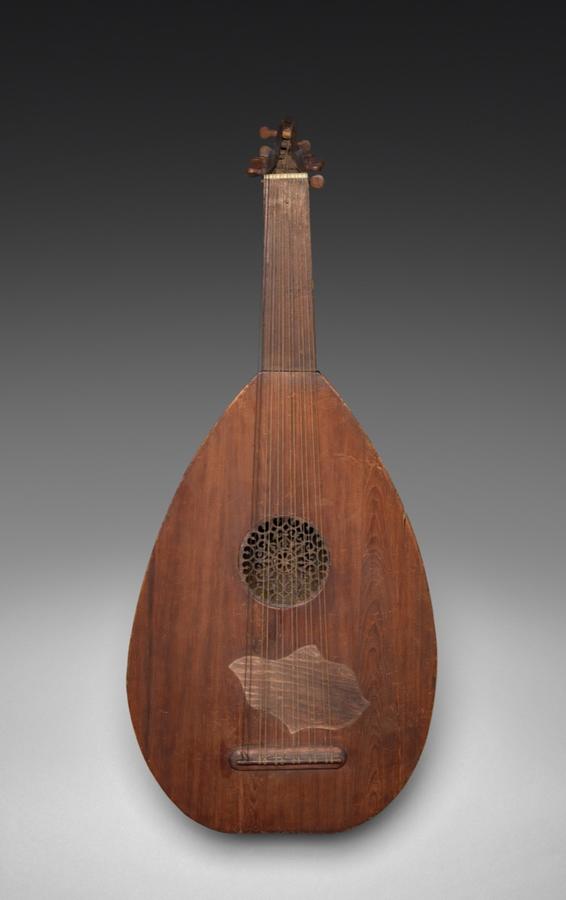
The oud is a pear-shaped, stringed instrument. It is similar to a modern western lute. It does not have frets. It is commonly used in Middle Eastern music and East African music.
Summary: Simple English Wikipedia, “Oud” — CC BY-SA 4.0. Revision of 2025-09-29.
Museum photographs
These 3 photographs span 1850–1918, 3 places of origin and 2 museums. Every photograph is public domain or openly licensed, and links to the museum’s own record.
-
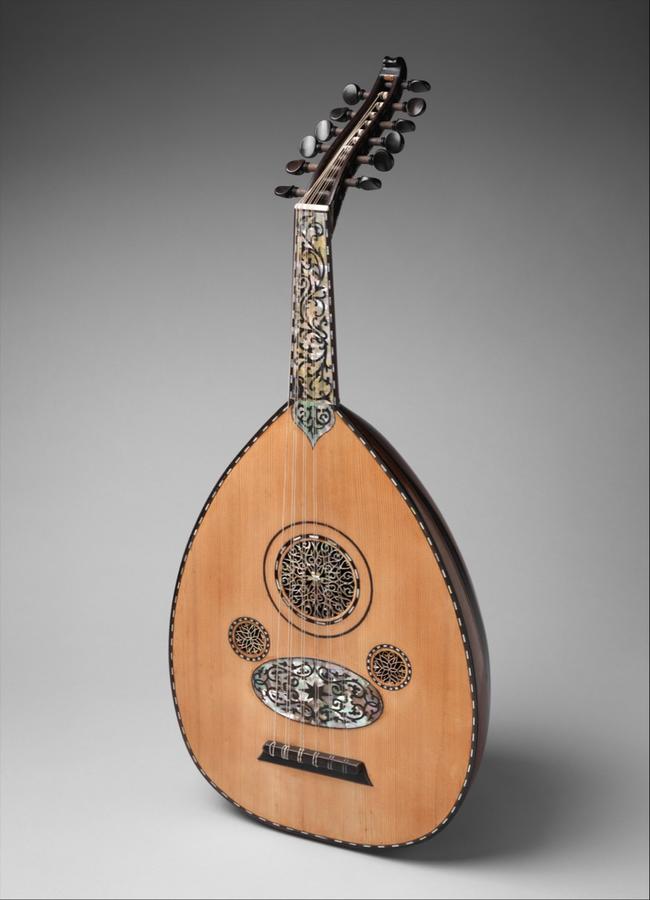
Ūd1916 · Turkish (Turkey) -
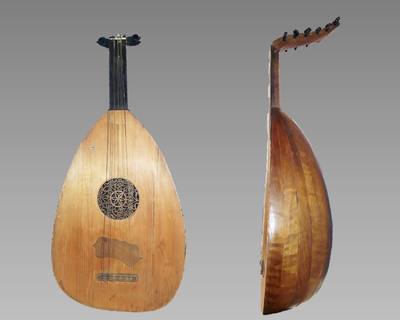
Ūdlate 19th century · possibly Syrian (Syria?) -
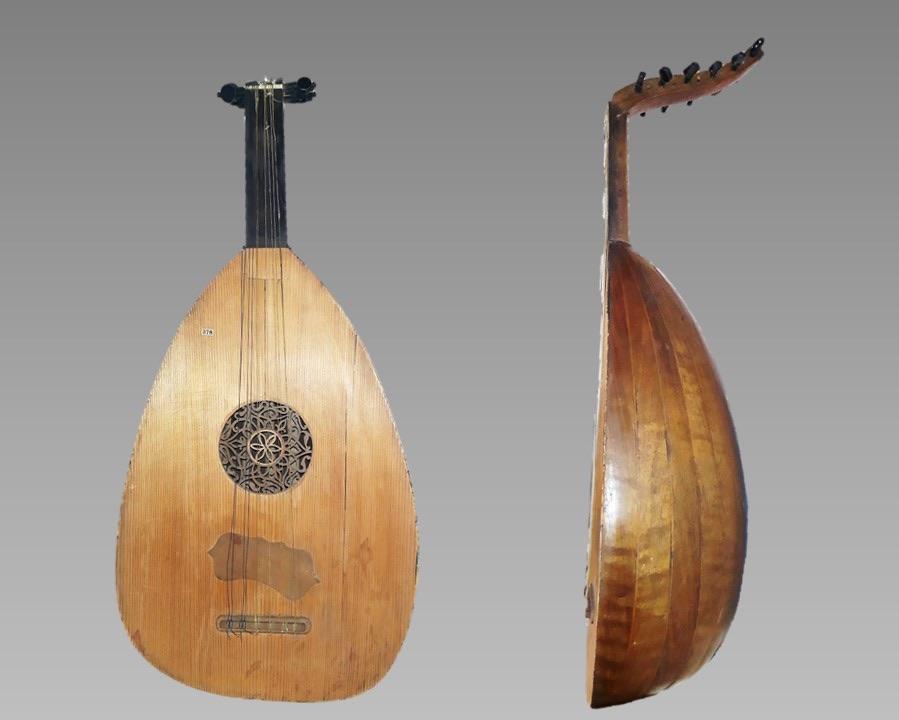
Oudlate 1800s–early 1900s · West Asia
Facts at a glance
| Hornbostel–Sachs number | 321.321-6 — Composite chordophone sounded with a plectrum |
|---|---|
| Hornbostel–Sachs group | Chordophones › Composite chordophones › Lutes |
| Also known as | outi, 'ud, Arab lute |
| Classification (Wikipedia infobox) | String instruments, Necked bowl lutes |
| Developed | Islamic Golden Age |
| Wikidata labels | 76 languages |
| Wikipedia article | Oud |
| Wikidata item | Q191000 |
| Wikimedia Commons category | Ouds |
| MusicBrainz instrument | 758c62c1-39c9-4fe9-8cb0-07398f3cb15a |
| Encyclopaedia Britannica | art/ud |
| Audio sample (Wikimedia Commons) | OUD.ogg |
Sources: Wikidata (CC0 1.0) — classification number, aliases, identifiers (dump of 2026-07-22); Wikipedia (CC BY-SA 4.0) — infobox fields (description of the classification number, development, inventors) and the names of the Hornbostel–Sachs groups (article “Hornbostel–Sachs”, revision of 2026-01-04).
The name in other languages
| Language | Name | Also written |
|---|---|---|
| English | oud | outi, 'ud, Arab lute |
| French | oud | Outi, Luth arabe, Barbat |
| German | Oud | Ud |
| Spanish | Laúd árabe | Laud árabe, Oúd, Laud arabe |
| Italian | Oud | 'ud, Ud |
| Portuguese | oud | |
| Dutch | oed | ud, oud, oed / oud |
| Russian | уд | уд (музыкальный инструмент) |
| Japanese | ウード | |
| Chinese | 烏德琴 | 乌德 |
| Korean | 우드 | 우드 (악기) |
| Arabic | عود | العود, عود (آلة موسيقية) |
Sources: Wikidata (CC0 1.0) — labels and aliases; MusicBrainz (CC0 1.0) — instrument aliases (names only).
About the oud: history, construction and playing
The oud (عُود) is a Middle Eastern short-neck lute-type, pear-shaped, fretless stringed instrument (a chordophone in the Hornbostel–Sachs classification of instruments), usually with 11 strings grouped in six courses, but some models have five or seven courses, with 10 or 13 strings respectively.
The oud is similar to other types of lute, and to Western lutes which developed out of the Medieval Islamic oud. Similar instruments have been used in the Middle East, some predating Islam, such as the barbat from Persia. Different versions of the oud are used in Arabia, Turkey, and other Middle Eastern and Balkan regions. The oud, as a fundamental difference with the western lute, has no frets and a smaller neck. It is the direct successor of the Persian barbat lute. The oldest surviving oud is thought to be in Brussels, at the Museum of Musical Instruments.
Names and etymology
The العود (al-ʿūd or oud) literally denotes a thin piece of wood similar to the shape of a straw. It may refer to the wooden plectrum traditionally used for playing the oud, to the thin strips of wood used for the back, or to the wooden soundboard that distinguishes it from similar instruments with skin-faced bodies. Henry George Farmer considers the similitude between al-ʿūd and al-ʿawda ("the return" – of bliss).
Multiple theories have been proposed for the origin of the Arabic name oud. The word oud (عود) means "from wood" and "stick" in Arabic. In 1940 Curt Sachs contradicted or refined that idea, saying oud meant flexible stick, not wood. A western scholar of Islamic musical subjects, Eckhard Neubauer, suggested that oud may be an Arabic borrowing from the Persian word rōd or rūd, which meant string. Another researcher, archaeomusicologist Richard J. Dumbrill, suggests that rud came from the Sanskrit rudrī (रुद्री, meaning "string instrument") and transferred to Arabic (a Semitic language) through a Semitic language. While the authors of these statements about the meanings or origins of the word may have accessed linguistic sources, they were not linguists.
However, another theory according to Semitic language scholars, is that the Arabic ʿoud is derived from Syriac ʿoud-a, meaning "wooden stick" and "burning wood"—cognate to Biblical Hebrew ’ūḏ, referring to a stick used to stir logs in a fire.
Names for the instrument in different languages include عود ʿūd or ʿoud (plural: أعواد aʿwād), ուդ, Syriac: ܥܘܕ ūd, ούτι oúti, עוּד ud, بربت barbat (although the barbat is a different lute instrument), ud or ut, Azeri: ud, and cuud 𐒋𐒓𐒆 or kaban 𐒏𐒖𐒁𐒖𐒒.
Musical instruments from pre-history
The entire complete history of the development of the lute family is not fully compiled at this date, only some of it. The highly influential organologist Curt Sachs distinguished between the "long-necked lute" and the short-necked variety. Douglas Alton Smith argues the long-necked variety should not be called lute at all because it existed for at least a millennium before the appearance of the short-necked instrument that eventually evolved into what is now known as the lute.
Musicologist Richard Dumbrill today uses the word more categorically to discuss instruments that existed millennia before the term "lute" was coined. Dumbrill documented more than 3000 years of iconographic evidence for the lutes in Mesopotamia, in his book The Archaeomusicology of the Ancient Near East. According to Dumbrill, the lute family included instruments in Mesopotamia prior to 3000 BC. He points to a cylinder seal as evidence; dating from c. 3100 BC or earlier (now in the possession of the British Museum); the seal depicts on one side what is thought to be a woman playing a stick "lute". Like Sachs, Dumbrill saw length as distinguishing lutes, dividing the Mesopotamian lutes into a long-necked variety and a short. He focuses on the longer lutes of Mesopotamia, and similar types of related necked chordophones that developed throughout the ancient world: Greek, Egyptian (in the Middle Kingdom), Elamites, Hittite, Roman, Bulgar, Turkic, Indian, Chinese, Armenian/Cilician, Canaanite/Phoenician, Israelite/Judean, and various other cultures. He names among the long lutes, the pandura, the panduri, tambur and tanbur.
The line of short-necked lutes was further developed to the east of Mesopotamia, in Bactria and Gandhara, into a short, almond-shaped lute. Curt Sachs talked about the depictions of Gandharan lutes in art, where they are presented in a mix of "Northwest Indian art" under "strong Greek influences". The short-necked lutes in these Gandhara artworks were "the venerable ancestor of the Islamic, the Sino-Japanese and the European lute families." He described the Gandhara lutes as having a "pear-shaped body tapering towards the short neck, a frontal stringholder, lateral pegs, and either four or five strings." The oldest images of short-necked lutes from the area that Sachs knew of were "Persian figurines of the 8th century B.C.," found in excavations at Suza, but he knew of nothing connecting these to the Oud-related Gandharan art 8 centuries later.
Spread of oud to Europe
When the Umayyads conquered Hispania in 711, they brought their ud along. An oud is depicted as being played by a seated musician in Qasr Amra of the Umayyad dynasty, one of the earliest depictions of the instrument as played in early Islamic history.
During the 8th and 9th centuries, many musicians and artists from across the Islamic world flocked to al-Andalus. Among them was Abu l-Hasan ‘Ali Ibn Nafi‘ (789–857), a prominent musician who had trained under Ishaq al-Mawsili in Baghdad and was exiled to al-Andalus before 833 AD. He taught and has been credited with adding a fifth string to his oud and with establishing one of the first schools of music in Córdoba.
By the 11th century, Muslim Iberia had become a center for the manufacture of instruments. These goods spread gradually to Provence, influencing French troubadours and trouvères and eventually reaching the rest of Europe. While Europe developed the lute, the oud remained a central part of Arab music, and broader Ottoman music as well, undergoing a range of transformations.
Although the major entry of the short lute was in western Europe, leading to a variety of lute styles, the short lute entered Europe in the East as well; as early as the sixth century, the Bulgars brought the short-necked variety of the instrument called Komuz to the Balkans.
Origins theory from religious and philosophical beliefs
According to Abū Ṭālib al-Mufaḍḍal (a-n-Naḥawī al-Lughawī) ibn Salma (9th century), who himself refers to Hishām ibn al-Kullā, the oud was invented by Lamech, the descendant of Adam and Cain. Another hypothetical attribution says that its inventor was Mani. Ibn a-ṭ-Ṭaḥḥān adds two possible mythical origins: the first involves the Devil, who would have lured the "People of David" into exchanging (at least part of) their instruments with the oud. He writes himself that this version is not credible. The second version attributes, as in many other cultures influenced by Greek philosophy, the invention of the oud to "Philosophers".
Central Asia
One theory is that the oud originated from the Persian instrument called a barbat (Persian: بربت) or barbud, a lute indicated by Marcel-Dubois to be of Central Asian origin. The earliest pictorial image of the barbat dates back to the 1st century BC from ancient northern Bactria and is the oldest evidence of the existence of the barbat. Evidence of a form of the barbaṭ is found in a Gandhara sculpture from the 2nd-4th centuries AD which may well have been introduced by the Kushan aristocracy, whose influence is attested in Gandharan art. The name barbat itself meant short-necked lute in Pahlavi, the language of the Sasanian Empire, through which the instrument came west from Central Asia to the Middle East, adopted by the Persians.
The barbat (possibly known as mizhar, kirān, or muwatter, all skin topped versions) was used by some Arabs in the sixth century. At the end of the 6th century, a wood topped version of the Persian-styled instrument was constructed by al Nadr, called "ūd", and introduced from Iraq to Mecca. This Persian-style instrument was being played there in the seventh century. Sometime in the seventh century it was modified or "perfected" by Mansour Zalzal, and the two instruments (barbat and "ūd shabbūt") were used side by side into the 10th century, and possibly longer. The two instruments have been confused by modern scholars looking for examples, and some of the ouds identified may possibly be barbats. Examples of this cited in the Encyclopedia of Islam include a lute in the Cantigas de Santa Maria and the frontispiece from The Life and Times of Ali Ibn Isa by Harold Bowen.
The oldest pictorial record of a short-necked lute-type vīnā dates from around the 1st to 3rd centuries AD. The site of origin of the oud seems to be Central Asia. The ancestor of the oud, the barbat was in use in pre-Islamic Persia. Since the Safavid period, and perhaps because of the name shift from barbat to oud, the instrument gradually lost favor with musicians.
The Turkic peoples had a similar instrument called the kopuz. This instrument was thought to have magical powers and was brought to wars and used in military bands. This is noted in the Göktürk monument inscriptions. The military band was later used by other Turkic state's armies and later by Europeans.
Tuning
Different ways of tuning the oud exist within the different oud traditions. Among those playing the oud in the Arabic tradition, a common older pattern of tuning the strings is (low pitch to high): D2 G2 A2 D3 G3 C4 on single string courses or D2, G2 G2, A2 A2, D3 D3, G3 G3, C4 C4 for a course of two strings. In the Turkish tradition, the "Bolahenk" tuning, is common, (low pitch to high): C#2 F#2 B2 E3 A3 D4 on instruments with single string courses or C#2, F#2 F#2, B2 B2, E3 E3, A3 A3, D4 D4 on instruments with courses of two strings. The C2 and F2 are actually tuned 1/4 of a tone higher than a normal c or f in the Bolahenk system.
Many current Arab players use this tuning: C2 F2 A2 D3 G3 C4 on the standard tuning instruments, and some use a higher pitch tuning, F2 A2 D3 G3 C4 F4, known as the Modern Arabic Tuning.
Zenne oud
The Zenne oud, often translated as a women's oud or female oud is a smaller version of the oud designed for those with smaller hands and fingers. It usually has a scale length of 55–57 cm, instead of the 60–62 cm of the Arabic oud, and the 58.5 cm of the Turkish oud.
Oud arbi and oud ramal
The oud arbi is a North African variant of the oud with a longer neck and only four courses. It is not to be confused with the differently shaped and tuned kwitra. The oud arbi is tuned in a re-entrant tuning of G3 G3, E4 E4, A3 A3, D4 D4.
Source: Wikipedia, “Oud” — CC BY-SA 4.0 — text excerpted as published (references, images and tables removed); see the article for the full text and the list of authors. Revision of 2026-06-23.
Composers who played it
6 composers on this site list the oud as an instrument they played. A selection:
- Mohammed Abdel Wahab 1898–1991
- Farid al-Atrash 1917–1974
- Salah El Mahdi 1925–2014
- Roman Bunka 1951–2022
- Mohammed Haddad 1975–
- Dusepo
Composers with a page on this site whose Wikidata record lists this instrument; featured and best-dated first. Data: Wikidata (property “instrument”, P1303), CC0 1.0.
Sources and licences
- Ūd, Manol (Emmanuel Venios), 1916, Turkish (Turkey). Spruce, mulberry, various woods, mother-of-pearl, mastic. Purchase, Amati Gifts, 2014 (2014.522a, b). Museum record · CC0 1.0 (public domain dedication)
- Ūd, late 19th century, possibly Syrian (Syria?). Wood. The Crosby Brown Collection of Musical Instruments, 1889 (89.4.378). Museum record · CC0 1.0 (public domain dedication)
- Oud, late 1800s–early 1900s, West Asia. Wood, gut, and metal. The Charles G. King Jr. collection; Gift of Ralph King in memory of Charles G. King Jr.. Museum record · CC0 1.0 (public domain dedication)
Photographs: open-access collections of the museums named above; each is shown here reduced in size, otherwise unchanged. Text: Wikipedia (CC BY-SA 4.0), Wikidata and MusicBrainz (CC0). The full list of sources and licences is on the credits page.