
Instruments · Chordophones
Sitar
The sitar (Punjabi: ਸਿਤਾਰ, Urdu: sitāra) is a plucked string instrument. It uses sympathetic strings along with a long hollow neck and a gourd resonating chamber to make a rich sound with complex harmonic resonance. It has been used throughout the Indian subcontinent for many centuries. Sitar is traditionally said to have been invented by the Sufi singer Amir Khosrow.
Summary: Simple English Wikipedia, “Sitar” — CC BY-SA 4.0. Revision of 2026-05-09.
Museum photographs
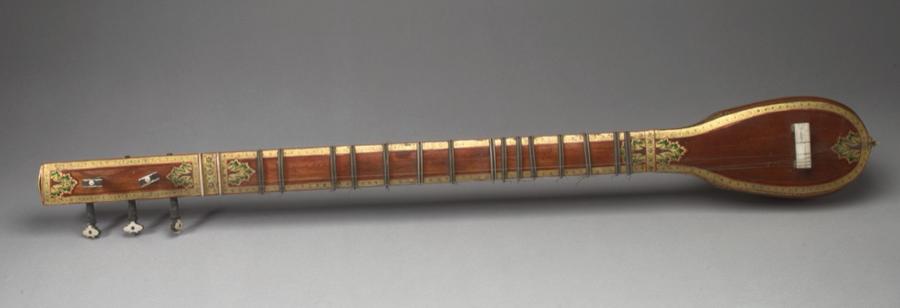
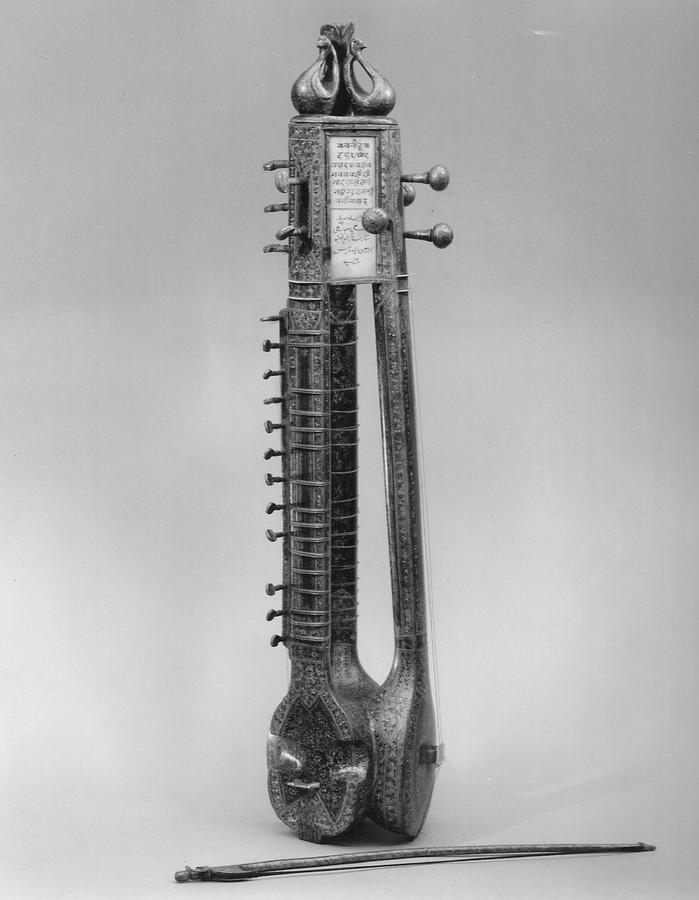
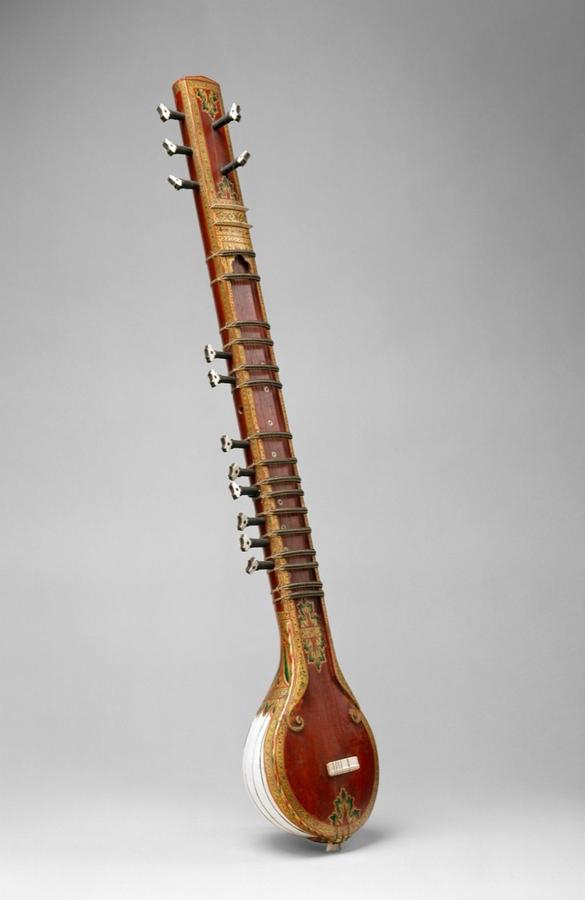
These 6 photographs span 1701–1920, 3 places of origin and 2 museums. Every photograph is public domain or openly licensed, and links to the museum’s own record.
-
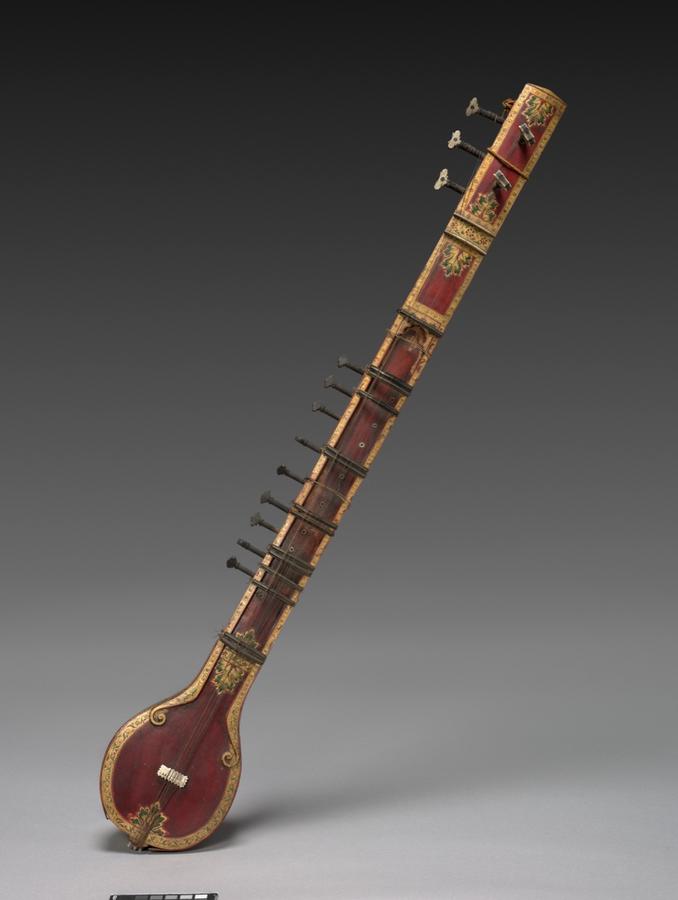
Sitarc. 1850 · Eastern India, Bengal or Bangladesh (Eastern India) -
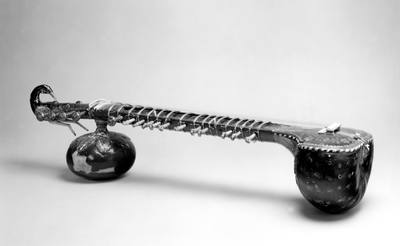
Sitar18th century · Indian (India) -
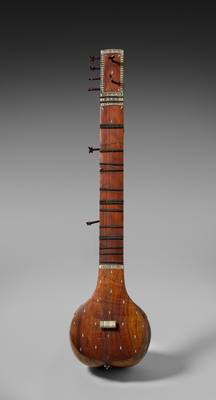
Sitar1800s · East India -
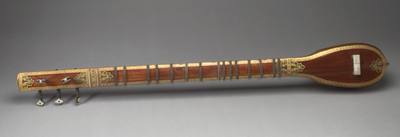
Sitarlate 19th century · Indian (India) -
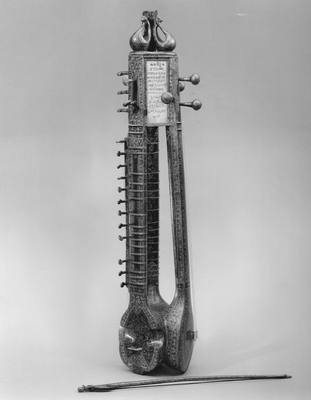
Sūr pyār (Compound Sitar, Tambura, Esraj)late 19th century · Indian (India) -
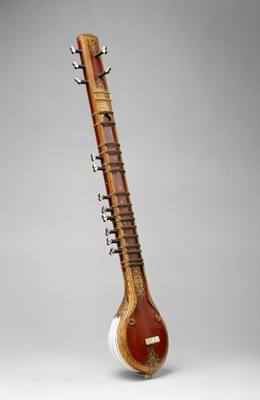
Sitarlate 19th Century · Indian (India)
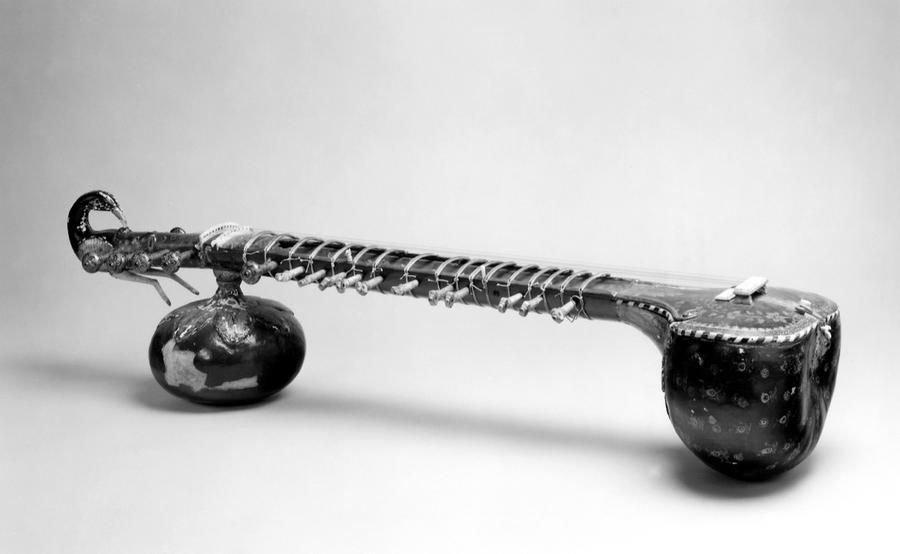
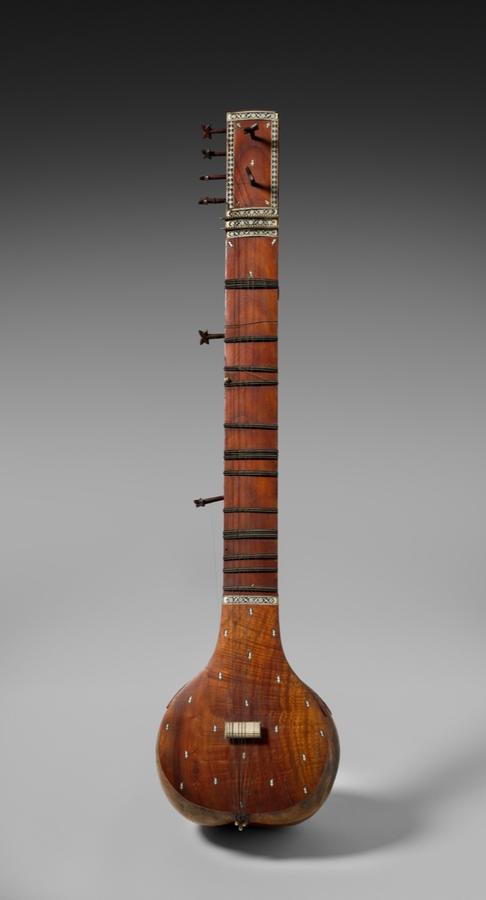
Facts at a glance
| Hornbostel–Sachs number | 321.321-6 — Composite chordophone sounded with a plectrum |
|---|---|
| Hornbostel–Sachs group | Chordophones › Composite chordophones › Lutes |
| Classification (Wikipedia infobox) | Necked bowl lutes, String instruments |
| Developed | 18th century |
| Wikidata labels | 79 languages |
| Wikipedia article | Sitar |
| Wikidata item | Q229205 |
| Wikimedia Commons category | Sitars |
| MusicBrainz instrument | 9290b2c1-97c3-4355-a26f-c6dba89cf8ff |
| Encyclopaedia Britannica | art/sitar |
Sources: Wikidata (CC0 1.0) — classification number, aliases, identifiers (dump of 2026-07-22); Wikipedia (CC BY-SA 4.0) — infobox fields (description of the classification number, development, inventors) and the names of the Hornbostel–Sachs groups (article “Hornbostel–Sachs”, revision of 2026-01-04).
The name in other languages
| Language | Name | Also written |
|---|---|---|
| English | sitar | |
| French | sitar | cithare |
| German | Sitar | |
| Spanish | sitar | |
| Italian | sitar | |
| Portuguese | sitar | |
| Dutch | sitar | |
| Russian | ситар | |
| Japanese | シタール | |
| Chinese | 锡塔琴 | 西塔琴 |
| Korean | 시타르 | |
| Arabic | سيتار |
Sources: Wikidata (CC0 1.0) — labels and aliases; MusicBrainz (CC0 1.0) — instrument aliases (names only).
About the sitar: history, construction and playing
The sitar is a plucked stringed instrument, originating from the Indian subcontinent, used in Hindustani classical music. The instrument was invented in the 18th century, and arrived at its present form in 19th-century India. Khusrau Khan, an 18th-century figure of the Mughal Empire, has been identified by modern scholarship as the inventor of the sitar. According to most historians, he developed the sitar from the setar, an Iranian instrument of Abbasid or Safavid origin.
Used widely throughout the Indian subcontinent, the sitar became popularly known in the wider world through the works of Ravi Shankar, beginning in the late 1950s and early 1960s. The advent of psychedelic culture during the mid-to-late 1960s set a trend for the use of the sitar in Western popular music, with the instrument appearing on tracks by bands such as The Beatles, The Rolling Stones, Metallica and many others.
Etymology
The word sitar is derived from the Persian word sehtar, meaning ‘three-stringed’.
According to Curt Sachs, Persians chose to name their lutes around the word tar, meaning string, combined with a word for the number of strings.
By example:
- Du + tar is the 2-stringed dutār,
- se + tar is the 3-stringed setār,
- čar + tar is for a tar with 4 strings,
- panč + tār is for a tar with 5 strings.
History
It was theorized that the sitar was invented, or rather developed by Amir Khusrow (c. 1253–1325), a famous Sufi inventor, poet and pioneer of Khyal, Tarana and Qawwali, during the 13th century. However, the tradition of Amir Khusrow is considered discredited by scholars. Whatever instruments he might have played, no record exists from this period using the name "sitar". An ambiguous statement made in a 19th-century work by Captain N. Augustus Willard may have resulted in the incorrect association of the renowned poet Amir Khusrau with a later individual, potentially named Khusrau Khan, who lived during the 18th century.
The earliest mention of Sitar dates back to 1739 AD. The "Muraqqa-i-Dehli", written by Dargah Quli Khan during the reign of Muhammad Shah Rangila, gives the earliest reference to the sitar. Oral and textual evidence analysed by historians indicate that an eighteenth-century figure of the Mughal court, named Khusrau Khan originated the sitar from the small Persian three-stringed setar. In the late Mughal Empire, the instrument began to take on its modern shape. The neck got wider. The bowl, which had been made of glued lathes of wood was now made of gourd, with metal frets and a bone nut on the neck. Masid Khan added two more strings to the sitar. The modern seven string sitar was created by Allauddin Khan. Sympathetic strings on sitar were first added by Imdad Khan. The earliest compositional style specifically for the sitar emerged in the mid-eighteenth century, attributed to Firoz Khan, who was either the son or nephew of Khusrau Khan.
Physical description
A sitar can have 18, 19, 20, or 21 strings; 6 or 7 of these run over curved, raised frets and are played strings; the remainder are sympathetic strings (tarb, also known as taarif or tarafdaar), running underneath the frets and resonating in sympathy with the played strings. The frets, which are known as or thaat, are movable, allowing fine tuning. The played strings run to tuning pegs on or near the head of the instrument, while the sympathetic strings, which have a variety of different lengths, pass through small holes in the fretboard to engage with the smaller tuning pegs that run down the instrument's neck.
The instrument has two bridges: the large bridge (badaa goraa) for the playing and drone strings and the small bridge (chota goraa) for the sympathetic strings. Its timbre results from the way the strings interact with the wide, rounded bridge. As a string vibrates, its length changes slightly as one edge moves along the rounded bridge, promoting the creation of overtones and giving the sound its distinctive tone. The maintenance of this specific tone by shaping the bridge is called jawari. Many musicians rely on instrument makers to adjust this.
Materials used in construction include teak wood or tun wood (Cedrela toona), which is a variation of mahogany, for the neck and faceplate (tabli), and calabash gourds for the resonating chambers. The instrument's bridges are made of deer horn, ebony, or very occasionally from camel bone. Synthetic material is now common as well.
Construction styles
There are two popular modern styles of sitar: the fully decorated "instrumental style" (sometimes called the "Ravi Shankar style") and the "gayaki" style (sometimes called the "Vilayat Khan" style).
The instrumental style sitar is most often made of seasoned toon wood, but sometimes made of teak. It is often fitted with a second resonator, a small tumba (pumpkin or pumpkin-like wood replica) on the neck. This style is usually fully decorated, with floral or grape carvings and celluloid inlays with colored (often brown or red) and black floral or arabesque patterns. It typically has 13 sympathetic strings. It is said that the best Teak sitars are made from teak that has been seasoned for generations. The sources of very old seasoned wood are guarded trade secrets. Therefore, instrument builders look for old teak that was used in old colonial-style villas as whole trunk columns for their special sitar constructions.
There are various additional sub-styles and cross mixes of styles in sitars, according to customer preferences. Most importantly, there are some differences in preferences for the positioning of sympathetic (taraf) string pegs.
Among all sitar styles, there are student styles, beginner models, semi-pro styles, pro models, master models, and so on. Prices are often determined by the manufacturer's name and not by looks alone or materials used. Some sitars by certain manufacturers fetch very high collectible prices. Most notable are older Rikhi Ram (Delhi) and older Hiren Roy (Kolkata) sitars, depending upon which master built the instrument. Nikhil Banerjee had a small extra bridge fixed at the top of the sitar fingerboard for sustain.
Tuning of sitar
Tuning depends on the sitarist's school or style, tradition and each artist's personal preference. The main playing string is almost invariably tuned a perfect fourth above the tonic, the second string being tuned to the tonic. The tonic in the Indian solfège system is referred to as ṣaḍja, ṣaḍaj, or the shortened form sa, or khaṛaj, a dialectal variant of ṣaḍaj, not as vād, and the perfect fifth to which one or more of the drones strings are tuned is referred to as pañcam, not samvād.
The player should re-tune for each raga. Strings are tuned by tuning pegs, and the main playing strings can be fine-tuned by sliding a bead threaded on each string just below the bridge.
In one or more of the more common tunings (used by Ravi Shankar, among others, called "Kharaj Pancham" sitar) the playable strings are strung in this fashion:
- Chikari strings: Sa (high), Sa (middle), and Pa.
- Kharaj (bass) strings: Sa (low) and Pa (low).
- Jod and baaj strings, Sa and Ma.
There is a lot of stylistic variance within these tunings, and like most Indian stringed instruments, there is no default tuning. Mostly, tunings vary by schools of teaching (gharana) and the piece that is meant to be played.
Playing
The instrument is balanced between the player's left foot and right knee. The hands move freely without having to carry any of the instrument's weight. The player plucks the string using a metallic pick or plectrum called a mizraab. The thumb stays anchored on the top of the fretboard just above the main gourd. Generally, only the index and middle fingers are used for fingering although a few players occasionally use the third. A specialized technique called "meend" involves pulling the main melody string down over the bottom portion of the sitar's curved frets, with which the sitarist can achieve a seven-semitone range of notes. This was developed by Vilayat Khan into a technique that imitated the melisma of the vocal style, a technique known as gayaki ang. Sometimes, a sitar could be played with a bow. Its sound is similar to sarangi, but raspier.
Adept players bring in charisma through the use of special techniques like Kan, Krintan, Murki, Zamzama, etc. They also use special Mizrab Bol-s, as in Misrabani.
World music influence
In the late 1950s and early 1960s Ravi Shankar, along with his tabla player, Alla Rakha, began a further introduction of Indian classical music to western culture.
The sitar saw use in western music when, guided by David Crosby's championing of Shankar, George Harrison played it on the Beatles' songs "Norwegian Wood (This Bird Has Flown)", "Love You To" and "Within You Without You", recorded between 1965 and 1967. The Beatles' association with the instrument helped popularise Indian classical music among Western youth, particularly once Harrison began receiving tutelage from Shankar and the latter's protégé Shambhu Das in 1966. That same year, Brian Jones of the Rolling Stones used a sitar on "Paint It Black", while another English guitarist, Dave Mason, played it on Traffic's 1967 hits "Paper Sun" and "Hole in My Shoe". These and other examples marked a trend of featuring the instrument in pop songs, which Shankar later described as "the great sitar explosion". Speaking to KRLA Beat in July 1967, he said: "Many people, especially young people, have started listening to sitar since George Harrison, one of the Beatles, became my disciple ... It is now the 'in' thing."
Led Zeppelin's Jimmy Page talked about his love of Indian music, saying: "I went to India after I came back from a tour with the Yardbirds in the late sixties just so I could hear the music firsthand. Let's put it this way: I had a sitar before George Harrison got his. I wouldn't say I played it as well as he did, though..." Robbie Krieger's guitar part on the Doors' 1967 track "The End" was heavily influenced by Indian ragas and features melodic and rhythmic qualities that suggest a sitar or veena. Many pop performances actually involve the electric sitar, which is a solid-body, guitar-like instrument and quite different from the traditional acoustic Indian instrument.
Source: Wikipedia, “Sitar” — CC BY-SA 4.0 — text excerpted as published (references, images and tables removed); see the article for the full text and the list of authors. Revision of 2026-06-17.
Sources and licences
- Sitar, c. 1850, Eastern India, Bengal or Bangladesh (Eastern India). Gourd and wood with pigment, ivory, and bone; copper alloy: frets; iron alloy: strings (with one modern…. The Charles G. King Jr. collection; Gift of Ralph King in memory of Charles G. King Jr.. Museum record · CC0 1.0 (public domain dedication)
- Sitar, 18th century, Indian (India). Gourds, paint, wood, various materials. Gift of Cathleen W. Treacy, 1994 (1994.63). Museum record · CC0 1.0 (public domain dedication)
- Sitar, 1800s, East India. Gourd, wood, ivory inlay, ebony? inlay, gut, and metal strings. The Charles G. King Jr. collection; Gift of Ralph King in memory of Charles G. King Jr.. Museum record · CC0 1.0 (public domain dedication)
- Sitar, late 19th century, Indian (India). Wood. The Crosby Brown Collection of Musical Instruments, 1889 (89.4.202). Museum record · CC0 1.0 (public domain dedication)
- Sūr pyār (Compound Sitar, Tambura, Esraj), late 19th century, Indian (India). gourd, wood, polychrome, steel and gut strings, ivory, metal. The Crosby Brown Collection of Musical Instruments, 1889 (89.4.1313). Museum record · CC0 1.0 (public domain dedication)
- Sitar, late 19th Century, Indian (India). Gourd, wood, ivory, metal. The Crosby Brown Collection of Musical Instruments, 1889 (89.4.1586). Museum record · CC0 1.0 (public domain dedication)
Photographs: open-access collections of the museums named above; each is shown here reduced in size, otherwise unchanged. Text: Wikipedia (CC BY-SA 4.0), Wikidata and MusicBrainz (CC0). The full list of sources and licences is on the credits page.