
Instruments · Chordophones
Hurdy-gurdy
The hurdy-gurdy is a string instrument that produces sound by means of a hand-cranked rosined wheel that rubs against the strings. The wheel functions much like a violin (or nyckelharpa) bow, and single notes played on the instrument sound similar to those of a violin. Melodies are played on a keyboard that presses tangents—small wedges, typically made of wood or metal—against one or more of the strings to change their pitch. Like most other acoustic stringed instruments, it has a sound board and hollow cavity to make the vibration of the strings audible.
Summary: Wikipedia, “Hurdy-gurdy” — CC BY-SA 4.0. Revision of 2026-06-06.
Museum photographs
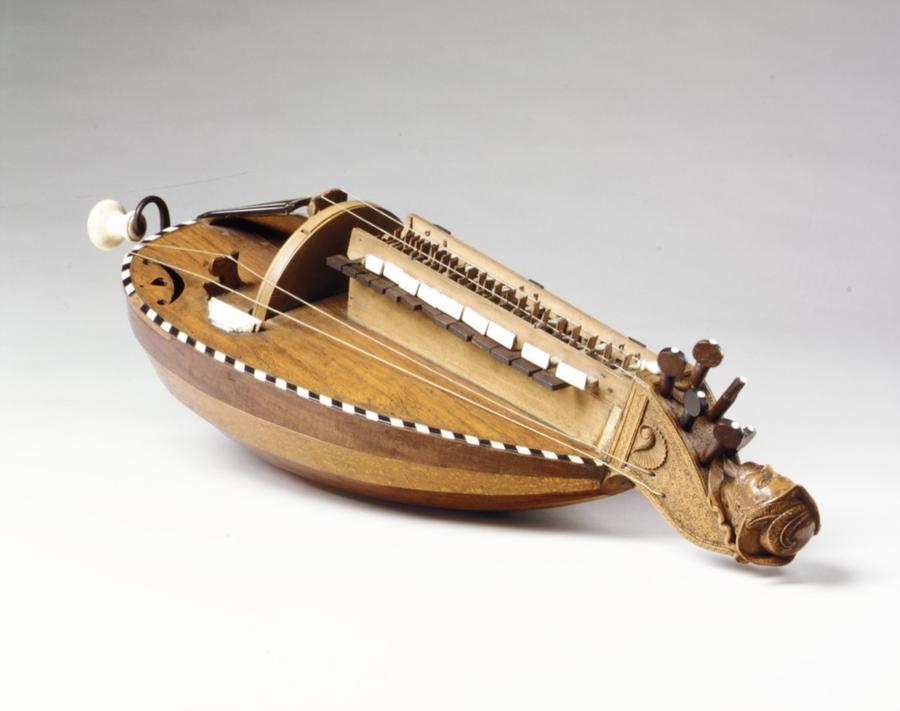
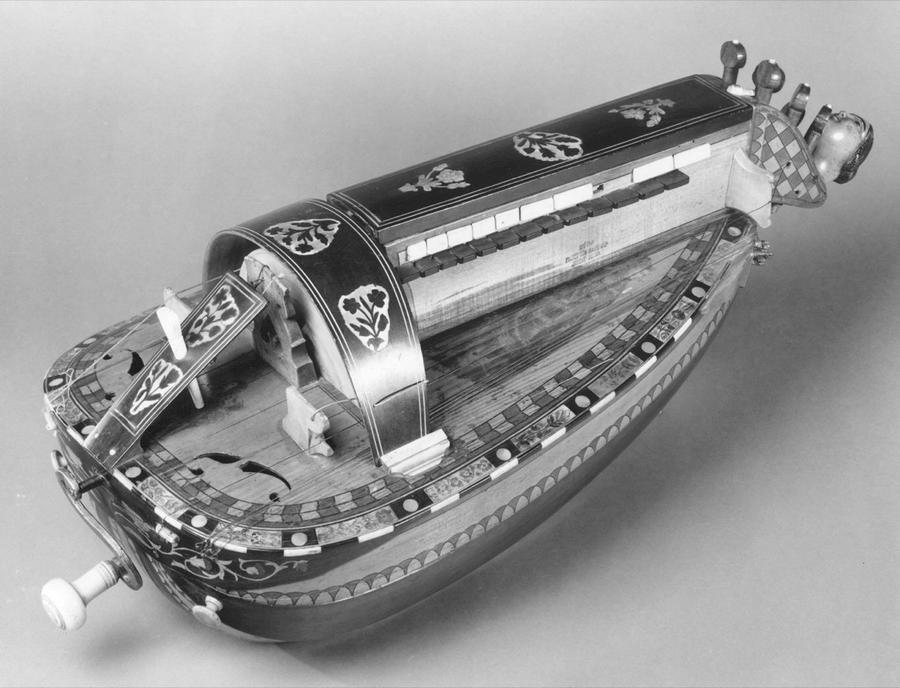
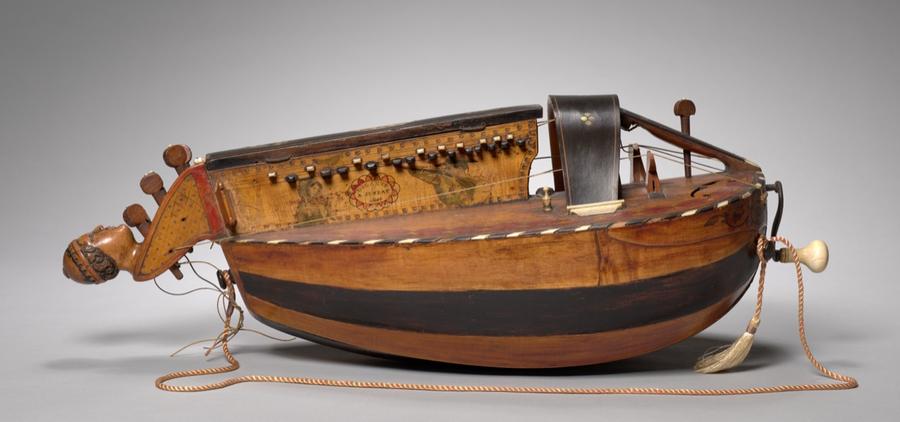
These 6 photographs span 1700–1899, 1 place of origin and 3 museums. Every photograph is public domain or openly licensed, and links to the museum’s own record.
-
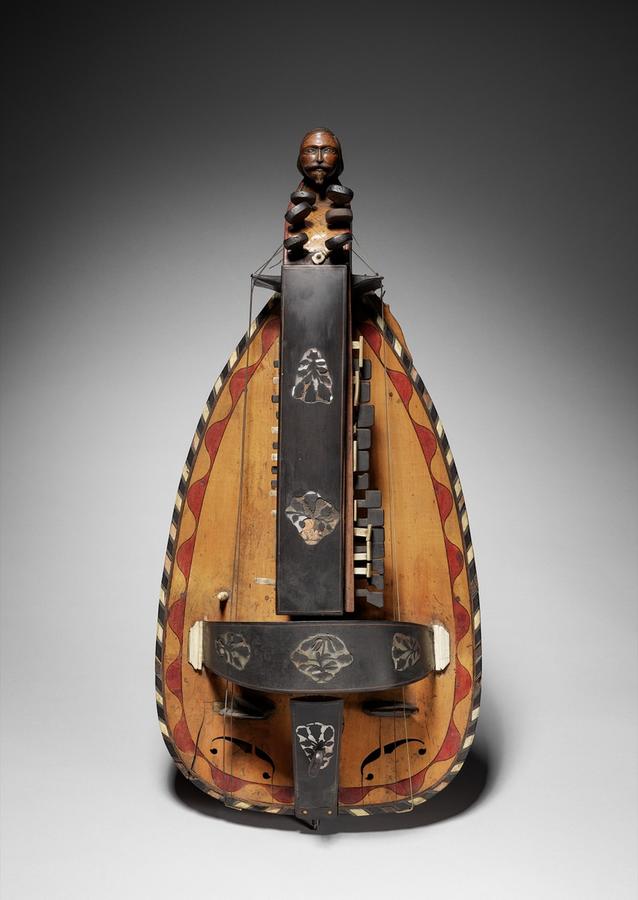
Vielle à roue1700s · France -
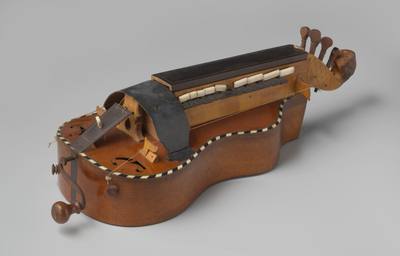
Hurdy-gurdyc. 1750 - c. 1800 · France -
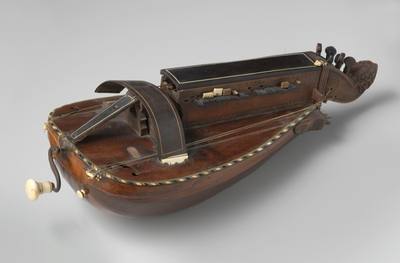
Hurdy-gurdyc. 1750 - c. 1784 · Paris -
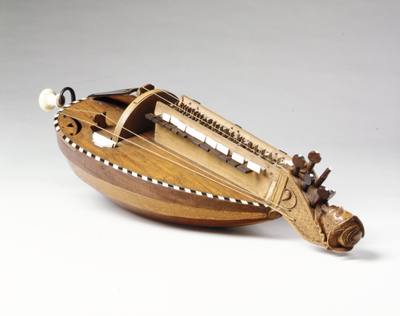
Hurdy-Gurdysecond half 18th century · French (France) -
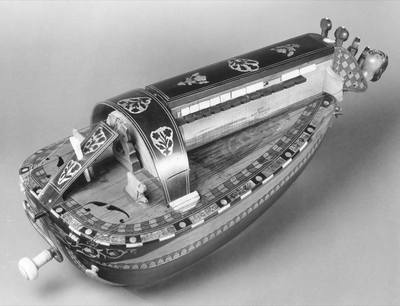
Hurdy-Gurdyca. 1879 · French (France) -
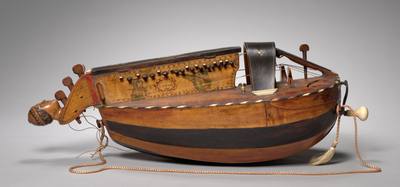
Vielle à Roue (Hurdy-Gurdy)1865–70 · France
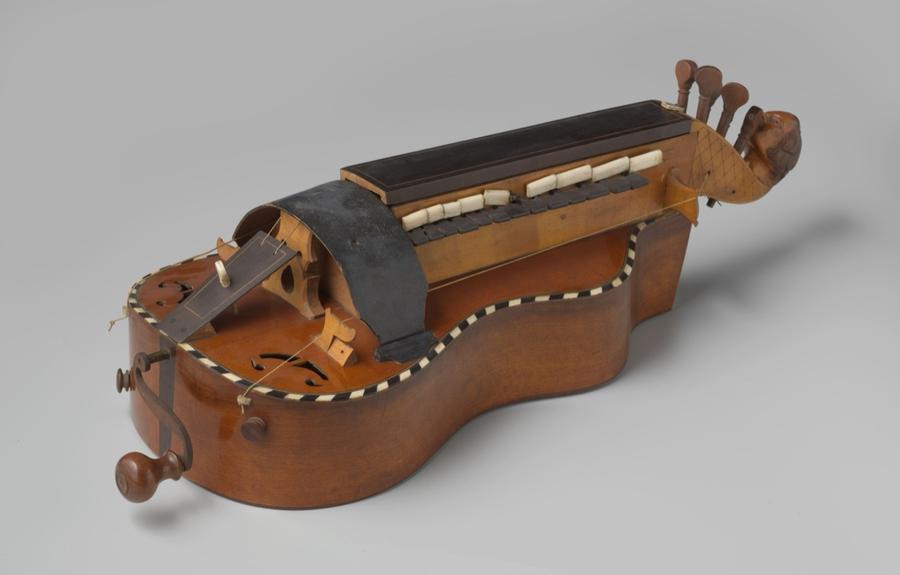
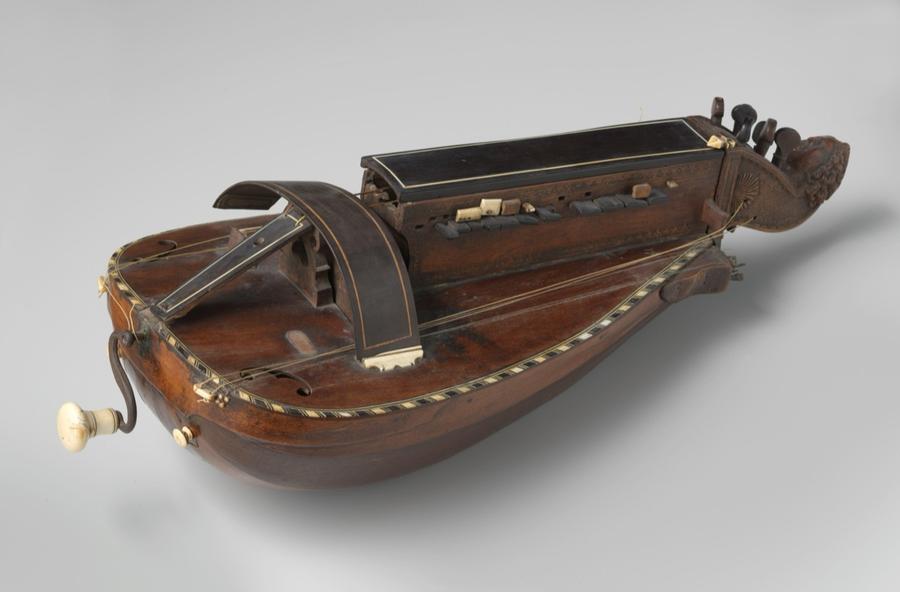
Facts at a glance
| Hornbostel–Sachs number | 321.321-72 — Composite chordophone sounded by rosined wheel |
|---|---|
| Hornbostel–Sachs group | Chordophones › Composite chordophones › Lutes |
| Also known as | hurdy gurdy, wheel fiddle, wheel vielle, organistrum, vieille, vielle à roue |
| Classification (Wikipedia infobox) | String instrument (bowed) |
| Wikidata labels | 57 languages |
| Wikipedia article | Hurdy-gurdy |
| Wikidata item | Q207821 |
| Wikimedia Commons category | Hurdy-gurdies |
| MusicBrainz instrument | 303d4f1a-f799-4c42-9bac-dbedd9139e91 |
| Encyclopaedia Britannica | art/hurdy-gurdy |
Sources: Wikidata (CC0 1.0) — classification number, aliases, identifiers (dump of 2026-07-22); Wikipedia (CC BY-SA 4.0) — infobox fields (description of the classification number, development, inventors) and the names of the Hornbostel–Sachs groups (article “Hornbostel–Sachs”, revision of 2026-01-04).
The name in other languages
| Language | Name | Also written |
|---|---|---|
| English | hurdy-gurdy | hurdy gurdy, wheel fiddle, wheel vielle |
| French | vielle à roue | Vielle a roue, Vièle à roue, Chifournie |
| German | Drehleier | Bauernleier, Zanfona, Vielle a Roue |
| Spanish | zanfona | Zanfonía, Hurdy gurdy, Zanfoña |
| Italian | ghironda | Hurdy gurdy, Hurdygurdy |
| Portuguese | sanfona | |
| Dutch | draailier | Hurdy gurdy, Hurdygurdy |
| Russian | колёсная лира | Лира колесная, Рыля, Рылей |
| Japanese | ハーディ・ガーディ | ハーディーガーディー, ハーディガーディ, ハーディー・ガーディー |
| Chinese | 手搖琴 | 手摇琴, 绞弦琴 |
| Korean | 허디 거디 | 오르가니스트룸, 허디거디 |
Sources: Wikidata (CC0 1.0) — labels and aliases; MusicBrainz (CC0 1.0) — instrument aliases (names only).
About the hurdy-gurdy: history, construction and playing
The hurdy-gurdy is a string instrument that produces sound by means of a hand-cranked rosined wheel that rubs against the strings. The wheel functions much like a violin (or nyckelharpa) bow, and single notes played on the instrument sound similar to those of a violin. Melodies are played on a keyboard that presses tangents—small wedges, typically made of wood or metal—against one or more of the strings to change their pitch. Like most other acoustic stringed instruments, it has a sound board and hollow cavity to make the vibration of the strings audible.
Most hurdy-gurdies have multiple drone strings, which give a constant pitch accompaniment to the melody, resulting in a sound similar to that of bagpipes. For this reason, the hurdy-gurdy is often used interchangeably or along with bagpipes. It is mostly used in French, Occitan, Aragonese, Cajun French, Asturian, Cantabrian, Galician, Hungarian, and Slavic folk music. It can also be seen in early music settings such as medieval, renaissance or baroque music. One or more of the gut strings called 'trompette' usually passes over a buzzing bridge called the 'chien' that can be made to produce a distinctive percussive buzzing sound as the player turns the wheel. The chien was originally designed with a hollow interior to provide a small storage space for spare strings. The players found that this hollow construction also enhanced the desired buzzing timbre.
History
The hurdy-gurdy is generally thought to have originated from fiddles in either Europe or the Middle East (e.g, the rebab instrument) before the eleventh century A.D. The first recorded reference to fiddles in Europe was in the 9th century by the Persian geographer Ibn Khurradadhbih (died 911) describing the lira (lūrā) as a typical instrument within the Byzantine Empire. One of the earliest forms of the hurdy-gurdy was the organistrum, a large instrument with a guitar-shaped body and a long neck in which the keys were set (covering one diatonic octave). The organistrum had a single melody string and two drone strings, which ran over a common bridge, and a relatively small wheel. Due to its size, the organistrum was played by two people, one of whom turned the crank while the other pulled the keys upward. Pulling keys upward is cumbersome, so only slow tunes could be played on the organistrum.
The pitches on the organistrum were set according to Pythagorean temperament and the instrument was primarily used in monastic and church settings to accompany choral music. Abbot Odo of Cluny (died 942) is supposed to have written a short description of the construction of the organistrum entitled Quomodo organistrum construatur (How the Organistrum Is Made), known through a much later copy, but its authenticity is very doubtful. Another 10th-century treatise thought to have mentioned an instrument like a hurdy-gurdy is an Arabic musical compendium written by Al Zirikli. One of the earliest visual depictions of the organistrum is from the twelfth-century Pórtico da Gloria (Portal of Glory) on the cathedral at Santiago de Compostela, Galicia, Spain: it has a carving of two musicians playing an organistrum.
Later, the organistrum was made smaller to let a single player both turn the crank and work the keys. The solo organistrum was known from Spain and France, but was largely replaced by an improved variant, known as a symphonia, in the 13th century, a small box-shaped version of the hurdy-gurdy with three strings and a diatonic keyboard. At about the same time, a new form of key pressed from beneath was developed. These keys were much more practical for faster music and easier to handle; eventually they completely replaced keys pulled up from above. Medieval depictions of the symphonia show both types of keys.
Nomenclature
According to the Oxford English Dictionary, the mid-18th-century origin of the term hurdy-gurdy is onomatopoeic in origin, after the repetitive warble in pitch that characterizes instruments with solid wooden wheels that have warped due to changes in humidity or after the sound of the buzzing-bridge. Alternately, the term is thought to come from the Scottish and northern English term for uproar or disorder, hirdy-girdy or from hurly-burly, an old English term for noise or commotion. The instrument is sometimes more descriptively called a wheel fiddle in English, but this term is rarely used among players of the instrument. Another possible derivation is from the Hungarian hegedűs (Slovenian variant hrgadus) meaning a fiddle.
In France, the instrument is known as vielle à roue (wheel fiddle) or simply vielle (even though there is another instrument with this name – vielle), while in the French-speaking regions of Belgium it is also known in local dialects as vièrlerète/vièrlète or tiesse di dj'va ('horse's head'). The Flemings and the Dutch call it a draailier, which is similar to its German name, Drehleier. An alternate German name, Bauernleier, means "peasant's lyre". In Italy, it is called the ghironda or lira tedesca while in Spain, it is a zanfona in Galicia, zanfoña in Zamora, rabil in Asturias and viola de roda in Catalonia. In the Basque language, it is known as a zarrabete. In Portugal, it is called sanfona.
The Hungarian name tekerőlant and the alternative forgólant both mean "turning lute". Another Hungarian name for the instrument is nyenyere, which is thought to be an onomatopoeic reference to the repetitive warble produced by a wheel that is not even. This term was considered derogatory in the Hungarian lowlands, but was the normal term for the instrument on Csepel island directly south of Budapest. The equivalent names ninera and niněra are used in Slovakia and the Czech Republic respectively. In Russian, Ukrainian, and Belarusian the instrument is called "wheel lyre" (колёсная лира, колісна ліра, колавая ліра). In Poland it is called "cranked lyre" (lira korbowa).
Leier, lant, and related terms today are generally used to refer to members of the lute or lyre family, but historically had a broader range of meaning and were used for many types of stringed instruments.
Shape
In her overview of the instrument's history, Palmer recorded twenty-three different forms, and there is still no standardized design today.
The six-stringed French vielle à roue is the best-known and most common sort. A number of regional forms developed, but outside France the instrument was considered a folk instrument and there were no schools of construction that could have determined a standard form.
There are two primary body styles for contemporary instruments: guitar-bodied and lute-backed. Both forms are found in French-speaking areas, while guitar-bodied instruments are the general form elsewhere. The box form symphonia is also commonly found among players of early music and historical re-enactors.
Strings
Historically, strings were made of gut, which is still a preferred material today and modern instruments are mounted with violin (D or A) and cello (A, G, C) strings. However, metal-wound strings have become common in the twentieth century, especially for the heavier drone strings or for lower melody strings if octave tuning is used. Nylon is also sometimes used, but is disliked by many players. Some instruments also have optional sympathetic strings, generally guitar or banjo B strings.
The drone strings produce steady sounds at fixed pitches. The melody string(s) (French chanterelle(s), Hungarian dallamhúr(ok)) are stopped with tangents attached to keys that change the vibration length of the string, much as a guitarist uses his or her fingers on the fretboard of a guitar. In the earliest hurdy-gurdies these keys were arranged to provide a Pythagorean temperament, but in later instruments the tunings have varied widely, with equal temperament most common because it allows easier blending with other instruments. However, because the tangents can be adjusted to tune individual notes, it is possible to tune hurdy-gurdies to almost any temperament as needed. Most contemporary hurdy-gurdies have 24 keys that cover a range of two chromatic octaves.
To achieve proper intonation and sound quality, each string of a hurdy-gurdy must be wrapped with cotton or similar fibers. The cotton on melody strings tends to be quite light, while drone strings have heavier cotton. Improper cottoning results in a raspy tone, especially at higher pitches. In addition, individual strings (in particular the melody strings) often have to have their height above the wheel surface adjusted by having small pieces of paper placed between the strings and the bridge, a process called shimming. Shimming and cottoning are connected processes since either one can affect the geometry of the instrument's strings.
Buzzing bridge
In some types of hurdy-gurdy, notably the French vielle à roue ('fiddle with a wheel') and the Hungarian tekerőlant (tekerő for short), makers have added a buzzing bridge—called a chien (French for dog) or recsegő (Hungarian for "buzzer")—on one drone string. Modern makers have increased the number of buzzing bridges on French-style instruments to as many as four. This mechanism consists of a loose bridge under a drone string. The tail of the buzzing bridge is inserted into a narrow vertical slot (or held by a peg in Hungarian instruments) that holds the buzzing bridge in place (and also serves as a bridge for additional drone strings on some instruments).
The free end of the dog (called the hammer) rests on the soundboard of the hurdy-gurdy and is more or less free to vibrate. When the wheel is turned regularly and not too fast the pressure on the string (called the trompette on French instruments) holds the bridge in place, sounding a drone. When the crank is struck, the hammer lifts up suddenly and vibrates against the soundboard, producing a characteristic rhythmic buzz that is used as an articulation or to provide percussive effect, especially in dance pieces.
On French-style instruments, the sensitivity of the buzzing bridge can be altered by turning a peg called a tirant in the tailpiece of the instrument that is connected by a wire or thread to the trompette. The tirant adjusts the lateral pressure on the trompette and thereby sets the sensitivity of the buzzing bridge to changes in wheel velocity. When hard to trigger, the strike or the bridge is said "sec" (dry), "chien sec", or "coup sec". When easy to trigger, the strike or the bridge is said "gras" (fat), "chien gras", or "coup gras".
Source: Wikipedia, “Hurdy-gurdy” — CC BY-SA 4.0 — text excerpted as published (references, images and tables removed); see the article for the full text and the list of authors. Revision of 2026-06-06.
Sources and licences
- Vielle à roue, Pajot of Jánzat (French), 1700s, France. wood. The Charles G. King Jr. collection; Gift of Ralph King in memory of Charles G. King Jr.. Museum record · CC0 1.0 (public domain dedication)
- Hurdy-gurdy, Anonymous, c. 1750 - c. 1800, France. ivory, wood (plant material), ebony (wood). Purchased with the support of the State of the Netherlands and the Vereeniging van Noord-Nederlandsche Muziekgeschiedenis. Museum record · Public Domain Mark 1.0
- Hurdy-gurdy, Pierre Louvet, c. 1750 - c. 1784, Paris. wood (plant material), ebony (wood), ivory. Rijksmuseum, Amsterdam. Museum record · Public Domain Mark 1.0
- Hurdy-Gurdy, second half 18th century, French (France). Wood, ivory, metal. The Crosby Brown Collection of Musical Instruments, 1889 (89.4.1059). Museum record · CC0 1.0 (public domain dedication)
- Hurdy-Gurdy, Gilbert Nigout, ca. 1879, French (France). Wood, bone, ivory, mother-of-pearl. Gift of Nat and Yanna Brandt, in memory of Sophie Kroyt, 1983 (1983.487.1). Museum record · CC0 1.0 (public domain dedication)
- Vielle à Roue (Hurdy-Gurdy), Jacques Decante (French, 1808–1884), 1865–70, France. Wood; mother-of-pearl inlay. Gift of Clara Taplin Rankin. Museum record · CC0 1.0 (public domain dedication)
Photographs: open-access collections of the museums named above; each is shown here reduced in size, otherwise unchanged. Text: Wikipedia (CC BY-SA 4.0), Wikidata and MusicBrainz (CC0). The full list of sources and licences is on the credits page.