
Instruments · Chordophones
Pipa
The pipa (Chinese: 琵琶; pinyin: pípá) is a four-stringed Chinese musical instrument, belonging to the plucked category of instruments (弹拨乐器/彈撥樂器).
Summary: Simple English Wikipedia, “Pipa” — CC BY-SA 4.0. Revision of 2025-05-03.
Museum photographs
These 4 photographs span 1590–1900, 1 place of origin and 2 museums. Every photograph is public domain or openly licensed, and links to the museum’s own record.
-
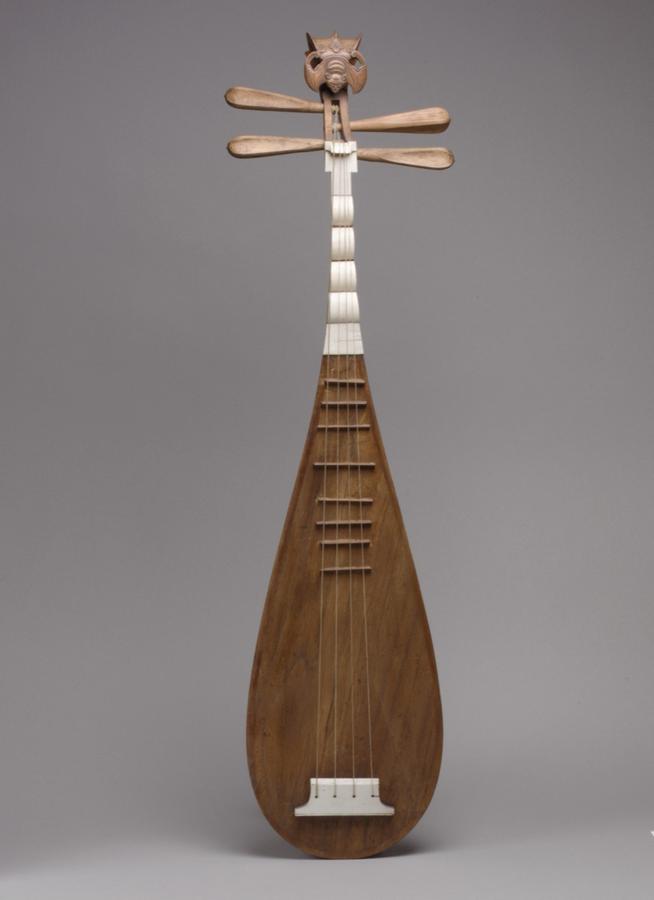
Pipa (琵琶 )19th century · Chinese (China) -
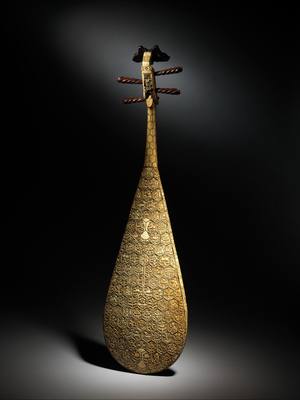
Pipa (琵琶 )late 16th–early 17th century · Chinese (China) -
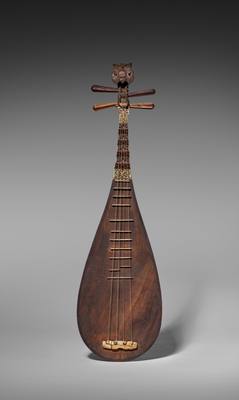
Pipa1800s · China, Qing dynasty (1644-1911) (China) -
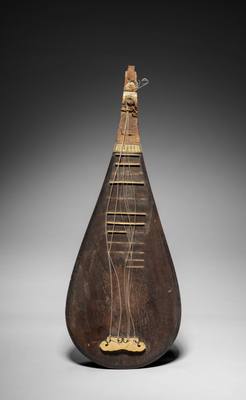
Liuxian Pipa (Six-String Pipa)1800s · China, Qing dynasty (1644-1911) (China)
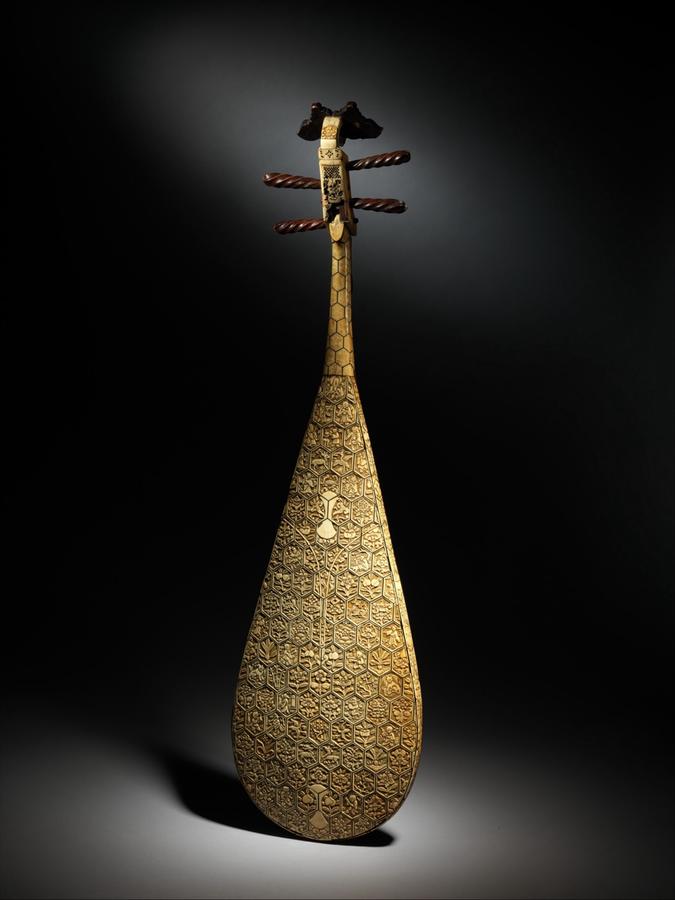
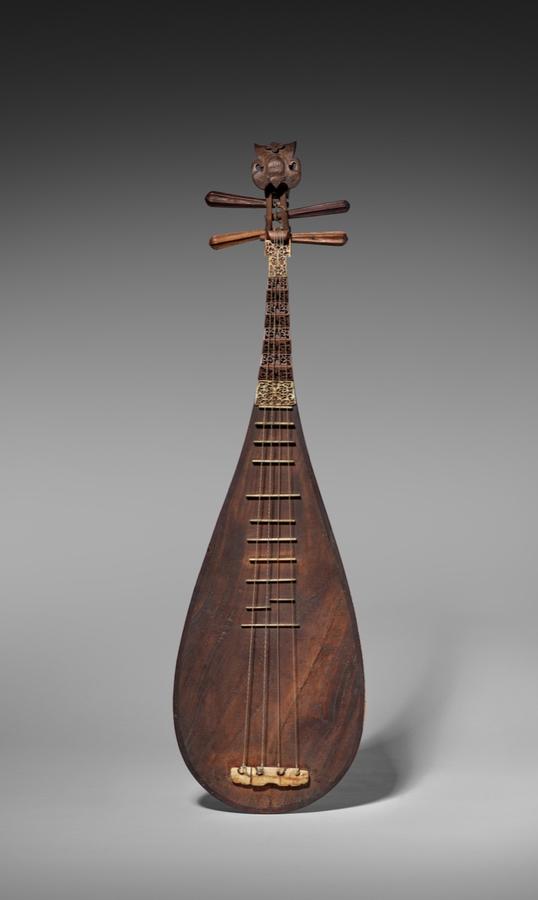
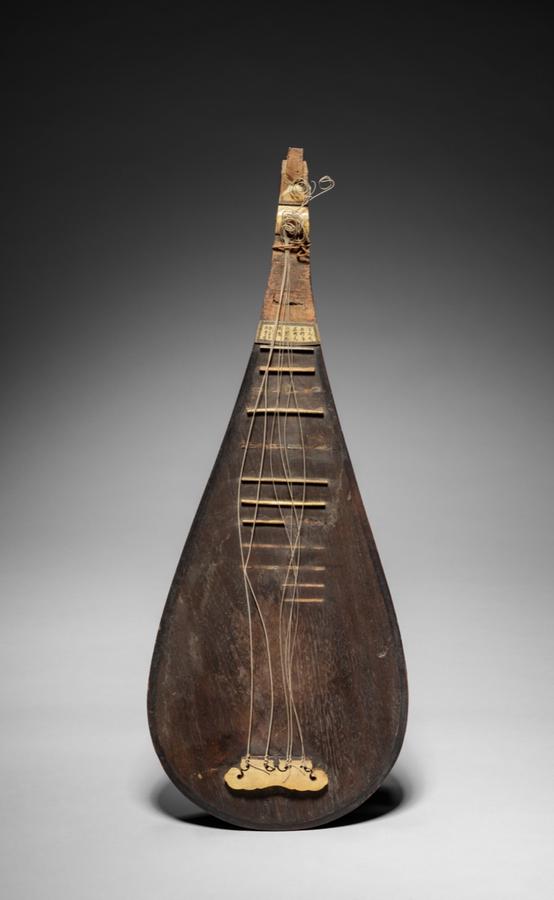
Facts at a glance
| Hornbostel–Sachs number | 321.321-5 |
|---|---|
| Hornbostel–Sachs group | Chordophones › Composite chordophones › Lutes |
| Also known as | pípá, p'i-p'a, Chinese lute, East Asian necked lute, 琵琶 |
| Classification (Wikipedia infobox) | Necked bowl lutes, String instruments |
| Wikidata labels | 50 languages |
| Wikipedia article | Pipa |
| Wikidata item | Q6685124 |
| Wikimedia Commons category | Pipa (musical instrument) |
| MusicBrainz instrument | 4ddf3737-9ef2-49c4-9de2-697a19884463 |
| Encyclopaedia Britannica | art/pipa-musical-instrument |
| Audio sample (Wikimedia Commons) | Pipa - sound.ogg |
Sources: Wikidata (CC0 1.0) — classification number, aliases, identifiers (dump of 2026-07-22); Wikipedia (CC BY-SA 4.0) — infobox fields (description of the classification number, development, inventors) and the names of the Hornbostel–Sachs groups (article “Hornbostel–Sachs”, revision of 2026-01-04).
The name in other languages
| Language | Name | Also written |
|---|---|---|
| English | pipa | pípá, p'i-p'a, Chinese lute |
| French | pipa | |
| German | Pipa | |
| Spanish | pipa | |
| Italian | pipa | liuti a collo dell'Asia orientale |
| Portuguese | pipa (instrumento musical) | |
| Dutch | pipa | |
| Russian | пипа | пипа (музыкальный инструмент) |
| Japanese | 琵琶 | ピーパー(琵琶) |
| Chinese | 中國琵琶 | 琵琶 |
| Korean | 비파 |
Sources: Wikidata (CC0 1.0) — labels and aliases; MusicBrainz (CC0 1.0) — instrument aliases (names only).
About the pipa: history, construction and playing
The pipa (Chinese: 琵琶; pinyin: pípá) is a traditional Chinese musical instrument belonging to the plucked category of instruments. Sometimes called the "Chinese lute", the instrument has a pear-shaped wooden body with a varying number of frets ranging from 12 to 31. Another Chinese four-string plucked lute is the liuqin, which looks like a smaller version of the pipa. The pear-shaped instrument may have existed in China as early as the Han dynasty, and although historically the term pipa was once used to refer to a variety of plucked chordophones, its usage since the Song dynasty refers exclusively to the pear-shaped instrument.
The pipa is one of the most popular Chinese instruments and has been played for almost two thousand years in China. Several related instruments are derived from the pipa, including the Japanese biwa and Korean bipa in East Asia, and the Vietnamese đàn tỳ bà in Southeast Asia. The Korean instrument is the only one of the three that is no longer widely used.
History
There are some confusions and disagreements about the origin of pipa. This may be due to the fact that the word pipa was used in ancient texts to describe a variety of plucked chordophones of the period from the Qin to the Tang dynasty, including the long-necked spiked lute and the short-necked lute, as well as the differing accounts given in these ancient texts. Traditional Chinese narrative prefers the story of the Han Chinese Princess Liu Xijun sent to marry a barbarian Wusun king during the Han dynasty, with the pipa being invented so she could play music on horseback to soothe her longings. Modern researchers such as Laurence Picken, Shigeo Kishibe, and John Myers suggested a non-Chinese origin.
The earliest mention of pipa in Chinese texts appeared late in the Han dynasty around the 2nd century AD. According to Liu Xi's Eastern Han dynasty Dictionary of Names, the word pipa may have an onomatopoeic origin (the word being similar to the sounds the instrument makes), although modern scholarship suggests a possible derivation from the Persian word "barbat", the two theories however are not necessarily mutually exclusive. Liu Xi also stated that the instrument called pipa, though written differently (Chinese: 枇杷; pinyin: pípá or Chinese: 批把; pinyin: pībǎ) in the earliest texts, originated from amongst the Hu people (a general term for non-Han people living to the north and west of ancient China).
In Chinese literature
Early literary tradition in China, for example in a 3rd-century description by Fu Xuan, Ode to Pipa, associates the Han pipa with the northern frontier, Wang Zhaojun and other princesses who were married to nomad rulers of the Wusun and Xiongnu peoples in what is now Mongolia, northern Xinjiang and Kazakhstan. Wang Zhaojun in particular is frequently referenced with pipa in later literary works and lyrics, for example Ma Zhiyuan's play Autumn in the Palace of Han (漢宮秋), especially since the Song dynasty (although her story is often conflated with other women including Liu Xijun), as well as in music pieces such as Zhaojun's Lament (昭君怨, also the title of a poem), and in paintings where she is often depicted holding a pipa.
During the Song dynasty, many of the literati and poets wrote ci verses, a form of poetry meant to be sung and accompanied by instruments such as pipa. They included Ouyang Xiu, Wang Anshi, and Su Shi. During the Yuan dynasty, the playwright Gao Ming wrote a play for nanxi opera called Pipa ji (琵琶記, or "Story of the Pipa"), a tale about an abandoned wife who set out to find her husband, surviving by playing the pipa. It is one of the most enduring works in Chinese theatre, and one that became a model for Ming dynasty drama as it was the favorite opera of the first Ming emperor. The Ming collection of supernatural tales Fengshen Yanyi tells the story of Pipa Jing, a pipa spirit, but ghost stories involving pipa existed as early as the Jin dynasty, for example in the 4th century collection of tales Soushen Ji. Novels of the Ming and Qing dynasties such as Jin Ping Mei showed pipa performance to be a normal aspect of life in these periods at home (where the characters in the novels may be proficient in the instrument) as well as outside on the street or in pleasure houses.
Playing and performance
The name "pipa" is made up of two Chinese syllables, "pí" (琵) and "pá" (琶). These, according to the Han dynasty text by Liu Xi, refer to the way the instrument is played – "pí" is to strike outward with the right hand, and "pá" is to pluck inward towards the palm of the hand. The strings were played using a large plectrum in the Tang dynasty, a technique still used now for the Japanese biwa. It has however been suggested that the long plectrum depicted in ancient paintings may have been used as a friction stick like a bow. The plectrum has now been largely replaced by the fingernails of the right hand. The most basic technique, tantiao (彈挑), involves just the index finger and thumb (tan is striking with the index finger, tiao with the thumb). The fingers normally strike the strings of pipa in the opposite direction to the way a guitar is usually played, i.e. the fingers and thumb flick outward, unlike the guitar where the fingers and thumb normally pluck inward towards the palm of the hand. Plucking in the opposite direction to tan and tiao are called mo (抹) and gou (勾) respectively. When two strings are plucked at the same time with the index finger and thumb (i.e. the finger and thumb separate in one action), it is called fen (分), the reverse motion is called zhi (摭). A rapid strum is called sao (掃), and strumming in the reverse direction is called fu (拂). A distinctive sound of pipa is the tremolo produced by the lunzhi (輪指) technique which involves all the fingers and thumb of the right hand. It is however possible to produce the tremolo with just one or more fingers.The left hand techniques are important for the expressiveness of pipa music. Techniques that produce vibrato, portamento, glissando, pizzicato, harmonics or artificial harmonics found in violin or guitar are also found in pipa. String-bending for example may be used to produce a glissando or portamento. Unlike violin or guitar, the frets on all Chinese lutes are high so that the fingers and strings never touch the fingerboard in between the frets, this is different from many Western fretted instruments and allows for dramatic vibrato and other pitch changing effects.
Schools
There are a number of different traditions with different styles of playing pipa in various regions of China, some of which then developed into schools. In the narrative traditions where the pipa is used as an accompaniment to narrative singing, there are the Suzhou tanci (蘇州彈詞), Sichuan qingyin (四川清音), and Northern quyi (北方曲藝) genres. Pipa is also an important component of regional chamber ensemble traditions such as Jiangnan sizhu, Teochew string music and Nanguan ensemble. In Nanguan music, the pipa is still held in the near-horizontal position or guitar-fashion in the ancient manner instead of the vertical position normally used for solo playing in the present day.
There were originally two major schools of pipa during the Qing dynasty—the Northern (Zhili, 直隸派) and Southern (Zhejiang, 浙江派) schools—and from these emerged the five main schools associated with the solo tradition. Each school is associated with one or more collections of pipa music and named after its place of origin:
- Wuxi school (無錫派) – associated with the Hua Collection by Hua Qiuping, who studied with Wang Junxi (王君錫) of the Northern school and Chen Mufu (陳牧夫) of the Southern school, and may be considered a synthesis of these two schools of the Qing dynasty. As the first published collection, the Hua Collection had considerable influence on later pipa players.
- Pudong school (浦東派) – associated with the Ju Collection (鞠氏譜) which is based on an 18th-century handwritten manuscript, Xianxu Youyin (閑敘幽音), by Ju Shilin.
- Pinghu school (平湖派) – associated with the Li Collection (李氏譜) first published in 1895; it was compiled by Li Fangyuan who came from a family of many generations of pipa players.
- Chongming school (崇明派) – associated with Old Melodies of Yingzhou (瀛洲古調) compiled by Shen Zhaozhou (沈肇州, 1859–1930) in 1916.
- Shanghai or Wang school (汪派) – named after Wang Yuting (汪昱庭) who created this style of playing. It may be considered a synthesis of the other four schools especially the Pudong and Pinghu schools. Wang did not publish his notation book in his lifetime, although handwritten copies were passed on to his students.
Electric pipa
The electric pipa was first developed in the late 20th century by adding electric guitar–style magnetic pickups to a regular acoustic pipa, allowing the instrument to be amplified through an instrument amplifier or PA system.
A number of Western pipa players have experimented with amplified pipa. Brian Grimm placed the contact mic pickup on the face of the pipa and wedged under the bridge so he is able to plug into pedalboards, live computer performance rigs, and direct input (DI) to an audio interface for studio tracking. In 2014, French zhongruan player and composer Djang San, created his own electric pipa and recorded an experimental album that puts the electric pipa at the center of music. He was also the first musician to add a strap to the instrument, as he did for the zhongruan, allowing him to play the pipa and the zhongruan like a guitar.
In 2014, an industrial designer residing in the United States Xi Zheng (郑玺) designed and crafted an electric pipa – "E-pa" in New York. In 2015, pipa player Jiaju Shen (沈嘉琚) released a mini album composed and produced by Li Zong (宗立), with E-pa music that has a strong Chinese flavor within a modern Western pop music mould.
Source: Wikipedia, “Pipa” — CC BY-SA 4.0 — text excerpted as published (references, images and tables removed); see the article for the full text and the list of authors. Revision of 2026-06-29.
Sources and licences
- Pipa (琵琶 ), Jiu-cheng, 19th century, Chinese (China). Wood, ivory, bone, gut. The Crosby Brown Collection of Musical Instruments, 1889 (89.4.52). Museum record · CC0 1.0 (public domain dedication)
- Pipa (琵琶 ), late 16th–early 17th century, Chinese (China). Wood, ivory, bone, silk. Bequest of Mary Stillman Harkness, 1950 (50.145.74). Museum record · CC0 1.0 (public domain dedication)
- Pipa, 1800s, China, Qing dynasty (1644-1911) (China). Wood, ivory, bone, gut. The Charles G. King Jr. collection; Gift of Ralph King in memory of Charles G. King Jr.. Museum record · CC0 1.0 (public domain dedication)
- Liuxian Pipa (Six-String Pipa), 1800s, China, Qing dynasty (1644-1911) (China). wood. The Charles G. King Jr. collection; Gift of Ralph King in memory of Charles G. King Jr.. Museum record · CC0 1.0 (public domain dedication)
Photographs: open-access collections of the museums named above; each is shown here reduced in size, otherwise unchanged. Text: Wikipedia (CC BY-SA 4.0), Wikidata and MusicBrainz (CC0). The full list of sources and licences is on the credits page.